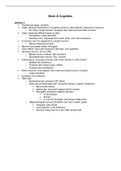
Brain & Cognition
Lecture 1:
Fluorescent algae, proteins
Golgi: staining mechanism to visualize neurons, black absorb (responsive neurons)
o So many canals (axons), thoughts they were all connected not true!
Cajal: observed different types of cells
o Cerebellum: large dendrites
o Discrete units, separated from each other, own cell membrane
A function can’t be assigned to a single neuron!
o Neural networks do exist
Neurons are plastic (brain changes!)
Axon hillock: axon part closest to cell body, very sensitive
Sensory neurons: info to CNS
o Bipolar neuron (retina): light sensitive
o Somatosensory neuron: skin, muscle
Interneurons: associate sensory and motor activity in CNS (most!)
o Stellate cell (thalamus)
o Pyramid cell (cortex) (grey matter)
o Purkinje cell (cerebellum)
Motor neurons: send signals from brain and spinal cord to muscles
o Large dendrites
Excitation and Inhibition
Glial cells:
o Ependymal cell: produce CSF (fluid)
o Astrocyte and Microglial cell: neuronal nutrition, support, defensive
Blood-brain barrier
Astrocytes: structural support blood vessels
Microglial: protective against intrusion
A red nucleus
B toxin
C a lot of microglial, scar tissue inside brain
o Oligodendroglial cell and Schwann cell: form myelin, repair
Schwann cells divide
Axon sprouts: in all directions
We don’t have this for in the CNS: spinal cord
,Lecture 2
Endoplasmic reticulum: polypeptide formed
Golgi: packages proteins
Tubule: support, transport
Cell membrane:
o Phospholipid bilayer: extracellular and intracellular fluid
Hydrophilic head and hydrophobic tails (lipids, fatty acid)
Nucleus:
o Nucleotides: T and A, G and C
o Protein synthesis:
1. DNA unwinds to expose a gene:
2. One strand (mRNA) reads info and goes to ER
3. Ribosomes in ER translates into specific amino acid chain -> protein
DNA (GCCAAACCG) -> mRNA (CGGUUUGGC) -> translation (Arg – Phe)
Amino acid:
o Amino group (NH3)
o Carboxyl group (COO-)
o R-group
Primary -> secondary (pleated sheets or helices) -> tertiary -> quaternary
Proteins enter Golgi bodies -> wrapped in membrane -> microtubule
o 1. Can be incorporated into membrane
o 2. Remain within cell to act as enzyme
o 3. Excreted from cell by exocytosis.
Cell membrane:
o Channel
o Gates
o Pumps
Recessive and dominant gene (allele, e.g., eye color)
Epigenetics: expression of genes
o No alteration of DNA (phenotypic)
o Experience and environment -> expression yes or no
o Describe cell differentiation, phenotypic variation and how cell functions can
go astray producing diseases
o Environmental control:
1. Histone modification: methyl group bind to tails of histones, blocking
them
2. Gene (DNA) methylation: methyl group bind to CG base to block
transcription
3. mRNA modification: ncRNA binds to mRNA, preventing translation
Chapter 4:
Glial cells (glue)
Membrane potentials
o Channels and pumps are specialized proteins
Diffusion: more neg on inside than outside
Generates membrane potential (-70mV)
A (extracellular fluid) and B (neuron)
Concentration equal
With channels: high to low: move along the concentration
gradient
o Concentration equal
o Potassium (+) and neg ions (-) and potassium channels
o Kinetic force (diffusion) and opposites attract! (- and +)
o Voltage gradient: attracts and repel
, o Equilibrium
o Concentration gradient = voltage gradient
o K/Na pump: creating concentration gradient (3Na out of
cell for every 2K that goes inside)
K and anion (neg. stay inside cell, for resting
potential) higher inside cell
K leak channels: K goes outside of cell
Cl and Na higher outside cell
Cl: channels freely, also for
concentration gradient
o Recording electrodes inside cell body (-70mV)
Lecture 1:
Fluorescent algae, proteins
Golgi: staining mechanism to visualize neurons, black absorb (responsive neurons)
o So many canals (axons), thoughts they were all connected not true!
Cajal: observed different types of cells
o Cerebellum: large dendrites
o Discrete units, separated from each other, own cell membrane
A function can’t be assigned to a single neuron!
o Neural networks do exist
Neurons are plastic (brain changes!)
Axon hillock: axon part closest to cell body, very sensitive
Sensory neurons: info to CNS
o Bipolar neuron (retina): light sensitive
o Somatosensory neuron: skin, muscle
Interneurons: associate sensory and motor activity in CNS (most!)
o Stellate cell (thalamus)
o Pyramid cell (cortex) (grey matter)
o Purkinje cell (cerebellum)
Motor neurons: send signals from brain and spinal cord to muscles
o Large dendrites
Excitation and Inhibition
Glial cells:
o Ependymal cell: produce CSF (fluid)
o Astrocyte and Microglial cell: neuronal nutrition, support, defensive
Blood-brain barrier
Astrocytes: structural support blood vessels
Microglial: protective against intrusion
A red nucleus
B toxin
C a lot of microglial, scar tissue inside brain
o Oligodendroglial cell and Schwann cell: form myelin, repair
Schwann cells divide
Axon sprouts: in all directions
We don’t have this for in the CNS: spinal cord
,Lecture 2
Endoplasmic reticulum: polypeptide formed
Golgi: packages proteins
Tubule: support, transport
Cell membrane:
o Phospholipid bilayer: extracellular and intracellular fluid
Hydrophilic head and hydrophobic tails (lipids, fatty acid)
Nucleus:
o Nucleotides: T and A, G and C
o Protein synthesis:
1. DNA unwinds to expose a gene:
2. One strand (mRNA) reads info and goes to ER
3. Ribosomes in ER translates into specific amino acid chain -> protein
DNA (GCCAAACCG) -> mRNA (CGGUUUGGC) -> translation (Arg – Phe)
Amino acid:
o Amino group (NH3)
o Carboxyl group (COO-)
o R-group
Primary -> secondary (pleated sheets or helices) -> tertiary -> quaternary
Proteins enter Golgi bodies -> wrapped in membrane -> microtubule
o 1. Can be incorporated into membrane
o 2. Remain within cell to act as enzyme
o 3. Excreted from cell by exocytosis.
Cell membrane:
o Channel
o Gates
o Pumps
Recessive and dominant gene (allele, e.g., eye color)
Epigenetics: expression of genes
o No alteration of DNA (phenotypic)
o Experience and environment -> expression yes or no
o Describe cell differentiation, phenotypic variation and how cell functions can
go astray producing diseases
o Environmental control:
1. Histone modification: methyl group bind to tails of histones, blocking
them
2. Gene (DNA) methylation: methyl group bind to CG base to block
transcription
3. mRNA modification: ncRNA binds to mRNA, preventing translation
Chapter 4:
Glial cells (glue)
Membrane potentials
o Channels and pumps are specialized proteins
Diffusion: more neg on inside than outside
Generates membrane potential (-70mV)
A (extracellular fluid) and B (neuron)
Concentration equal
With channels: high to low: move along the concentration
gradient
o Concentration equal
o Potassium (+) and neg ions (-) and potassium channels
o Kinetic force (diffusion) and opposites attract! (- and +)
o Voltage gradient: attracts and repel
, o Equilibrium
o Concentration gradient = voltage gradient
o K/Na pump: creating concentration gradient (3Na out of
cell for every 2K that goes inside)
K and anion (neg. stay inside cell, for resting
potential) higher inside cell
K leak channels: K goes outside of cell
Cl and Na higher outside cell
Cl: channels freely, also for
concentration gradient
o Recording electrodes inside cell body (-70mV)