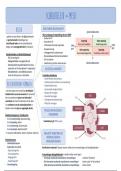
Summary chapter 4
Universally, nonverbal cues are essential in guiding our decisions (first impression).
There are four fundamental questions: 1 do I like you, 2 can I trust you, 3 am I safe with you,
4 who do you remind me of. Nonverbal communication is also a major source for
establishing identity like hair and way of walking. Collective cultures influence the way we
use nonverbal outward expressions to communicate, to judge and to establish identity. At
individual level everybody is unique, and we can only guess that if a person comes from a
certain collective culture. Nonverbal communication on universal level have crucial roles in:
being the primary means of communication, being indicators for judgement, creating
identities. High context dependence contributes to situational efficiency, flexibility and
holistic policies. Low context dependence contributes to universal efficiency and change
processes with a transparent and logistic nature. Context dependence can dynamically
change with paradoxes at both collective and individual level, depending on circumstances.
Monochronic means time is money and polychronic means people over time. Chronemics
can dynamically change with paradoxes existing at both collective and individual levels,
depending on circumstances. There are different distances: public, social, personal and
intimate space. Proxemics are the fundamental areas: space, distances and territory. The
body context in outwards expressions can be neutral or affective, neutral means holding
your emotions and body in control. Affective means tend to find an outlet for their feelings
and their body language is more animated. The setting means time and space. There are
several body contexts: silence, eye contact, touch and body movement. Nonverbal
communication can be ambiguous, not necessarily an indicator for values, and its current
theories may undermine the dynamics of culture.
Universally, nonverbal cues are essential in guiding our decisions (first impression).
There are four fundamental questions: 1 do I like you, 2 can I trust you, 3 am I safe with you,
4 who do you remind me of. Nonverbal communication is also a major source for
establishing identity like hair and way of walking. Collective cultures influence the way we
use nonverbal outward expressions to communicate, to judge and to establish identity. At
individual level everybody is unique, and we can only guess that if a person comes from a
certain collective culture. Nonverbal communication on universal level have crucial roles in:
being the primary means of communication, being indicators for judgement, creating
identities. High context dependence contributes to situational efficiency, flexibility and
holistic policies. Low context dependence contributes to universal efficiency and change
processes with a transparent and logistic nature. Context dependence can dynamically
change with paradoxes at both collective and individual level, depending on circumstances.
Monochronic means time is money and polychronic means people over time. Chronemics
can dynamically change with paradoxes existing at both collective and individual levels,
depending on circumstances. There are different distances: public, social, personal and
intimate space. Proxemics are the fundamental areas: space, distances and territory. The
body context in outwards expressions can be neutral or affective, neutral means holding
your emotions and body in control. Affective means tend to find an outlet for their feelings
and their body language is more animated. The setting means time and space. There are
several body contexts: silence, eye contact, touch and body movement. Nonverbal
communication can be ambiguous, not necessarily an indicator for values, and its current
theories may undermine the dynamics of culture.