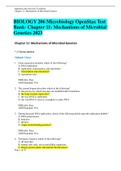
BIOLOGY 206 Microbiology OpenStax Test Bank- Chapter 11: Mechanisms of Microbial Genetics 2023
BIOLOGY 206 Microbiology OpenStax Test Bank- Chapter 11: Mechanisms of Microbial Genetics 2023 Chapter 11: Mechanisms of Microbial Genetics * = Correct answer Multiple Choice 1. Gene expression includes which of the following? A. DNA replication B. replication, transcription, and translation C. transcription and translation* D. translation only Difficulty: Easy ASM Standard: N/A 2. The central dogma describes which of the following? A. the process by which enzymes are modified after translation B. the steps of gene expression* C. the way DNA is replicated D. the way RNA is used as a template to make DNA Difficulty: Easy ASM Standard: N/A 3. During bacterial DNA replication, which of the following holds open the replication bubble? A. DNA polymerases B. helicases C. primers D. single-strand binding proteins* Difficulty: Easy ASM Standard: N/A 4. Telomeres found in which of the following? A. all microbes B. animal cells only, not in unicellular organisms C. fungal, protist, plant, and animal chromosomes* OpenStax Microbiology Test Bank Chapter 11: Mechanisms of Microbial Genetics Page 2 of 32 D. microbes only, including all domains Difficulty: Easy ASM Standard: 16 5. Which of the following best describes the direction in which lagging strands are added? A. as 5′ to 3′ Okazaki fragments in an overall 3′ to 5′ direction only* B. as 5′ to 3′ Okazaki fragments in an overall 5′ to 3′ direction only C. in the 3′ to 5′ or 5′ to 3′ direction OpenStax Microbiology Test Bank Chapter 11: Mechanisms of Microbial Genetics Page 3 of 32 D. in variable directions depending on the species Difficulty: Easy ASM Standard: N/A 6. Which of the following correctly describes uracil and where is it found? A. It is a nitrogenous base found in DNA and RNA. B. It is a nitrogenous base found in DNA only. C. It is a nitrogenous base found in RNA only.* D. It is a nitrogenous base found only in nucleotides of molecules other than RNA and DNA. Difficulty: Easy ASM Standard: N/A 7. Which of the following is another name for the template strand (the strand of DNA that is transcribed)? A. anticodon strand B. antisense strand* C. sense strand D. transcription strand Difficulty: Moderate ASM Standard: N/A 8. Which of the following correctly describes events that occur during transcription? A. DNA polymerase binds to the site of initiation. B. RNA polymerase binds to the core enzyme. C. RNA polymerase binds to the operator. D. RNA polymerase binds to the promoter.* Difficulty: Easy ASM Standard: N/A 9. Which of the following correctly explains why DNA replication is described as semiconservative? A. Each daughter strand contains one old strand and one new strand.* B. Each daughter strand contains two new strands. C. The nucleotides used in replication are recycled multiple times. D. The nucleotides used in replication contain old and new components. Difficulty: Moderate ASM Standard: N/A 10. During DNA replication in bacteria, which of the following enzymes adds DNA nucleotides to the growing strand? A. DNA polymerase I OpenStax Microbiology Test Bank Chapter 11: Mechanisms of Microbial Genetics Page 4 of 32 B. DNA polymerase II C. DNA polymerase III* D. DNA polymerase IV Difficulty: Moderate ASM Standard: 16 11. Topoisomerase II in bacteria is also called which of the following? A. gyrase* B. helicase C. primase D. topoisomerase β Difficulty: Moderate ASM Standard: 16 12. DNA polymerase III adds DNA nucleotides in which of the following direction(s)? A. in the 3′ to 5′ direction only B. in the 3′ to 5′ direction and in 5′ to 3′ direction C. in the 5′ to 3′ direction on one strand and in the 3′ to 5′ direction on the complementary strand D. in the 5′ to 3′ direction only* Difficulty: Moderate ASM Standard: 16 13. Which of the following removes the primers during DNA replication in bacteria? A. DNA polymerase I* B. DNA polymerase II C. DNA polymerase III D. DNA polymerase IV Difficulty: Moderate ASM Standard: 16 14. The noncoding, repetitive sequences at the end of eukaryotic chromosomes are called which of the following? A. bubbles B. forks C. lagging strands D. telomeres* Difficulty: Easy ASM Standard: 16 15. During DNA replication, the lagging strand is formed from which of the following? OpenStax Microbiology Test Bank Chapter 11: Mechanisms of Microbial Genetics Page 5 of 32 A. helicases B. leading strands C. Okazaki fragments* D. single strand binding proteins Difficulty: Moderate ASM Standard: N/A 16. Which statement best describes DNA polymerase I? A. It acts as a ligase. B. It has exonuclease activity.* C. It joins fragments together. D. It prevents supercoiling. Difficulty: Moderate ASM Standard: 16 17. Which describes one difference between prokaryotic and eukaryotic DNA replication? A. Eukaryotes have more origins of replication than prokaryotes.* B. The chromosomes are usually circular in eukaryotes and usually linear in prokaryotes. C. The DNA is not tightly complexed with histones in eukaryotes. D. The RNA primer is removed by ribonuclease H instead of a DNA polymerase I in prokaryotes Difficulty: Moderate ASM Standard: 16 18. Which of the following uses rolling circle replication? A. some bacteria only B. some bacteria and some viruses C. some bacteria, some plasmids, and some viruses* D. some bacteria, some plasmids, some viruses, and some eukaryotic main chromosomes Difficulty: Moderate ASM Standard: 16 19. Which of the following defines a sigma () factor? A. a subunit of eukaryotic RNA polymerase that is important in binding to DNA B. a subunit of eukaryotic RNA polymerase that is important in binding to RNA B. a subunit of prokaryotic RNA polymerase that is important in binding to DNA* C. a subunit of prokaryotic RNA polymerase that is important in binding to RNA Difficulty: Easy ASM Standard: 16 OpenStax Microbiology Test Bank Chapter 11: Mechanisms of Microbial Genetics Page 6 of 32 20. Which sequences of eukaryotic genes code for proteins? A. exons* B. introns C. invariant D. the spliceosome Difficulty: Moderate ASM Standard: 16 21. Which of the following is one important distinction between prokaryotic and eukaryotic mRNA? A. Eukaryotic mRNA is generally monocistronic.* B. Eukaryotic mRNA is generally polycistronic. C. Eukaryotic mRNA is equally likely to be monocistronic or polycistronic. D. Eukaryotic mRNA is often both monocistronic and polycistronic within an operon. Difficulty: Moderate ASM Standard: 16 22. Stop codons are also known as which of the following? A. antisense codons B. missense codons C. nonsense codons* D. sense codons Difficulty: Moderate ASM Standard: N/A 23. Which researchers provided evidence that DNA replication was semiconservative? A. George Beadle, Edward Tatum, and colleagues B. Alfred Hershey and Martha Chase C. Matthew Meselson and Franklin Stahl* D. James Watson and Francis Crick Difficulty: Moderate ASM Standard: N/A 24. Following DNA replication, bacterial chromosomes become which of the following? A. concatenated* B. linear C. plasmids D. single stranded Difficulty: Difficult ASM Standard: 16 25. Human telomeres contain 100 to 1000 copies of which nucleotide sequence?
Escuela, estudio y materia
- Institución
- BIOLOGY 206 Microbiology
- Grado
- BIOLOGY 206 Microbiology
Información del documento
- Subido en
- 4 de febrero de 2023
- Número de páginas
- 33
- Escrito en
- 2022/2023
- Tipo
- Examen
- Contiene
- Preguntas y respuestas
Temas
-
biolo
-
biology 206 microbiology openstax test bank chapter 11 mechanisms of microbial genetics 2023
-
biology 206 microbiology openstax test bank chapter 11
-
biology 206 microbiology openstax test bank

Documento también disponible en un lote