

HC 7: Techniques to determine adaptive immune response (16/09/22)
-How me measure these adaptive responses? -> Flow cytometry and ELISA
-Learning objectives:
• Adaptive immune response:
o What is an adaptive immune response?
o When would you like to determine one?
o How can you determine adaptive immune responses?
• Flow cytometry and ELISA:
o How do the techniques work?
o What can you measure using these techniques and how?
o When do you use either one of the techniques?
Recap
-DCs activate T (direct) and B (indirect, via T cells) cells in secondary lymphoid organs.
-Follicle T cells mainly interact with naive B cells (-> to activate B cells).
Techniques used to measure adaptive response
-Different effector mechanisms ensure enhanced clearing of pathogens or danger, so what and when
would you like to determine?
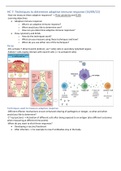
-1st top (picture) -> Activation of different cells after being exposed to an antigen (also different outcomes
when measuring at different time points).
-When do you want to elicit these responses?
• Developing a vaccine/treatment
• After infection -> For example to now if antibodies stay in the body.
,-The problem -> Pathogen causing very severe disease and dysregulated immune system.
-The aim -> (Re)-write the immune system to prevent (vaccine) or beat (treatment) the disease.
-In the lab we want to know 2 things -> Which immune response do we induce AND do we create memory?
• Adaptive immunity AND immunological memory
-Vaccine design, steps:
1. Antigen selection (different options) -> Search through databases and in in-vitro studies
2. Search for the antigenic determinant of the antigen (-> epitope) -> big/small epitopes,
whole antigen
3. Have antigen -> Need to test the antigen in-vitro for immunological parameters.
4. In-vivo animal testing (→ clinical trials in humans)
-Techniques we use: flow cytometry and ELISA
Flow cytometry: determining adaptive immune
responses
-Definition -> Measuring properties of cells as they
flow in a fluidic suspension across an illuminated
light path.
• Measuring of cells (properties of cells)
-Usage of light (laser).
-How does it work.
• Need a light source and a flow chamber (->
where the cells go through).
• Optical system to detect
• Specific light detector
• All this gives a signal to the computer, like
intensity
• Two lasers:
o Forward scatter -> The bigger, the
further on the diagram
o Sideward scatter -> measuring of the
granularity
-Readout -> Using output data to analyze multiple
immune parameters.
• Every dot is one cell.
,-Is this enough to distinguish all the different immune cells? -> NO, because there are, for example,
different kind of granulocytes, so only looking at the granularity and size will not distinguish these cells.
• Different kind of granulocytes
• Different type of lymphocytes
-How CAN we see which type of cells there are? How to distinguish the different immune cells?
• Fluorescence antibodies -> Nice to use, because we can make them very specific for cell specific
molecules. Identification of different immune cells within the same mixture is possible!
o On the tail, we can attach the fluorescence label (-> fluorochromes).
o Look at the markers on the outside of the (for example) T cells -> To determine the type of
antibody.
▪ You can take an antibody which is specific for CD3+ and now you have every kind of
T cell (as CD3 is a marker for T cells in general).
▪ You can go further with this -> Antibodies for CD4+ and CD8+ (helper T and cT cells).
▪ Important to take control! So also add CD8- and CD4-
, o So, if you can distinguish different subsets of T cells, you know their phenotype and gain
information about activation and specificity.
-If it is a sample with lot of cells, you’ll have to step by step approach the cells of interest. So first select for
CD3, then CD4 and CD8 etc.
-How can you measure the proliferation of these cells? -> Cell division tracking dies (explanation lower)
-So, flow cytometry can be used to measure the amount (-> count the fluorescent peaks (-> which each
height of a peak representing a different time of divisions, so that you know which peak height represents
how many divisions, which represents an amount of cells)) AND proliferation of different kind of sub types
of cells, but it can be used for more!
-How can you measure cytokines? -> Flow cytometry measures compartments of cells.
-Measure different things (examples):
• Number of cells and proliferation -> Stain them with a die and give them an activation stimulus for
proliferation.
o Mother cells have a high signal
o Daughter cells -> Become half the intensity of the color
o When daughter cells proliferate, their replicates will then have the half of the intensity of
the daughter cells.
o Each peak -> less intensity of the die, so each peak is one replication.
▪ So, with a vaccine, you want to see a lot of proliferation (many peaks), because the
number of immune cells must be higher than first if you want to have a (good)
immune response.
-How me measure these adaptive responses? -> Flow cytometry and ELISA
-Learning objectives:
• Adaptive immune response:
o What is an adaptive immune response?
o When would you like to determine one?
o How can you determine adaptive immune responses?
• Flow cytometry and ELISA:
o How do the techniques work?
o What can you measure using these techniques and how?
o When do you use either one of the techniques?
Recap
-DCs activate T (direct) and B (indirect, via T cells) cells in secondary lymphoid organs.
-Follicle T cells mainly interact with naive B cells (-> to activate B cells).
Techniques used to measure adaptive response
-Different effector mechanisms ensure enhanced clearing of pathogens or danger, so what and when
would you like to determine?
-1st top (picture) -> Activation of different cells after being exposed to an antigen (also different outcomes
when measuring at different time points).
-When do you want to elicit these responses?
• Developing a vaccine/treatment
• After infection -> For example to now if antibodies stay in the body.
,-The problem -> Pathogen causing very severe disease and dysregulated immune system.
-The aim -> (Re)-write the immune system to prevent (vaccine) or beat (treatment) the disease.
-In the lab we want to know 2 things -> Which immune response do we induce AND do we create memory?
• Adaptive immunity AND immunological memory
-Vaccine design, steps:
1. Antigen selection (different options) -> Search through databases and in in-vitro studies
2. Search for the antigenic determinant of the antigen (-> epitope) -> big/small epitopes,
whole antigen
3. Have antigen -> Need to test the antigen in-vitro for immunological parameters.
4. In-vivo animal testing (→ clinical trials in humans)
-Techniques we use: flow cytometry and ELISA
Flow cytometry: determining adaptive immune
responses
-Definition -> Measuring properties of cells as they
flow in a fluidic suspension across an illuminated
light path.
• Measuring of cells (properties of cells)
-Usage of light (laser).
-How does it work.
• Need a light source and a flow chamber (->
where the cells go through).
• Optical system to detect
• Specific light detector
• All this gives a signal to the computer, like
intensity
• Two lasers:
o Forward scatter -> The bigger, the
further on the diagram
o Sideward scatter -> measuring of the
granularity
-Readout -> Using output data to analyze multiple
immune parameters.
• Every dot is one cell.
,-Is this enough to distinguish all the different immune cells? -> NO, because there are, for example,
different kind of granulocytes, so only looking at the granularity and size will not distinguish these cells.
• Different kind of granulocytes
• Different type of lymphocytes
-How CAN we see which type of cells there are? How to distinguish the different immune cells?
• Fluorescence antibodies -> Nice to use, because we can make them very specific for cell specific
molecules. Identification of different immune cells within the same mixture is possible!
o On the tail, we can attach the fluorescence label (-> fluorochromes).
o Look at the markers on the outside of the (for example) T cells -> To determine the type of
antibody.
▪ You can take an antibody which is specific for CD3+ and now you have every kind of
T cell (as CD3 is a marker for T cells in general).
▪ You can go further with this -> Antibodies for CD4+ and CD8+ (helper T and cT cells).
▪ Important to take control! So also add CD8- and CD4-
, o So, if you can distinguish different subsets of T cells, you know their phenotype and gain
information about activation and specificity.
-If it is a sample with lot of cells, you’ll have to step by step approach the cells of interest. So first select for
CD3, then CD4 and CD8 etc.
-How can you measure the proliferation of these cells? -> Cell division tracking dies (explanation lower)
-So, flow cytometry can be used to measure the amount (-> count the fluorescent peaks (-> which each
height of a peak representing a different time of divisions, so that you know which peak height represents
how many divisions, which represents an amount of cells)) AND proliferation of different kind of sub types
of cells, but it can be used for more!
-How can you measure cytokines? -> Flow cytometry measures compartments of cells.
-Measure different things (examples):
• Number of cells and proliferation -> Stain them with a die and give them an activation stimulus for
proliferation.
o Mother cells have a high signal
o Daughter cells -> Become half the intensity of the color
o When daughter cells proliferate, their replicates will then have the half of the intensity of
the daughter cells.
o Each peak -> less intensity of the die, so each peak is one replication.
▪ So, with a vaccine, you want to see a lot of proliferation (many peaks), because the
number of immune cells must be higher than first if you want to have a (good)
immune response.

