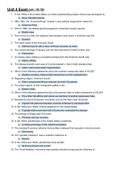
Unit 4 Exam (ch. 10-12)
1. In the 1840s in the United States, an initial understanding of germ theory was developed by
a. Oliver Wendell Holmes
2. After 1852, the “Know-Nothings” created a new political organization called the
a. American Party
3. Prior to 1860, the fastest-growing segment in American society was the
a. Middle class
4. Prior to the Civil War, the religious denomination most active in feminism was the
a. Quakers
5. The slave codes of the American South
a. Defined anyone with a trace of African ancestry as black
6. The central ideology of slavery, and the vital instrument of white control, was
a. Paternalism
7. A runaway slave making a successful escape from the American South was
a. Highly unlikely
8. The Massachusetts court case of Commonwealth v. Hunt (1842) declared that
a. Labor unions were lawful organizations
9. Which of the following statements about the southern aristocratic ideal is FALSE?
a. Wealthy southern whites prided themselves on their egalitarianism
10. Regarding religion, American slaves
a. Often incorporated African features into their Christianity
11. The great majority of Irish immigrants settled in the
a. Eastern cities
12. Which of the following statements about the poorest class of white southerners is FALSE?
a. They often felt affinity with slaves as members of another oppressed class
13. Nineteenth-century Protestant revivalists such as the New Light revivalists
a. Argued that personal salvation could be achieved by individual effort
14. In the 1830s and 1840s, cholera epidemics in the United States
a. Typically killed more than half of those who contracted the disease
15. The writings of Edgar Allen Poe were
a. Primarily sad and macabre
16. In the 1830s, abolitionists in the United States constituted
a. A small percentage of the national population
17. The nineteenth-century reformer Horace Mann believed that education should promote
a. Democracy
18. The “peculiar institution” was a southern reference to
a. Slavery
19. In the 1830s and 1840s, abolitionists were divided
a. All these answers are correct
20. The “Know-Nothing” movement was partially directed at reducing the influence of
1. In the 1840s in the United States, an initial understanding of germ theory was developed by
a. Oliver Wendell Holmes
2. After 1852, the “Know-Nothings” created a new political organization called the
a. American Party
3. Prior to 1860, the fastest-growing segment in American society was the
a. Middle class
4. Prior to the Civil War, the religious denomination most active in feminism was the
a. Quakers
5. The slave codes of the American South
a. Defined anyone with a trace of African ancestry as black
6. The central ideology of slavery, and the vital instrument of white control, was
a. Paternalism
7. A runaway slave making a successful escape from the American South was
a. Highly unlikely
8. The Massachusetts court case of Commonwealth v. Hunt (1842) declared that
a. Labor unions were lawful organizations
9. Which of the following statements about the southern aristocratic ideal is FALSE?
a. Wealthy southern whites prided themselves on their egalitarianism
10. Regarding religion, American slaves
a. Often incorporated African features into their Christianity
11. The great majority of Irish immigrants settled in the
a. Eastern cities
12. Which of the following statements about the poorest class of white southerners is FALSE?
a. They often felt affinity with slaves as members of another oppressed class
13. Nineteenth-century Protestant revivalists such as the New Light revivalists
a. Argued that personal salvation could be achieved by individual effort
14. In the 1830s and 1840s, cholera epidemics in the United States
a. Typically killed more than half of those who contracted the disease
15. The writings of Edgar Allen Poe were
a. Primarily sad and macabre
16. In the 1830s, abolitionists in the United States constituted
a. A small percentage of the national population
17. The nineteenth-century reformer Horace Mann believed that education should promote
a. Democracy
18. The “peculiar institution” was a southern reference to
a. Slavery
19. In the 1830s and 1840s, abolitionists were divided
a. All these answers are correct
20. The “Know-Nothing” movement was partially directed at reducing the influence of