PH338 National/Global Obligations
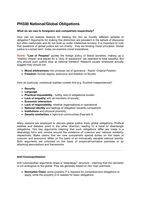
What do we owe to foreigners and compatriots respectively?
How can we analyse reasons for treating the two as morally different spheres of
obligation? Arguments for making this distinction are prevalent in the sphere of discourse
but often inarticulate and do not hold up under intellectual scrutiny. It is important to note
that questions of global justice are not charity - they are binding moral principles. Global
justice is a broad term. today we examine moral imperatives.
Rawls' "Law of Peoples" guides the foreign policy of liberal societies, making up a
“realistic utopia” and argues for a “duty of assistance” (as opposed to total equality). But
why should such justice stop at national borders? Reasons usually employed actually
suggest they should not:
Moral arbitrariness: the universal veil of ignorance - Rawls’ Original Position.
Freedom: Human dignity, autonomy and freedom to flourish
How do particular, contextual realities contest this (e.g. Scottish independence)?
Security
Language
Practical impossibility - futility, size of obligational burden
Lack of empathy with all members of society
Economic interaction
Lack of responsibility, whether organisational or operational
National identity and feelings of obligation towards compatriots
Institutions and physical proximity
Genetic similarities in tight-knit communities (Fascistic?)
Many reasons are employed to discuss global justice imply global obligations. Political
realities and debates point in the other direction, leading to a need to disentangle
obligations. Two key arguments claiming that such obligations differ are made in a
disanalogy form and revolve around the existence of coercion and national solidarity,
respectively. Blake claims that we owe compatriots special duties on the basis of
coercion and autonomy; Miller on the basis of an intrinsically valuable national identity.
Both arguments are criticised on the basis of empirical/normative premises or by
attacking assumptions and frameworks.
Anti-Cosmopolitanism
Anti-cosmopolitan arguments share a “disanalogy” structure - claiming that the domestic
is not analogous to the global. They are generally based on two main premises:
Normative Claim: some property P is required for comprehensive obligations to
apply, while the property Q is needed for basic obligations.
What do we owe to foreigners and compatriots respectively?
How can we analyse reasons for treating the two as morally different spheres of
obligation? Arguments for making this distinction are prevalent in the sphere of discourse
but often inarticulate and do not hold up under intellectual scrutiny. It is important to note
that questions of global justice are not charity - they are binding moral principles. Global
justice is a broad term. today we examine moral imperatives.
Rawls' "Law of Peoples" guides the foreign policy of liberal societies, making up a
“realistic utopia” and argues for a “duty of assistance” (as opposed to total equality). But
why should such justice stop at national borders? Reasons usually employed actually
suggest they should not:
Moral arbitrariness: the universal veil of ignorance - Rawls’ Original Position.
Freedom: Human dignity, autonomy and freedom to flourish
How do particular, contextual realities contest this (e.g. Scottish independence)?
Security
Language
Practical impossibility - futility, size of obligational burden
Lack of empathy with all members of society
Economic interaction
Lack of responsibility, whether organisational or operational
National identity and feelings of obligation towards compatriots
Institutions and physical proximity
Genetic similarities in tight-knit communities (Fascistic?)
Many reasons are employed to discuss global justice imply global obligations. Political
realities and debates point in the other direction, leading to a need to disentangle
obligations. Two key arguments claiming that such obligations differ are made in a
disanalogy form and revolve around the existence of coercion and national solidarity,
respectively. Blake claims that we owe compatriots special duties on the basis of
coercion and autonomy; Miller on the basis of an intrinsically valuable national identity.
Both arguments are criticised on the basis of empirical/normative premises or by
attacking assumptions and frameworks.
Anti-Cosmopolitanism
Anti-cosmopolitan arguments share a “disanalogy” structure - claiming that the domestic
is not analogous to the global. They are generally based on two main premises:
Normative Claim: some property P is required for comprehensive obligations to
apply, while the property Q is needed for basic obligations.