Unit 6: Waves
Transverse and Longitudinal Waves
All waves transfer energy from one place to another.
Particles that make up a wave oscillate about a fixed point. In doing so they transfer the
energy to the next particles, which oscillate, and so forth.
Energy moves along but the matter remains.
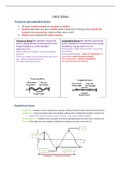
Transverse WavesThe vibration causing the Longitudinal WavesThe vibration causing the
wave is perpendicular to the direction of the wave is parallel to the direction of the energy
energy transfere.g. water and light transfere.g. sound waves.Example:
waves.Example: Pull and push a slinky back and forth; waves move
Shake a slinky up and down, someone holding at horizontally
each end Areas pushed together = areas of compression (in
Pulses are created; you feel them when they reach sound wave: area of greater pressure)
you – energy is being transferred Areas pulled apart = areas of rarefaction
The slinky itself doesn’t move No material moves permanently.
Properties of waves
- Frequency = number of waves produced or passing a fixed point per second, measured in Hertz (Hz)
- Amplitude = maximum displacement any particle achieves from undisturbed position in metres (m).
Indicates the amount of energy a wave is carrying – more energy, higher amplitude.
- Wavelength (λ) = distance from one point on wave to equivalent point on next wave in metres (m).
- Period = time taken for one complete oscillation/to produce one wave in seconds (s).
Crest
Amplitude
time
0 1 (s)
Trough Frequency
(f)
Frequency = 2 waves per second
,Observing waves
- Amplitude is seen as wave height measured from the middle
- Period is the time taken for one complete wave to pass a fixed point
1
- period(T )=
frequency( f )
When the power supply is turned on, the motor on the paddle
makes it move up and down.
This creates waves in the water.
The higher the power supply the faster the paddle will move
and waves will be made faster.
The light shining through the waves lets us see them as a clear
pattern on the floor.
Wave speed
Speed of a wave = the speed at which energy is transferred (and the waves move)
Measured by how far a wave moves in one second
wave speed (v ,m/ s)=frequency (f , Hz)× wavelength(λ ,m)
Example: Measuring the Speed of Sound
What is the purpose of the signal generator and loudspeaker?
The signal generator creates a sound at a specific
frequency.The loudspeaker amplifies this sound at the
microphones.
How could this experiment be used to measure the speed of
sound?
a) Microphone A picks up the sound first, followed some time
by microphone B each creating a pulse on the screen.
b) Using s=d/t, the d= the distance between microphones and
t= the time taken for second pulse to appear on screen, you can
find out speed of sound.
Ripples on water’s surface are slow so their speed is measured by direct observation and
timed with a stopwatch
Waves’ speed and thus wavelength change when transmitted from one medium to another
e.g. water waves travelling from deep to shallow water or sound travelling from air to water.
Frequency does not change as the same number of waves are being produced per second
Speed and wavelength are directly proportional as all waves obey the wave equation:
- Doubling the speed, doubles the wavelength
- Halving the speed, halves the wavelength
, Required Practical: Identify the suitability of apparatus to measure the frequency, wavelength
and speed of waves in a ripple tank.
Method 1: Measuring waves using a ripple tank. Control variable: Water depth. It is
Set up the ripple tank according to the diagram. important to ensure the water depth
Fill the tank to a depth of 5mm. is kept constant across the tank as,
Adjust the oscillating dipper so it just touches the surface of the for a given frequency, the depth will
water. affect speed and λ.
Switch on the power supply and light. Hazards/Risks:Stroboscopes can be
Adjust the speed of the motor so that low frequency waves that a risk to people with photo-
can be counted are produced. sensitive epilepsy, check this before
Move the light up and down until a clear pattern is seen. using this equipment.
Use a metre ruler to measure across as many wave shadows as
possible, divide the length by number of waves. This gives the
wavelength.
Count no. of waves passing a point in the pattern in 10 seconds.
Divide this by 10 seconds = frequency.
Calculate wave speed: v = fλ.
Use a stroboscope to compare results.
Considerations/Mistakes/Errors:- Using a stroboscope significantly improves accuracy of results.- By
projecting a shadow of the waves onto a screen below the stroboscope, flash speed can be adjusted to
make the waves appear stationary, making wavelength measurements much more accurate. - For high
frequencies that are difficult to count, this can be used with the wave speed measurement to calculate the
frequency using .
Method 2: Waves on a String - The power supply is connected to a
Hang masses from the string to keep it under tension. signal generator capable of
Set the frequency of the signal generator and turn on. generating different frequencies.-
Move the wooden bridge backwards or forwards until you can see The wooden bridge is movable.-
waves form. Waves of a particular frequency will
Measure the distance between the bridge and vibration need a particular length of string to
generator. be seen, too much or too little and
Count the number of waves. no waves form. Each wave has one
Divide the distance by the number of waves to get the peak and one trough, there are
wavelength. eight complete waves (see left)
Find the wave speed by multiplying the measured wavelength by within 100cm, wavelength = 100/8 =
the frequency of the signal generator. 12.5cm.
Transverse and Longitudinal Waves
All waves transfer energy from one place to another.
Particles that make up a wave oscillate about a fixed point. In doing so they transfer the
energy to the next particles, which oscillate, and so forth.
Energy moves along but the matter remains.
Transverse WavesThe vibration causing the Longitudinal WavesThe vibration causing the
wave is perpendicular to the direction of the wave is parallel to the direction of the energy
energy transfere.g. water and light transfere.g. sound waves.Example:
waves.Example: Pull and push a slinky back and forth; waves move
Shake a slinky up and down, someone holding at horizontally
each end Areas pushed together = areas of compression (in
Pulses are created; you feel them when they reach sound wave: area of greater pressure)
you – energy is being transferred Areas pulled apart = areas of rarefaction
The slinky itself doesn’t move No material moves permanently.
Properties of waves
- Frequency = number of waves produced or passing a fixed point per second, measured in Hertz (Hz)
- Amplitude = maximum displacement any particle achieves from undisturbed position in metres (m).
Indicates the amount of energy a wave is carrying – more energy, higher amplitude.
- Wavelength (λ) = distance from one point on wave to equivalent point on next wave in metres (m).
- Period = time taken for one complete oscillation/to produce one wave in seconds (s).
Crest
Amplitude
time
0 1 (s)
Trough Frequency
(f)
Frequency = 2 waves per second
,Observing waves
- Amplitude is seen as wave height measured from the middle
- Period is the time taken for one complete wave to pass a fixed point
1
- period(T )=
frequency( f )
When the power supply is turned on, the motor on the paddle
makes it move up and down.
This creates waves in the water.
The higher the power supply the faster the paddle will move
and waves will be made faster.
The light shining through the waves lets us see them as a clear
pattern on the floor.
Wave speed
Speed of a wave = the speed at which energy is transferred (and the waves move)
Measured by how far a wave moves in one second
wave speed (v ,m/ s)=frequency (f , Hz)× wavelength(λ ,m)
Example: Measuring the Speed of Sound
What is the purpose of the signal generator and loudspeaker?
The signal generator creates a sound at a specific
frequency.The loudspeaker amplifies this sound at the
microphones.
How could this experiment be used to measure the speed of
sound?
a) Microphone A picks up the sound first, followed some time
by microphone B each creating a pulse on the screen.
b) Using s=d/t, the d= the distance between microphones and
t= the time taken for second pulse to appear on screen, you can
find out speed of sound.
Ripples on water’s surface are slow so their speed is measured by direct observation and
timed with a stopwatch
Waves’ speed and thus wavelength change when transmitted from one medium to another
e.g. water waves travelling from deep to shallow water or sound travelling from air to water.
Frequency does not change as the same number of waves are being produced per second
Speed and wavelength are directly proportional as all waves obey the wave equation:
- Doubling the speed, doubles the wavelength
- Halving the speed, halves the wavelength
, Required Practical: Identify the suitability of apparatus to measure the frequency, wavelength
and speed of waves in a ripple tank.
Method 1: Measuring waves using a ripple tank. Control variable: Water depth. It is
Set up the ripple tank according to the diagram. important to ensure the water depth
Fill the tank to a depth of 5mm. is kept constant across the tank as,
Adjust the oscillating dipper so it just touches the surface of the for a given frequency, the depth will
water. affect speed and λ.
Switch on the power supply and light. Hazards/Risks:Stroboscopes can be
Adjust the speed of the motor so that low frequency waves that a risk to people with photo-
can be counted are produced. sensitive epilepsy, check this before
Move the light up and down until a clear pattern is seen. using this equipment.
Use a metre ruler to measure across as many wave shadows as
possible, divide the length by number of waves. This gives the
wavelength.
Count no. of waves passing a point in the pattern in 10 seconds.
Divide this by 10 seconds = frequency.
Calculate wave speed: v = fλ.
Use a stroboscope to compare results.
Considerations/Mistakes/Errors:- Using a stroboscope significantly improves accuracy of results.- By
projecting a shadow of the waves onto a screen below the stroboscope, flash speed can be adjusted to
make the waves appear stationary, making wavelength measurements much more accurate. - For high
frequencies that are difficult to count, this can be used with the wave speed measurement to calculate the
frequency using .
Method 2: Waves on a String - The power supply is connected to a
Hang masses from the string to keep it under tension. signal generator capable of
Set the frequency of the signal generator and turn on. generating different frequencies.-
Move the wooden bridge backwards or forwards until you can see The wooden bridge is movable.-
waves form. Waves of a particular frequency will
Measure the distance between the bridge and vibration need a particular length of string to
generator. be seen, too much or too little and
Count the number of waves. no waves form. Each wave has one
Divide the distance by the number of waves to get the peak and one trough, there are
wavelength. eight complete waves (see left)
Find the wave speed by multiplying the measured wavelength by within 100cm, wavelength = 100/8 =
the frequency of the signal generator. 12.5cm.