Unit 4: Atomic Structure
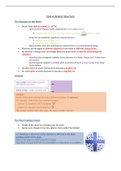
The Structure of the Atom
Atoms have radii of around 1 x 10⁻¹⁰m
- Have positively charged nuclei composed of protons and neutrons
1
contain most of the mass but their radii are less than of atom’s radii
10000
- Nuclei are surrounded by negatively charged electrons
Protons have a charge of +1
Electrons have a charge of -1
- Equal numbers of protons and electrons means there is no overall electrical charge
Electrons are arranged at different distances from nuclei in different energy levels
An electron’s energy level can change when the atom emits or absorbs electromagnetic
radiation:
- Absorbing electromagnetic radiation moves electrons to a higher energy level, further from
the nucleus
- Electromagnetic radiation is emitted when an electron drops to a lower energy level, closer
to the nucleus
An atom loses an outer electron(s) to become a positive ion
An atom gains an extra electron to become a negative ion
Isotopes
Mass number: total number of protons
and neutrons in an atom.
Atomic number: number of protons in an
atom (they all have the same number)
Isotopes:
Atoms of the same element that have different numbers of neutrons.
For example: carbon has two common isotopes:
12
- carbon-12, 6 protons and 6 neutrons: 6C
14
- carbon-14, 6 protons and 8 neutrons: 6C
The atomic number stays the same, the mass number changes.
The Plum Pudding Model
Model of the atom has changed over the years
Atoms once thought to be tiny spheres that couldn’t be divided
J.J. Thompson’s discovery of the electron in 1897 led to the plum
pudding model of the atom.
Depicts the atom as a ball of positive charge
Negatively charged electrons are embedded in it like plums in a pudding
, Rutherford and Marsden
In 1905 Rutherford and Marsden bombarded thin gold foil with alpha particles
If the plum pudding model was correct the heavy, positively charged alpha particles would have passed straight
through
Most particles did but not all
Some of the alpha particles were deflected, so they must have come close to a concentration of charge, unlike the
spread out charge described by the plum pudding model.
Some alpha particles were reflected back so:
they must have been repelled by the same charge that the alpha particles carried
the repelling charge must have been much heavier than the alpha particle otherwise it would have passed through
In conclusion:
the mass of the atom was concentrated in a central nucleus with a positive charge
the electrons surround this nucleus
Further Developments
Niels Bohr adapted this nuclear model by suggesting electrons orbit the nucleus at specific
distances
Later experiments led to realising the nucleus’ positive charge can be divided into a whole
number of smaller particles, ‘protons’, called each with the same amount of positive
charge
In 1932, 20 years after the nuclear model was accepted, James Chadwick carried out a
number of experiments
- These provided evidence that within the nucleus there was another particle, the ‘neutron’,
leading to further refinement of the nuclear model for the structure of the atom
The structure of the atom is an example of a theory which, through experiment and peer
review, has changed and developed over time.
The Structure of the Atom
Atoms have radii of around 1 x 10⁻¹⁰m
- Have positively charged nuclei composed of protons and neutrons
1
contain most of the mass but their radii are less than of atom’s radii
10000
- Nuclei are surrounded by negatively charged electrons
Protons have a charge of +1
Electrons have a charge of -1
- Equal numbers of protons and electrons means there is no overall electrical charge
Electrons are arranged at different distances from nuclei in different energy levels
An electron’s energy level can change when the atom emits or absorbs electromagnetic
radiation:
- Absorbing electromagnetic radiation moves electrons to a higher energy level, further from
the nucleus
- Electromagnetic radiation is emitted when an electron drops to a lower energy level, closer
to the nucleus
An atom loses an outer electron(s) to become a positive ion
An atom gains an extra electron to become a negative ion
Isotopes
Mass number: total number of protons
and neutrons in an atom.
Atomic number: number of protons in an
atom (they all have the same number)
Isotopes:
Atoms of the same element that have different numbers of neutrons.
For example: carbon has two common isotopes:
12
- carbon-12, 6 protons and 6 neutrons: 6C
14
- carbon-14, 6 protons and 8 neutrons: 6C
The atomic number stays the same, the mass number changes.
The Plum Pudding Model
Model of the atom has changed over the years
Atoms once thought to be tiny spheres that couldn’t be divided
J.J. Thompson’s discovery of the electron in 1897 led to the plum
pudding model of the atom.
Depicts the atom as a ball of positive charge
Negatively charged electrons are embedded in it like plums in a pudding
, Rutherford and Marsden
In 1905 Rutherford and Marsden bombarded thin gold foil with alpha particles
If the plum pudding model was correct the heavy, positively charged alpha particles would have passed straight
through
Most particles did but not all
Some of the alpha particles were deflected, so they must have come close to a concentration of charge, unlike the
spread out charge described by the plum pudding model.
Some alpha particles were reflected back so:
they must have been repelled by the same charge that the alpha particles carried
the repelling charge must have been much heavier than the alpha particle otherwise it would have passed through
In conclusion:
the mass of the atom was concentrated in a central nucleus with a positive charge
the electrons surround this nucleus
Further Developments
Niels Bohr adapted this nuclear model by suggesting electrons orbit the nucleus at specific
distances
Later experiments led to realising the nucleus’ positive charge can be divided into a whole
number of smaller particles, ‘protons’, called each with the same amount of positive
charge
In 1932, 20 years after the nuclear model was accepted, James Chadwick carried out a
number of experiments
- These provided evidence that within the nucleus there was another particle, the ‘neutron’,
leading to further refinement of the nuclear model for the structure of the atom
The structure of the atom is an example of a theory which, through experiment and peer
review, has changed and developed over time.