Unit 1: Energy
Types of Energy
MAGNETIC Energy causing push or pull
+ KINETIC Movement or motion
+ THERMAL/INTERNAL Heat energy (moving particles)
LIGHT Form of energy our eyes can detect
+ GRAVITATIONAL POTENTIAL Energy stored in an object when it is above the earth’s surface
+ CHEMICAL Held in chemical bonds (stored in food and fuel)
SOUND Form of energy we can hear, a vibration transferred from a wave to
produce sound
ELECTRICAL Energy of particles moving through a wire (flow of electrical charge)
+ ELASTIC POTENTIAL Energy stored in objects that are stretched
+ NUCLEAR From breaking atoms apart, stored in atoms’ nuclei
Energy Stores and Systems
System: an object or group of objects.
Closed system: no energy leaves or enters overall.
When this is changed, there are changes in the way energy is stored.
Example:
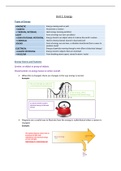
The cars start high up, with a lot
of Gravitational Potential Energy.
As the car drops, GPE is
transferred into Kinetic Energy.
An electric kettle transfers
electrical energy to thermal
energy.
Diagrams are a useful way to illustrate how the energy is redistributed when a system is
changed.
Example:
This Sankey Diagram shows that an
incandescent light bulb
redistributes the electrical energy
as heat and light.
total energy in = total energy out
, Calculating Energy Changes
Kinetic Energy (moving objects)
2
kinetic energy ( J )=0.5 × mass(kg)× speed (m/ s)
1 2
Ek = m v
2
Gravitational Potential Energy (raising an object above ground level)
gravitational potential energy ( J )=mass ( kg ) × gravitational field strength ( N / Kg ) ×height (m)
E p =mgh
Elastic Potential Energy (the amount of elastic energy stored in a stretched or compressed spring)
elastic potential energy (J )=0.5 × spring constant ( N /m)× extension( m)2
1 2
Ee = k e
2
Specific Heat Capacity and Internal Energy
Internal energy: the total kinetic and potential energy of all the particles that make up a system.
Specific heat capacity: the amount of energy required to raise the temperature of one kilogram of
a substance by one degree Celsius.
change ∈thermal energy ( J )=mass ( kg ) × specific heat capacity ( J /kg ˚ C ) ×temperature change (˚ C )
∆ E=mc ∆ θ
Doing work on a system increases the energy stored in a system.
Heating changes the kinetic energy stored in a system by increasing the heat of the
particles within it.
As the energy increases, this will either increase the temperature or produce a change of
state.
If the temperature increases, the increase depends on:
- The mass of the substance heated
- What the substance is
- The energy input
Types of Energy
MAGNETIC Energy causing push or pull
+ KINETIC Movement or motion
+ THERMAL/INTERNAL Heat energy (moving particles)
LIGHT Form of energy our eyes can detect
+ GRAVITATIONAL POTENTIAL Energy stored in an object when it is above the earth’s surface
+ CHEMICAL Held in chemical bonds (stored in food and fuel)
SOUND Form of energy we can hear, a vibration transferred from a wave to
produce sound
ELECTRICAL Energy of particles moving through a wire (flow of electrical charge)
+ ELASTIC POTENTIAL Energy stored in objects that are stretched
+ NUCLEAR From breaking atoms apart, stored in atoms’ nuclei
Energy Stores and Systems
System: an object or group of objects.
Closed system: no energy leaves or enters overall.
When this is changed, there are changes in the way energy is stored.
Example:
The cars start high up, with a lot
of Gravitational Potential Energy.
As the car drops, GPE is
transferred into Kinetic Energy.
An electric kettle transfers
electrical energy to thermal
energy.
Diagrams are a useful way to illustrate how the energy is redistributed when a system is
changed.
Example:
This Sankey Diagram shows that an
incandescent light bulb
redistributes the electrical energy
as heat and light.
total energy in = total energy out
, Calculating Energy Changes
Kinetic Energy (moving objects)
2
kinetic energy ( J )=0.5 × mass(kg)× speed (m/ s)
1 2
Ek = m v
2
Gravitational Potential Energy (raising an object above ground level)
gravitational potential energy ( J )=mass ( kg ) × gravitational field strength ( N / Kg ) ×height (m)
E p =mgh
Elastic Potential Energy (the amount of elastic energy stored in a stretched or compressed spring)
elastic potential energy (J )=0.5 × spring constant ( N /m)× extension( m)2
1 2
Ee = k e
2
Specific Heat Capacity and Internal Energy
Internal energy: the total kinetic and potential energy of all the particles that make up a system.
Specific heat capacity: the amount of energy required to raise the temperature of one kilogram of
a substance by one degree Celsius.
change ∈thermal energy ( J )=mass ( kg ) × specific heat capacity ( J /kg ˚ C ) ×temperature change (˚ C )
∆ E=mc ∆ θ
Doing work on a system increases the energy stored in a system.
Heating changes the kinetic energy stored in a system by increasing the heat of the
particles within it.
As the energy increases, this will either increase the temperature or produce a change of
state.
If the temperature increases, the increase depends on:
- The mass of the substance heated
- What the substance is
- The energy input