Unit 9: Chemistry of the Atmosphere
The Earth’s Atmosphere
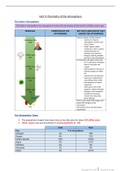
The Earth’s atmosphere has changed a lot since the formation of the Earth 4.6 billion years ago.
TIMESCALE CONDITION OF THE KEY FACTS AND EVENTS THAT
ATMOSPHERE SHAPED THE ATMOSPHERE
Intense volcanic activity releases:
Formation of the - Mainly CO2 (like the
Earth atmospheres of Mars and
Venus today)
- Water vapour (which
condenses to form oceans)
- Small proportions of
methane and ammonia
4 billion years - Nitrogen (which gradually
ago built up in the atmosphere)
Green plants and algae evolve and:
- CO2 is reduced as the plants
take it in and give out
3 billion years oxygen
ago - Microorganisms that can’t
tolerate oxygen are killed
off
- Carbon from CO2 becomes
2 billion years locked up in sedimentary
ago rocks formed from shells
and skeletons of marine
organisms
- Other gases react with
1 billion years oxygen to release nitrogen
ago - Nitrogen is also produced
by bacteria removing
nitrates from decaying
plant material
There is now about 20% oxygen and
about 80% nitrogen in the
atmosphere
Now The amount of CO2 has decreased
significantly
The Atmosphere Today
The proportions of gases have been more or less the same for about 200 million years
Water vapour may also be present in varying quantities (0 - 3%)
Early Now
Gas: % in atmosphere
Nitrogen 2% 78%
Oxygen 0% 21%
Carbon dioxide 92% 0.03%
Argon 0% 0.9%
Methane 2% 0%
Ammonia 1% 0%
Water 3% 0.07%
Decrease in CO2 and Increase in O2 and
, Increase of Oxygen Levels
Algae and plants photosynthesise
During photosynthesis CO2 and H2O react to produce C6H12O6
Algae first started producing oxygen about 2.7 billion years ago
Over the next billion years plants evolved and O2 levels in the atmosphere increased
Eventually the level of O2 in the atmosphere increased enough to allow animals to evolve
Decrease of Carbon Dioxide Levels
As plants and algae have evolved CO2 levels in the atmosphere have decreased
This is because plants use CO2 during photosynthesis
Carbon also becomes locked up in sedimentary rocks (e.g. limestone) and fossil fuels (e.g.
Increase in O2 and
coal, crude oil, natural gas) N2
Decrease in CO2
Limestone contains calcium carbonate (CaCO3) and is formed from the shells and skeletons
of sea creatures
Coal is a sedimentary rock formed from plant deposits that were buried and compressed
over millions of years
The reaction between CO2 and sea water has also reduced CO2 levels, it produces:
- insoluble carbonates that are deposited as sediment
- soluble hydrogen carbonates
Too much CO2 dissolving in the oceans can harm marine life – e.g. coral reefs.
Greenhouse Gases
The Sun emits short-wavelength, high
energy radiation CO2CH4
- e.g. UV which is absorbed by and H2O
warms the Earth
The Earth emits long-wavelength,
lower energy radiation and loses heat
- e.g. infrared thermal radiation
Greenhouse gases absorb some of this
radiation
This warms the atmosphere
Without them the Earth would be too
cold for water to be liquid and couldn’t
sustain life
The Impact of Human Activities
Increase the levels of greenhouse gases in the atmosphere
Carbon Methane
CO2 levels have increased over the last Cattle farming:
100 years - cattle produce methane and are
Burning fossil fuels: reared for humans (consumption
- the increase correlates with the of beef and milk)
The Earth’s Atmosphere
The Earth’s atmosphere has changed a lot since the formation of the Earth 4.6 billion years ago.
TIMESCALE CONDITION OF THE KEY FACTS AND EVENTS THAT
ATMOSPHERE SHAPED THE ATMOSPHERE
Intense volcanic activity releases:
Formation of the - Mainly CO2 (like the
Earth atmospheres of Mars and
Venus today)
- Water vapour (which
condenses to form oceans)
- Small proportions of
methane and ammonia
4 billion years - Nitrogen (which gradually
ago built up in the atmosphere)
Green plants and algae evolve and:
- CO2 is reduced as the plants
take it in and give out
3 billion years oxygen
ago - Microorganisms that can’t
tolerate oxygen are killed
off
- Carbon from CO2 becomes
2 billion years locked up in sedimentary
ago rocks formed from shells
and skeletons of marine
organisms
- Other gases react with
1 billion years oxygen to release nitrogen
ago - Nitrogen is also produced
by bacteria removing
nitrates from decaying
plant material
There is now about 20% oxygen and
about 80% nitrogen in the
atmosphere
Now The amount of CO2 has decreased
significantly
The Atmosphere Today
The proportions of gases have been more or less the same for about 200 million years
Water vapour may also be present in varying quantities (0 - 3%)
Early Now
Gas: % in atmosphere
Nitrogen 2% 78%
Oxygen 0% 21%
Carbon dioxide 92% 0.03%
Argon 0% 0.9%
Methane 2% 0%
Ammonia 1% 0%
Water 3% 0.07%
Decrease in CO2 and Increase in O2 and
, Increase of Oxygen Levels
Algae and plants photosynthesise
During photosynthesis CO2 and H2O react to produce C6H12O6
Algae first started producing oxygen about 2.7 billion years ago
Over the next billion years plants evolved and O2 levels in the atmosphere increased
Eventually the level of O2 in the atmosphere increased enough to allow animals to evolve
Decrease of Carbon Dioxide Levels
As plants and algae have evolved CO2 levels in the atmosphere have decreased
This is because plants use CO2 during photosynthesis
Carbon also becomes locked up in sedimentary rocks (e.g. limestone) and fossil fuels (e.g.
Increase in O2 and
coal, crude oil, natural gas) N2
Decrease in CO2
Limestone contains calcium carbonate (CaCO3) and is formed from the shells and skeletons
of sea creatures
Coal is a sedimentary rock formed from plant deposits that were buried and compressed
over millions of years
The reaction between CO2 and sea water has also reduced CO2 levels, it produces:
- insoluble carbonates that are deposited as sediment
- soluble hydrogen carbonates
Too much CO2 dissolving in the oceans can harm marine life – e.g. coral reefs.
Greenhouse Gases
The Sun emits short-wavelength, high
energy radiation CO2CH4
- e.g. UV which is absorbed by and H2O
warms the Earth
The Earth emits long-wavelength,
lower energy radiation and loses heat
- e.g. infrared thermal radiation
Greenhouse gases absorb some of this
radiation
This warms the atmosphere
Without them the Earth would be too
cold for water to be liquid and couldn’t
sustain life
The Impact of Human Activities
Increase the levels of greenhouse gases in the atmosphere
Carbon Methane
CO2 levels have increased over the last Cattle farming:
100 years - cattle produce methane and are
Burning fossil fuels: reared for humans (consumption
- the increase correlates with the of beef and milk)