Unit 1: Atomic Structure and the Periodic Table
Atoms, Elements, Compounds and Mixtures
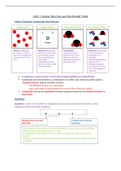
Oxygen Atoms Oxygen element Carbon Dioxide (CO2) CO2 and H2O Mixture
AtomsAll substances ElementsElements are CompoundsA MixturesConsist of two
are made of atoms.An substances that contain compound contains or more elements or
atom is the smallest part only one type of atom. atoms of two or more compounds, not
of an element that can They are displayed on elements, which are chemically
exist. the periodic chemically combined in combine.Components of
table.Represented by fixed proportions. mixtures retain
one or two letters called individual properties,
chemical symbols. e.g. mixtures of Fe and
S, Fe is still magnetic, S
still yellow.
A molecule is a group of two or more atoms joined together by covalent bonds.
Compounds are represented by a combination of numbers and chemical symbols called a
‘chemical formula’ used by scientists to show…
- the different elements in a compound
- how many atoms of each element one mole of the compound contains
Compounds can only be separated into their component elements by chemical reactions or
electrolysis.
Equations
Equations: used to sum up what has happened during a chemical reaction by writing a word
equation or balanced symbol equations.
Reactants are on the left- Products are on the left-
hand side. hand side.
The total mass of the products of a chemical reaction is always equal to the total mass
of the reactants, as no atoms are lost or made.
The products of a chemical reaction are made from exactly the same atoms as the
reactants.
The above reaction shows how when magnesium is burned in oxygen, magnesium oxide
is produced.
, Chemical Formulae
Valency: the number of bonds that each element can make.
- Elements in Group 1 and 7 make 1 bond.
e.g. Lithium, Sodium, Potassium
- Elements in Group 2 and 6 make 2 bonds.
e.g. Beryllium, Magnesium, Calcium
- Elements in Group 3 and 5 make 3 bonds.
e.g. Boron, Aluminium
- Elements in Group 4 make 4 bonds.
Carbon, Silicon
Valences help us to calculate the chemical formula of a compound:
If 2 elements have the same valency, e.g. sodium and chlorine, they will join 1 to
1: NaCl.
If not, e.g. calcium is 2 and chlorine is 1, you have to balance them out: CaCl 2.
Aluminium Carbonate Platinum (II) Nitrate
Al+3 CO3-2 Pt+2 NO3-
+3 -2 +2 -1
2 3 1 2
Al2(CO3) 3 Pt(NO3)2
Iron (III) Sulphate Ammonium Chloride
Fe 3+
SO4 2-
NH4+ Cl-
+3 -2 + -
2 3 1 1
Fe2(SO4)3 NH4Cl
We can also use valences with groups of atoms, here are some examples:
- Hydroxide, OH = valency 1
- Sulphate, SO4 = valency 2
- Nitrate, NO3 = valency 1
- Carbonate, CO3 = valency 2
Atoms, Elements, Compounds and Mixtures
Oxygen Atoms Oxygen element Carbon Dioxide (CO2) CO2 and H2O Mixture
AtomsAll substances ElementsElements are CompoundsA MixturesConsist of two
are made of atoms.An substances that contain compound contains or more elements or
atom is the smallest part only one type of atom. atoms of two or more compounds, not
of an element that can They are displayed on elements, which are chemically
exist. the periodic chemically combined in combine.Components of
table.Represented by fixed proportions. mixtures retain
one or two letters called individual properties,
chemical symbols. e.g. mixtures of Fe and
S, Fe is still magnetic, S
still yellow.
A molecule is a group of two or more atoms joined together by covalent bonds.
Compounds are represented by a combination of numbers and chemical symbols called a
‘chemical formula’ used by scientists to show…
- the different elements in a compound
- how many atoms of each element one mole of the compound contains
Compounds can only be separated into their component elements by chemical reactions or
electrolysis.
Equations
Equations: used to sum up what has happened during a chemical reaction by writing a word
equation or balanced symbol equations.
Reactants are on the left- Products are on the left-
hand side. hand side.
The total mass of the products of a chemical reaction is always equal to the total mass
of the reactants, as no atoms are lost or made.
The products of a chemical reaction are made from exactly the same atoms as the
reactants.
The above reaction shows how when magnesium is burned in oxygen, magnesium oxide
is produced.
, Chemical Formulae
Valency: the number of bonds that each element can make.
- Elements in Group 1 and 7 make 1 bond.
e.g. Lithium, Sodium, Potassium
- Elements in Group 2 and 6 make 2 bonds.
e.g. Beryllium, Magnesium, Calcium
- Elements in Group 3 and 5 make 3 bonds.
e.g. Boron, Aluminium
- Elements in Group 4 make 4 bonds.
Carbon, Silicon
Valences help us to calculate the chemical formula of a compound:
If 2 elements have the same valency, e.g. sodium and chlorine, they will join 1 to
1: NaCl.
If not, e.g. calcium is 2 and chlorine is 1, you have to balance them out: CaCl 2.
Aluminium Carbonate Platinum (II) Nitrate
Al+3 CO3-2 Pt+2 NO3-
+3 -2 +2 -1
2 3 1 2
Al2(CO3) 3 Pt(NO3)2
Iron (III) Sulphate Ammonium Chloride
Fe 3+
SO4 2-
NH4+ Cl-
+3 -2 + -
2 3 1 1
Fe2(SO4)3 NH4Cl
We can also use valences with groups of atoms, here are some examples:
- Hydroxide, OH = valency 1
- Sulphate, SO4 = valency 2
- Nitrate, NO3 = valency 1
- Carbonate, CO3 = valency 2