Laura Heijnen – Working Man
Problem 3. Two’s better than one…
Arnold & Randall (2010) – Work psychology. Understanding human behaviour in
the workplace – Chapter 12: Decisions, groups, and teams at work.
Huczynski & Buchanan (2013) – Organizational behavior: An introductory text –
Chapter 10: Group formation.
Huczynski & Buchanan (2013) – Organizational behavior: An introductory text –
Chapter 11: Group structure.
I: Groupies
What is the definition of a group?
Group: ≥ 2 people, in face-to-face interaction, each aware of group
membership + interdependence, as they strive to achieve goals (=
psychological group). Perceptions sometimes not observable. Unlikely to
exceed 12 persons reduced frequent interaction between members +
group awareness.
- Aggregate: collection of unrelated people who happen to be in close
physical proximity for a short period of time. Can be transformed
into group through outside circumstances: interaction increased
awareness seeing common problems.
- Group characteristics: more characteristics = more recognized as
group.
o Minimum membership of 2 people: 2-30, but more people =
more possible relationships more communication required
more complex structure needed to operate group
successfully.
o Communication network: each member must be capable to
communicate with every other member. Exchange of aims +
purposes group. Interaction satisfies some of social needs +
used to set and enforce standards of group behaviour.
o Shared sense of collective identity: each member identifying
other members + not seeing themselves as individual acting
independently. Believe to be participant in group which is
distinct from other groups.
o Complementary goals: individual goals may differ but are
sufficiently complementary that members feel able to achieve
through participation in group. Recognize the need to work
collectively.
o Group structure: individuals different roles, become fixed
indicate what to expect of each other. Norms/rules indicate
acceptable behaviours in group.
1
, Laura Heijnen – Working Man
- Group dynamics: forces operating within groups that affect their
performance + their members’ satisfaction.
- Benefits of group working:
o Allow organisations to provide services quickly + cost-
effectively with quality.
o Enable organisations to (retain) learn(ing) more effectively.
o Cross-functional groups promote improved quality managed.
o Cross-functional design groups can undertake effective
process re-engineering.
o Production time can be reduced.
o Promotes innovation because cross-fertilization of ideas.
o Organisations with flat structures can be monitored,
coordinated + directed more effectively if functional unit is
group.
o Groups can better handle rise in organisational info-processing
requirements caused by increasing complexity.
Groups and teams
- Team: label to collection of employees to which it is imaginatively,
but not literally, appropriate what they should be/prefer them to
be, rather than actually are.
- Differences teams and groups:
2
Problem 3. Two’s better than one…
Arnold & Randall (2010) – Work psychology. Understanding human behaviour in
the workplace – Chapter 12: Decisions, groups, and teams at work.
Huczynski & Buchanan (2013) – Organizational behavior: An introductory text –
Chapter 10: Group formation.
Huczynski & Buchanan (2013) – Organizational behavior: An introductory text –
Chapter 11: Group structure.
I: Groupies
What is the definition of a group?
Group: ≥ 2 people, in face-to-face interaction, each aware of group
membership + interdependence, as they strive to achieve goals (=
psychological group). Perceptions sometimes not observable. Unlikely to
exceed 12 persons reduced frequent interaction between members +
group awareness.
- Aggregate: collection of unrelated people who happen to be in close
physical proximity for a short period of time. Can be transformed
into group through outside circumstances: interaction increased
awareness seeing common problems.
- Group characteristics: more characteristics = more recognized as
group.
o Minimum membership of 2 people: 2-30, but more people =
more possible relationships more communication required
more complex structure needed to operate group
successfully.
o Communication network: each member must be capable to
communicate with every other member. Exchange of aims +
purposes group. Interaction satisfies some of social needs +
used to set and enforce standards of group behaviour.
o Shared sense of collective identity: each member identifying
other members + not seeing themselves as individual acting
independently. Believe to be participant in group which is
distinct from other groups.
o Complementary goals: individual goals may differ but are
sufficiently complementary that members feel able to achieve
through participation in group. Recognize the need to work
collectively.
o Group structure: individuals different roles, become fixed
indicate what to expect of each other. Norms/rules indicate
acceptable behaviours in group.
1
, Laura Heijnen – Working Man
- Group dynamics: forces operating within groups that affect their
performance + their members’ satisfaction.
- Benefits of group working:
o Allow organisations to provide services quickly + cost-
effectively with quality.
o Enable organisations to (retain) learn(ing) more effectively.
o Cross-functional groups promote improved quality managed.
o Cross-functional design groups can undertake effective
process re-engineering.
o Production time can be reduced.
o Promotes innovation because cross-fertilization of ideas.
o Organisations with flat structures can be monitored,
coordinated + directed more effectively if functional unit is
group.
o Groups can better handle rise in organisational info-processing
requirements caused by increasing complexity.
Groups and teams
- Team: label to collection of employees to which it is imaginatively,
but not literally, appropriate what they should be/prefer them to
be, rather than actually are.
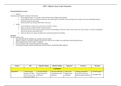
- Differences teams and groups:
2