Class 1: Introduction
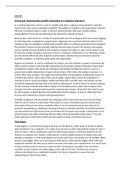
2) Security: a hot topic!
Why are security issues high on the agenda?
1. Basic need → Maslow’s hierarchy of needs
2. Technological development → technology can’t develop without security
- Complex systems
→ new types of risks
→ normal accidents
3. Globalization
- Global as a geospatial concept
→ global in scale (climate change) → cause & effects all over the world
→ global in reach (migration) → regional causes → areas
connect
- Global as an all encompassing concept
→ universal field of study
Globalization
- no boundaries for security issues
- process of states becoming more interlinked: cultural, political, social, economics
3) security studies
→ interstate war & military intervention
- Emerging phase = first post war decade → political science was studied
- The golden age = during cold war → strong focus on war and military force in
international relation
- The decline = after cold war → end was not predicted
New forms of security threats
→ from state-centered to human-centered approach
→ Broadening
→ Deepening → adding people & sources
Short history:
- emerged as academic discipline as a RESPONSE to (world) WARS
- Initially focused completely on (inter)national security
- Key topic of study:
- war & conflict
,Class 2: welcome to the science department
1) Introduction
Science: research (methods), experiment, hypotheses
- Conceptions are a bit flat
- Several world views & fields in science
- Different expectations & ideas what they can accomplish
2) Science?
What is science?
- Good & bad inventions
- Some inventions bring problems & opportunities
Definition: “Science is a systematic and logical approach to discovering how things in the
universe work. […] It is also the body of knowledge accumulated through the discoveries
about all the things in the universe.”
- Types of questions → systematic & logical way → others can replicate the study →
same results/outcome → knowledge
- Build upon the methods of others
- Progression & moving forward
- The tree of science -
Why & when does a discipline become a discipline?
History of science:
- People try to understand the world they see
- Ancient times: a lot of explanations → often magical
- Scientific way of thinking moves away from the other 2 → many centuries
→ connected at first
1) Science
2) Magic
3) Religion
Science does not ever refer to supernatural powers
- over time we develop techniques
, ● Early scientific discoveries
Babylon 4000 B.C.
→ Inventions that we use till this day
- Counting system, dividing years into 52 weeks, zodiac
Egypt 3500 B.C
→ First society that develops writing & paper to write on
- Year calendar, translate into practical farmers guide when to plant & harvest
- Architects, artists
- Advanced brain surgeries
China 3000 B.C
- Actual paper
- Gun powder
- Periodic table → 5 elements → wood, fire, earth, metal, water
- Magnetism → compasses
India 3000 B.C
- Number system
- Medicine, math, physical science
→ all practical inventions
Science: handle a problem (wonder) → can we come up with a solution?
Europe
Thales of miletus → 624-545 B.C
- What makes a scientific way of thinking different from a normal way of thinking?
→ Facts, observable, see happening in the world
→ stop mixing science & mythical thinking
= Natural philosophy
→ claims that everything is made of water → no proof
1) Atomism (420 B.C.)
- What is everything made of?
- natural philosophers → interested in asking questions about the world around them
→ getting a better understanding in reality
- 4 main materials → earth, water, fire, air
- some said it’s all earth/water/fire/air
- atoms
2) Geometry (300 B.C)
-
3) Astronomy (150 B.C)
- First map of the stars → old ideas → earth center of the universe
, Middle-East
- 600 - 1600
- A lot of inventions due to scholarship & copying books
- Muslims got their hands in copies of books → own language & keep them for
themselves → now we know a lot about our ancients
- Middle-East becomes a center of the world
- Medicine, surgery, foundations of astronomy
Europe
- Dark ages
1) Backward looking
- New discoveries
- People study things from ancient times → back to Europe
- Study the past
2) Religion
- See how it could be aligned with the catholic church
- Scholarship → start thinking about the world around them & always ensure that they
align with the church
- In 1100 it starts to change
3) Universities
- Different from now
- 1575 (Leiden University) → 40 students
- Not accessible
- 4 faculties → Medicine, law, art, ….
- Standing if you were a munk(!), doctor, lawyer
Developments
1) Renaissance
- +/- 1450-1600
- Reappreciation/rediscovery roman & greek times
- Art, literature, architecture
- Humanists: artistic stuff → literature, architecture, science → intellectuals
- What are human beings & what can they do
2) Age of discovery
- +/- 1450-1750
- Traveling the globe, colonization, international trade
- Create maps, faith
3) Scientific revolution
- new scientific & technological discoveries
- Asking questions
- At the beginning: scholars have their own approaches
2) Security: a hot topic!
Why are security issues high on the agenda?
1. Basic need → Maslow’s hierarchy of needs
2. Technological development → technology can’t develop without security
- Complex systems
→ new types of risks
→ normal accidents
3. Globalization
- Global as a geospatial concept
→ global in scale (climate change) → cause & effects all over the world
→ global in reach (migration) → regional causes → areas
connect
- Global as an all encompassing concept
→ universal field of study
Globalization
- no boundaries for security issues
- process of states becoming more interlinked: cultural, political, social, economics
3) security studies
→ interstate war & military intervention
- Emerging phase = first post war decade → political science was studied
- The golden age = during cold war → strong focus on war and military force in
international relation
- The decline = after cold war → end was not predicted
New forms of security threats
→ from state-centered to human-centered approach
→ Broadening
→ Deepening → adding people & sources
Short history:
- emerged as academic discipline as a RESPONSE to (world) WARS
- Initially focused completely on (inter)national security
- Key topic of study:
- war & conflict
,Class 2: welcome to the science department
1) Introduction
Science: research (methods), experiment, hypotheses
- Conceptions are a bit flat
- Several world views & fields in science
- Different expectations & ideas what they can accomplish
2) Science?
What is science?
- Good & bad inventions
- Some inventions bring problems & opportunities
Definition: “Science is a systematic and logical approach to discovering how things in the
universe work. […] It is also the body of knowledge accumulated through the discoveries
about all the things in the universe.”
- Types of questions → systematic & logical way → others can replicate the study →
same results/outcome → knowledge
- Build upon the methods of others
- Progression & moving forward
- The tree of science -
Why & when does a discipline become a discipline?
History of science:
- People try to understand the world they see
- Ancient times: a lot of explanations → often magical
- Scientific way of thinking moves away from the other 2 → many centuries
→ connected at first
1) Science
2) Magic
3) Religion
Science does not ever refer to supernatural powers
- over time we develop techniques
, ● Early scientific discoveries
Babylon 4000 B.C.
→ Inventions that we use till this day
- Counting system, dividing years into 52 weeks, zodiac
Egypt 3500 B.C
→ First society that develops writing & paper to write on
- Year calendar, translate into practical farmers guide when to plant & harvest
- Architects, artists
- Advanced brain surgeries
China 3000 B.C
- Actual paper
- Gun powder
- Periodic table → 5 elements → wood, fire, earth, metal, water
- Magnetism → compasses
India 3000 B.C
- Number system
- Medicine, math, physical science
→ all practical inventions
Science: handle a problem (wonder) → can we come up with a solution?
Europe
Thales of miletus → 624-545 B.C
- What makes a scientific way of thinking different from a normal way of thinking?
→ Facts, observable, see happening in the world
→ stop mixing science & mythical thinking
= Natural philosophy
→ claims that everything is made of water → no proof
1) Atomism (420 B.C.)
- What is everything made of?
- natural philosophers → interested in asking questions about the world around them
→ getting a better understanding in reality
- 4 main materials → earth, water, fire, air
- some said it’s all earth/water/fire/air
- atoms
2) Geometry (300 B.C)
-
3) Astronomy (150 B.C)
- First map of the stars → old ideas → earth center of the universe
, Middle-East
- 600 - 1600
- A lot of inventions due to scholarship & copying books
- Muslims got their hands in copies of books → own language & keep them for
themselves → now we know a lot about our ancients
- Middle-East becomes a center of the world
- Medicine, surgery, foundations of astronomy
Europe
- Dark ages
1) Backward looking
- New discoveries
- People study things from ancient times → back to Europe
- Study the past
2) Religion
- See how it could be aligned with the catholic church
- Scholarship → start thinking about the world around them & always ensure that they
align with the church
- In 1100 it starts to change
3) Universities
- Different from now
- 1575 (Leiden University) → 40 students
- Not accessible
- 4 faculties → Medicine, law, art, ….
- Standing if you were a munk(!), doctor, lawyer
Developments
1) Renaissance
- +/- 1450-1600
- Reappreciation/rediscovery roman & greek times
- Art, literature, architecture
- Humanists: artistic stuff → literature, architecture, science → intellectuals
- What are human beings & what can they do
2) Age of discovery
- +/- 1450-1750
- Traveling the globe, colonization, international trade
- Create maps, faith
3) Scientific revolution
- new scientific & technological discoveries
- Asking questions
- At the beginning: scholars have their own approaches