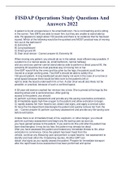
FISDAP Operations Study Questions And Answers 2022
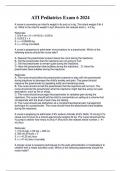
A patient is found unresponsive in his small bathroom. He is not breathing and is sitting in the corner. Two EMTs are able to reach him, but they are unable to stand side by side. He appears to weigh about 150 pounds and there is no evidence that he has been injured. Which of the following would be the quickest and MOST practical way of moving him out of the bathroom? A) Extremity lift B) Long backboard C) Direct ground lift D) Stair chair device - Correct answer-A) Extremity lift When moving any patient, you should do so in the safest, most efficient way possible. If a patient is in a narrow space (ie, small bathroom, narrow hallway) and you and your partner cannot stand side by side to perform a direct ground lift, the extremity lift would be the most practical way of moving him or her. One EMT would lift by the arms and the other by the legs; the patient could then be moved to a larger working area. Two EMTs should be able to safely lift a 150-pound patient. A long backboard would clearly not work in the case of a narrow or small space because there would be little room to the patient's left or right to slide the board underneath him or her. A stair chair would also likely not be possible, or practical, because of such a confined space. A 52-year-old woman crashed her minivan into a tree. She is pinned at the legs by the steering wheel and is semiconscious. After gaining access to the patient, you should: A) perform a primary assessment and provide any life-saving care before extrication. B) immediately apply high-flow oxygen to the patient and allow extrication to begin. C) rapidly assess her from head to toe, obtain vital signs, and apply a cervical collar. D) have the fire department disentangle the patient and quickly remove her from the car. - Correct answer-A) perform a primary assessment and provide any life-saving care before extrication. Unless there is an immediate threat of fire, explosion, or other danger, you should perform a primary assessment and begin any life-saving care as soon as you have gained access to the patient. If you wait to do this until after the patient has been disentangled, it may be too late; the patient may already be dead. After you have assessed the patient and treated any immediate threats to life, allow extrication to commence. Once the patient has been freed from the vehicle, continue any lifesaving care and perform a rapid head-to -toe assessment to identify and treat other life- threatening injuries. Another EMT can obtain vital signs as you rapidly assess the patient. Prepare for immediate transport after the rapid head-to-toe assessment has been performed and spinal precautions have been taken (if indicated). When arriving at the scene of a motor vehicle crash at night, you determine that the safest place to park the ambulance is in a direction that faces oncoming traffic. What should you do? A) Position road flares around the front of the ambulance. B) Turn all emergency lighting off to avoid blinding the traffic. C) Turn the high-beam headlights on to alert oncoming traffic. D) Turn your headlights off, but keep the emergency lights on. - Correct answer-D) Turn your headlights off, but keep the emergency lights on. Emergency operations on the highway at night can be especially dangerous for responders; it is important to position emergency vehicles correctly, while at the same time ensuring visibility for oncoming traffic without blinding them. First of all, road flares near an automobile crash are dangerous because leaking fluids , such as gasoline, may not be immediately apparent; safety triangles are safer. If your emergency vehicle is facing oncoming traffic, you should keep your emergency lights on, but turn your headlights off. Bright lights, such as high-beam headlights, can effectively blind and disorient an oncoming driver, and could cause them to crash into the scene. A 72-year-old woman fell and has a hip injury. She is on the second floor of her home. Which of the following devices should you use to move her down the flight of stairs A) Stair chair B) Long backboard C) Wheeled stretcher D) Scoop stretcher - Correct answer-D) Scoop stretcher Of the options listed, the scoop stretcher, also called an orthopaedic stretcher or split litter, would be the most appropriate to use. The scoop stretcher is contoured and allows for the placement of straps to secure the patient; it also allows you to place padding around and under the patient. The long backboard, unlike the scoop stretcher, is flat; therefore, the patient can slide from side to side or top to bottom, even when straps are placed. The wheeled ambulance stretcher is top heavy and is not safe for patient movement down a flight of stairs or across rough terrain. Because the patient has a hip injury, the stair chair would not be appropriate to use. When calling in your radio report to the receiving hospital, you should: A) include the patient's name. B) be brief, concise, and factual. C) give your report only to a physician. D) break your report into 60-second increments. - Correct answer-B) be brief, concise, and factual. A radio report should be brief, concise, and factual. It should include the patient's age and sex, his or her chief complaint, associated assessment findings, vital signs, treatment that you provided, and the patient's response to your treatment. Avoid speculative statements regarding the patient's condition; report only what you know to be fact. Longer radio reports should be broken into 30-second increments; after 30 seconds, pause and ensure the listener heard your previous traffic. The patient's name is not vital to your report; thus, there is no need to disclose it. Unless you are requesting medical direction, it is acceptable, and routine practice, to give your report to a registered nurse. At the scene of a mass-casualty incident, you notice a bystander who is emotionally upset. An appropriate action to take would be to: A) tell the bystander to leave the scene at once. B) have the bystander assist you with patient care. C) notify the police and have the bystander removed. D) assign the bystander a simple, non-patient-care task. - Correct answer-D) assign the bystander a simple, non-patient-care task. One of the most effective ways to reduce stress in a bystander at the scene of a masscasualty incident is to assign the bystander a task that is not related to patient care. This may involve assisting other bystanders who are having difficulties as well or providing water to the rescuers. An obviously distressed bystander should not simply be sent away from the scene, but should be looked at as a patient as well. Clearly, if the bystander becomes aggressive or violent, law enforcement personnel should get involved. Upon arriving at a mass-casualty incident, the EMT is assigned to the treatment area. Upon completion of duties in the treatment area, the EMT should: A) notify the incident commander and return to service. B) report to the treatment officer for further instructions. C) report to the transportation area to assist with transport. D) report to the triage section to check for remaining patients. - Correct answer-B) report to the treatment officer for further instructions. Organized operations at the scene of a mass-casualty incident are crucial in order to achieve the best possible outcome and maximize the number of lives saved. When the EMT is given an assignment, he or she should complete the assignment and then return to the individual who gave the assignment for further instructions. Self-assigning at the scene (freelancing) is dangerous and can compromise the effectiveness of the overall operation. A patient injured his arm and asks to be transported to a specific hospital because he has been there before. The EMT states that he does not feel the doctors there are competent and recommends a different hospital. The EMT's behavior is: A) legal and ethical. B) ethical, but illegal. C) legal, but unethical. D) illegal and unethical. - Correct answer-C) legal, but unethical. The EMT's actions in this case are not illegal; he cannot go to jail for making such comments. However, his actions are clearly unethical and unprofessional, and could lead to allegations of slander by the physician; this would be a civil case, not a criminal one. You must not allow your personal feelings to influence a patient's decision as to who treats him or her, or where he or she is treated. You arrive at the scene of an 80-year-old woman who is weak and lightheaded. Her son, who called 911, is present and asks you to transport his mother to the hospital. You should: A) advise the son that he can probably drive his mother to the hospital. B) comply with the son's request and transport the woman to the hospital. C) take the woman's vital signs and apply supplemental oxygen if necessary. D) assess the woman and determine if she wishes to be treated and transported. - Correct answer-D) assess the woman and determine if she wishes to be treated and transported. You must obtain consent from any mentally competent adult patient prior to initiating treatment. Just because the patient is 80 years old does not mean that she does not have decision-making capacity. Also, just because her son wants her to be transported does not mean that she agrees with this request. Ask her if she wishes to be treated and transported to the hospital. If she does, then you have obtained consent and should proceed accordingly. If she does not, you should determine if she has decision-making capacity--that is, whether she is mentally competent. If she is determined to have decision-making capacity, then you cannot legally treat or transport her. If she does not have decision-making capacity (eg, she is confused, she is under the influence of drugs or alcohol), then you may treat and transport under the law of implied consent. It is not the EMT's decision to determine, let alone recommend, that a patient be taken to the hospital via privately owned vehicle (POV}. If the patient requests EMS treatment and transport, you are legally obligated to do so. When using the power lift to lift a stretcher, you should: A) maintain a slight inward curve to your back. B) bend at the waist and keep your back straight C) ensure that you lift with your palms facing up. D) maintain a slight outward curve to your back. - Correct answer-C) ensure that you lift with your palms facing up. To achieve the best grip and to avoid injury to your wrists, you should lift a stretcher, backboard, or other carrying device with your palms facing up. Do not bend at the waist; rather, bend at the knees and keep your back in a straight, locked-in position. You and your partner have secured a trauma patient to a long backboard and are preparing to lift the backboard onto the stretcher. When doing so, you should: A) lift the backboard from the sides instead of from the ends. B) be sure to lift the backboard with the powerful muscles of your back. C) recall that most of the patient's weight is at the foot end of the backboard. D) ensure that the strongest EMT is positioned at the head of the backboard. - Correct answer-D) ensure that the strongest EMT is positioned at the head of the backboard. Since most of the patient's weight is distributed to the head end of a backboard, you should always ensure that the strongest EMT is at that position. This will reduce the risk of injury to less strong personnel as well as the risk of dropping the patient. The backboard should be lifted from the ends, not the sides; you have less control over the board if it is lifted from the sides. When lifting any patient, you should use the powerful muscles of your thighs, not your back, to lift. Keep your back straight and in a locked-in position. Which of the following statements regarding the high-efficiency particulate air (HEPA) respirator is correct? A) HEPA respirator should be placed on any patient with tuberculosis. B) Long sideburns or a beard will prevent the proper fit of a HEPA respirator. C) A surgical mask provides better protection against tuberculosis than a HEPA respirator. D) A HEPA respirator is necessary only if the patient with suspected tuberculosis is coughing. - Correct answer-B) Long sideburns or a beard will prevent the proper fit of a HEPA respirator. If you are caring for a patient with known or suspected tuberculosis (TB) or COVID-19, regardless of whether the patient is coughing, you should place a surgical mask (or high-flow oxygen, if indicated) on the patient and a high-efficiency particulate air (HEPA) respirator (N-95 or higher) on yourself. Unlike a surgical mask, the HEPA respirator is specifically designed to prevent exposure to the bacterium that causes TB; it can also filter out particles of the SARSCoV-2 virus, the virus that causes COVID-19. A surgical mask, however, will reduce the transmission of germs from the patient into the air. Do not place a HEPA respirator on the patient; it is unnecessary and uncomfortable. Use of a HEPA respirator should comply with OSHA standards, which state that facial hair, such as long sideburns or beards, will prevent a proper fit. A 30-year-old woman crashed her car into a tree at a high rate of speed. She is conscious and alert and has stable vital signs. She has some small lacerations and abrasions to her arms and face, but no obviously life-threatening injuries. As you are loading her into the ambulance, she tells you that she does not want to go to the hospital. You should: A) advise her that she is probably too emotionally upset to be able to refuse EMS treatment and transport. B) ask a law enforcement officer to administer a breathalyzer test to determine if she has been drinking alcohol. C) advise the patient that she should be transported to the hospital because of the seriousness of the crash. D) obtain a signed refusal from the patient and ask a law enforcement officer to transport her to the hospital. - Correct answer-C) advise the patient that she should be transported to the hospital because of the seriousness of the crash. The consequences of refusal should be explained to any patient who refuses EMS treatment and/or transport. After establishing that the patient can legally refuse treatment and transport (eg, he or she is of legal age AND has decision-making capacity), you must advise her that because of the significant mechanism of injury, the potential for critical injury cannot be ruled out in the field , even though she may feel fine now. It should also be explained, in a manner that the patient can understand, that a hidden significant injury could result in death if untreated. Once this is explained, and the patient understands and is willing to accept the possible consequences, obtain a signed refusal and ask an impartial person (eg, police officer) to witness the signed refusal. The role of triage officer at a mass-casualty incident should be assumed by the: A) most knowledgeable EMS provider. B) EMS provider with the most years in EMS. C) first EMS provider who is willing to perform the task. D) EMS medical director via telephone communication. - Correct answer-A) most knowledgeable EMS provider. The role of triage officer should be assumed by the most knowledgeable EMS provider at the scene. Knowledge and experience will enable this person to most effectively manage the triage process. Just because a person has been in the EMS profession for a long period of time does not mean that he or she has been active or has maintained clinical competence. While triaging patients at a mass-casualty incident, you encounter a responsive middleaged woman with a respiratory rate of 26 breaths/min. What should you do next? A) Triage her as immediate (red tag) B) Assess for bilateral radial pulses C) Administer high-flow oxygen at once D) Assess her ability to follow commands - Correct answer-B) Assess for bilateral radial pulses According to the Simple Triage and Rapid Treatment {START) method, if you encounter an adult patient with a respiratory rate that is less than 10 breaths/min or greater than 29 breaths/min, you should triage him or her as immediate (red tag) and move to the next patient. However, if the patient's respiratory rate is between 10 and 29 breaths/min, you should assess his or her hemodynamic status by checking for bilateral radial pulses. If the patient's radial pulses are absent, triage him or her as immediate and move to the next patient. If the patient's radial pulses are present, assess his or her ability to follow simple commands. If the patient is able to follow simple commands, triage him or her as delayed (yellow tag) and move to the next patient. If the patient is unable to follow simple commands, triage him or her as immediate and move to the next patient. Treatment does not occur during the initial triage process. Which of the following patients has the highest priority at the scene of a mass-casualty incident? A) 29-year-old man who is pulseless and apneic with an abdominal evisceration B) 35-year-old unresponsive woman with snoring respirations and severe burns C) 38-year-old woman who remains apneic after you manually open her airway D) 44-year-old unresponsive man with an open head injury and agonal gasps - Correct answer-B) 35-year-old unresponsive woman with snoring respirations and severe burns The goal of triage is to provide the greatest good for the greatest number of people. Relative to the other patients, who are either in respiratory or cardiac arrest or have injuries incompatible with life, the woman with snoring respirations and severe burns has the best chance for survival. Therefore, she is the highest treatment priority. The process of removing or neutralizing and properly disposing of hazardous materials from equipment, patients, and rescue personnel is called: A) autoclaving. B) sterilization. C) detoxification. D) decontamination. - Correct answer-D) decontamination. Decontamination is the process of removing or neutralizing and properly disposing of hazardous materials from equipment, patients, and rescue personnel. Decontamination should occur in the warm zone of a hazardous materials incident. The process of autoclaving involves the use of heat to sterilize instruments; clearly, this is not practical in the prehospital setting. Sterilization involves making an object free from bacteria or other living organisms; sterilization at an emergency incident is generally not possible. Detoxification involves the removal of toxic substances from a living organism; while the process of decontamination may remove or neutralize toxins, it does not kill them. Which of the following statements regarding the use of an escort vehicle when en route to an emergency call is correct?
Escuela, estudio y materia
- Institución
- FISDAP
- Grado
- FISDAP
Información del documento
- Subido en
- 16 de enero de 2023
- Número de páginas
- 47
- Escrito en
- 2022/2023
- Tipo
- Examen
- Contiene
- Preguntas y respuestas
Temas
-
fisdap operations
-
fisdap
-
fisdap operations study
-
fisdap operations study questions and answers 2022
-
a patient is found unresponsive in his small bathroom he is not breathing and is sitting in the cor

Documento también disponible en un lote