Updated
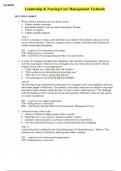
Leadership & Nursing Care Management Testbank
MULTIPLE CHOICE
1. Which of these statements are true about culture?
a. Culture remains consistent.
b. Individuals identify with one culture during their lifetime.
c. Culture is complex.
d. Culture excludes religion.
ANS: C
Culture is dynamic in nature, and individuals may identify with multiple cultures over the
course of their lifetimes. There is a complex nature to culture, which has been defined and
studied across many disciplines.
DIF: Cognitive Level: Remember (Knowledge)
TOP: Nursing Process: Assessment
MSC: Client Needs: Physiological Integrity: Basic Care and Comfort
2. A client of Vietnamese background is admitted to the unit after a hysterectomy. She has an
order for clear liquids. When her tray is brought to her, she refuses the lime Jell-O. Which
response by the nurse is most appropriate?
a. “I don’t blame you. I don’t like lime Jell-O either.”
b. “Tell me about your cultural beliefs to best help you.”
c. “Why don’t you want to eat the lime Jell-O?”
d. “It is important for you toNeURo I
at sS thN
G ouBwill
at yT
.COheal.”
M
ANS: B
The first step toward multicultural competence is to recognize one’s own prejudices and learn
about other people’s differences. The problem is that many Americans are afraid to ask people
about their culture because of the idea that “we don’t want to offend anyone.” The challenge
with this thinking is that if nurses do not ask about people’s differences, then the only option
is to make assumptions.
DIF: Cognitive Level: Apply (Application)
TOP: Nursing Process: Assessment
MSC: Client Needs: Safe and Effective Care Environment: Management of Care
3. Cultural diversity refers to the:
a. variety of cultural or ethnic groups within a society.
b. belief that one’s own culture is similar to another’s culture.
c. realization that all people in a particular culture have the same beliefs.
d. view that individuals living in a country should speak the native language.
ANS: A
Cultural diversity is defined by the Oxford Dictionary (“Cultural diversity,” 2016) as “The
existence of a variety of cultural or ethnic groups within a society.”
DIF: Cognitive Level: Understand (Comprehension)
TOP: Nursing Process: Assessment
,Updated
MSC: Client Needs: Safe and Effective Care Environment: Management of Care
4. Which of these is the fastest growing minority group in the United States?
a. Asians
b. Caucasians
c. Blacks
d. Hispanics
ANS: D
The U.S. Census Bureau (2014) estimates that minorities (anyone who is not a single-race
non-Hispanic White) will be the majority in America by 2044 as a result of both immigration
and growth rate. The nation’s racial and ethnic minority groups, especially Hispanics, are
growing more rapidly than the non-Hispanic White population, fueled by both immigration
and births.
DIF: Cognitive Level: Remember (Knowledge)
TOP: Nursing Process: Assessment
MSC: Client Needs: Safe and Effective Care Environment: Management of Care
5. Which of the following ethnic populations has seen the fastest growth?
a. African Americans
b. Iranians
c. Hispanics
d. Vietnamese
ANS: C
Results from the 2010 census show that racial and ethnic minorities accounted for 91.7% of
the nation’s growth since 200N0. M
Hispanics. URosSIt of
NGthat
TBi.ncC
reasMe, from 2000 to 2010 (56%), was due to
O
DIF: Cognitive Level: Remember (Knowledge)
TOP: Nursing Process: Assessment
MSC: Client Needs: Safe and Effective Care Environment: Management of Care
6. Equity is the absence of avoidable differences among groups of people, whether those groups
are defined socially, economically, demographically, or geographically. Which group
formulated this definition?
a. World Health Organization
b. Affordable Care Act
c. Centers for Disease Control
d. Agency for Healthcare Research and Quality
ANS: A
According to the World Health Organization (2016), “Equity is the absence of avoidable or
remediable differences among groups of people, whether those groups are defined socially,
economically, demographically or geographically.”
DIF: Cognitive Level: Remember (Knowledge)
TOP: Nursing Process: Assessment
MSC: Client Needs: Safe and Effective Care Environment: Management of Care
,Updated
7. Recognizing one’s own prejudices and learning about other people’s differences is the first
step toward:
a. cultural diversity.
b. multicultural competence.
c. social change.
d. valuing.
ANS: B
To reduce cross-cultural miscommunications and improve patient satisfaction, the
multicultural competence of health care practitioners needs to be improved. The first step
toward multicultural competence is to recognize one’s own prejudices and learn about other
people’s differences.
DIF: Cognitive Level: Apply (Application) TOP: Nursing Process: Planning
MSC: Client Needs: Safe and Effective Care Environment: Management of Care
8. A nurse believes that she should provide optimal care to all clients, regardless of their cultural
background. She is struggling with her emotions when caring for a client with a violent
criminal background. What would be the best course of action for this nurse?
a. Avoiding the client as much as possible but providing care
b. Identifying her biases but providing care
c. Requesting another patient assignment
d. Taking sick days while the patient is hospitalized
ANS: B
The first step toward multicultural competence is to recognize one’s own prejudices and learn
about other people’s differences. The problem is that many Americans are afraid to ask people
about their culture because oN heRiS
f tU deIaN
thG
atT“B
w.eC
doOnM
’t want to offend anyone.” The challenge
with this thinking is that if nurses do not ask about people’s differences, then the only option
is to make assumptions.
DIF: Cognitive Level: Apply (Application)
TOP: Nursing Process: Assessment
MSC: Client Needs: Safe and Effective Care Environment: Management of Care
9. Which of the following supports successful workplace diversity?
a. Being a “devil’s advocate”
b. Holding tight to one’s cultural values
c. Respect for differences
d. Withholding judgment of others
ANS: C
To reduce cross-cultural miscommunications and improve patient satisfaction, the
multicultural competence of health care practitioners needs to be improved. The first step
toward multicultural competence is to recognize one’s own prejudices and learn about other
people’s differences.
DIF: Cognitive Level: Apply (Application)
TOP: Nursing Process: Assessment
MSC: Client Needs: Safe and Effective Care Environment: Management of Care
, Updated
10. According to the National Healthcare Quality and Disparities Report, which group has worse
access to health care in America, compared with Whites?
a. Hispanics
b. Asians
c. Blacks
d. American Indians
ANS: A
According to the 2014 National Healthcare Quality and Disparities Report (Agency for
Healthcare Research and Quality [AHRQ], 2015), “Historically, Americans have experienced
variable access to care based on race, ethnicity, socioeconomic status, age, sex, disability
status, sexual orientation, and residence location.” This study found that Blacks had worse
access to health care than Whites for about half of measures of access, Hispanics had worse
access to care than Whites for two-thirds of access measures, and Asians and American
Indians and Alaska Natives had worse access to care than Whites for about one-third of access
measures.
DIF: Cognitive Level: Remember (Knowledge)
TOP: Nursing Process: Assessment
MSC: Client Needs: Safe and Effective Care Environment: Management of Care
11. The variation among groups of people with respect to habits, values, preferences, beliefs,
taboos, and rules for behavior determined to be appropriate for individual and societal
interaction is known as:
a. bias.
b. diversity.
c. culture
d. stereotyping. NURSINGTB.COM
ANS: B
Culture refers to the variation among groups of people with respect to habits, values,
preferences, beliefs, taboos, and rules for behavior determined to be appropriate for individual
and societal interaction.
DIF: Cognitive Level: Apply (Application)
TOP: Nursing Process: Assessment
MSC: Client Needs: Safe and Effective Care Environment: Management of Care
12. What is the most modifiable factor in the provision of equitable health care?
a. Availability of services
b. Socioeconomic status
c. Care that is responsive to cultural needs
d. Education level
ANS: C
Health inequities are directly related to the existence of historical and current discrimination
and social injustice, and one of the most modifiable factors is the lack of culturally and
linguistically appropriate services, broadly defined as care and services that are respectful of
and responsive to the cultural and linguistic needs of all individuals.
DIF: Cognitive Level: Apply (Application)
TOP: Nursing Process: Assessment
Leadership & Nursing Care Management Testbank
MULTIPLE CHOICE
1. Which of these statements are true about culture?
a. Culture remains consistent.
b. Individuals identify with one culture during their lifetime.
c. Culture is complex.
d. Culture excludes religion.
ANS: C
Culture is dynamic in nature, and individuals may identify with multiple cultures over the
course of their lifetimes. There is a complex nature to culture, which has been defined and
studied across many disciplines.
DIF: Cognitive Level: Remember (Knowledge)
TOP: Nursing Process: Assessment
MSC: Client Needs: Physiological Integrity: Basic Care and Comfort
2. A client of Vietnamese background is admitted to the unit after a hysterectomy. She has an
order for clear liquids. When her tray is brought to her, she refuses the lime Jell-O. Which
response by the nurse is most appropriate?
a. “I don’t blame you. I don’t like lime Jell-O either.”
b. “Tell me about your cultural beliefs to best help you.”
c. “Why don’t you want to eat the lime Jell-O?”
d. “It is important for you toNeURo I
at sS thN
G ouBwill
at yT
.COheal.”
M
ANS: B
The first step toward multicultural competence is to recognize one’s own prejudices and learn
about other people’s differences. The problem is that many Americans are afraid to ask people
about their culture because of the idea that “we don’t want to offend anyone.” The challenge
with this thinking is that if nurses do not ask about people’s differences, then the only option
is to make assumptions.
DIF: Cognitive Level: Apply (Application)
TOP: Nursing Process: Assessment
MSC: Client Needs: Safe and Effective Care Environment: Management of Care
3. Cultural diversity refers to the:
a. variety of cultural or ethnic groups within a society.
b. belief that one’s own culture is similar to another’s culture.
c. realization that all people in a particular culture have the same beliefs.
d. view that individuals living in a country should speak the native language.
ANS: A
Cultural diversity is defined by the Oxford Dictionary (“Cultural diversity,” 2016) as “The
existence of a variety of cultural or ethnic groups within a society.”
DIF: Cognitive Level: Understand (Comprehension)
TOP: Nursing Process: Assessment
,Updated
MSC: Client Needs: Safe and Effective Care Environment: Management of Care
4. Which of these is the fastest growing minority group in the United States?
a. Asians
b. Caucasians
c. Blacks
d. Hispanics
ANS: D
The U.S. Census Bureau (2014) estimates that minorities (anyone who is not a single-race
non-Hispanic White) will be the majority in America by 2044 as a result of both immigration
and growth rate. The nation’s racial and ethnic minority groups, especially Hispanics, are
growing more rapidly than the non-Hispanic White population, fueled by both immigration
and births.
DIF: Cognitive Level: Remember (Knowledge)
TOP: Nursing Process: Assessment
MSC: Client Needs: Safe and Effective Care Environment: Management of Care
5. Which of the following ethnic populations has seen the fastest growth?
a. African Americans
b. Iranians
c. Hispanics
d. Vietnamese
ANS: C
Results from the 2010 census show that racial and ethnic minorities accounted for 91.7% of
the nation’s growth since 200N0. M
Hispanics. URosSIt of
NGthat
TBi.ncC
reasMe, from 2000 to 2010 (56%), was due to
O
DIF: Cognitive Level: Remember (Knowledge)
TOP: Nursing Process: Assessment
MSC: Client Needs: Safe and Effective Care Environment: Management of Care
6. Equity is the absence of avoidable differences among groups of people, whether those groups
are defined socially, economically, demographically, or geographically. Which group
formulated this definition?
a. World Health Organization
b. Affordable Care Act
c. Centers for Disease Control
d. Agency for Healthcare Research and Quality
ANS: A
According to the World Health Organization (2016), “Equity is the absence of avoidable or
remediable differences among groups of people, whether those groups are defined socially,
economically, demographically or geographically.”
DIF: Cognitive Level: Remember (Knowledge)
TOP: Nursing Process: Assessment
MSC: Client Needs: Safe and Effective Care Environment: Management of Care
,Updated
7. Recognizing one’s own prejudices and learning about other people’s differences is the first
step toward:
a. cultural diversity.
b. multicultural competence.
c. social change.
d. valuing.
ANS: B
To reduce cross-cultural miscommunications and improve patient satisfaction, the
multicultural competence of health care practitioners needs to be improved. The first step
toward multicultural competence is to recognize one’s own prejudices and learn about other
people’s differences.
DIF: Cognitive Level: Apply (Application) TOP: Nursing Process: Planning
MSC: Client Needs: Safe and Effective Care Environment: Management of Care
8. A nurse believes that she should provide optimal care to all clients, regardless of their cultural
background. She is struggling with her emotions when caring for a client with a violent
criminal background. What would be the best course of action for this nurse?
a. Avoiding the client as much as possible but providing care
b. Identifying her biases but providing care
c. Requesting another patient assignment
d. Taking sick days while the patient is hospitalized
ANS: B
The first step toward multicultural competence is to recognize one’s own prejudices and learn
about other people’s differences. The problem is that many Americans are afraid to ask people
about their culture because oN heRiS
f tU deIaN
thG
atT“B
w.eC
doOnM
’t want to offend anyone.” The challenge
with this thinking is that if nurses do not ask about people’s differences, then the only option
is to make assumptions.
DIF: Cognitive Level: Apply (Application)
TOP: Nursing Process: Assessment
MSC: Client Needs: Safe and Effective Care Environment: Management of Care
9. Which of the following supports successful workplace diversity?
a. Being a “devil’s advocate”
b. Holding tight to one’s cultural values
c. Respect for differences
d. Withholding judgment of others
ANS: C
To reduce cross-cultural miscommunications and improve patient satisfaction, the
multicultural competence of health care practitioners needs to be improved. The first step
toward multicultural competence is to recognize one’s own prejudices and learn about other
people’s differences.
DIF: Cognitive Level: Apply (Application)
TOP: Nursing Process: Assessment
MSC: Client Needs: Safe and Effective Care Environment: Management of Care
, Updated
10. According to the National Healthcare Quality and Disparities Report, which group has worse
access to health care in America, compared with Whites?
a. Hispanics
b. Asians
c. Blacks
d. American Indians
ANS: A
According to the 2014 National Healthcare Quality and Disparities Report (Agency for
Healthcare Research and Quality [AHRQ], 2015), “Historically, Americans have experienced
variable access to care based on race, ethnicity, socioeconomic status, age, sex, disability
status, sexual orientation, and residence location.” This study found that Blacks had worse
access to health care than Whites for about half of measures of access, Hispanics had worse
access to care than Whites for two-thirds of access measures, and Asians and American
Indians and Alaska Natives had worse access to care than Whites for about one-third of access
measures.
DIF: Cognitive Level: Remember (Knowledge)
TOP: Nursing Process: Assessment
MSC: Client Needs: Safe and Effective Care Environment: Management of Care
11. The variation among groups of people with respect to habits, values, preferences, beliefs,
taboos, and rules for behavior determined to be appropriate for individual and societal
interaction is known as:
a. bias.
b. diversity.
c. culture
d. stereotyping. NURSINGTB.COM
ANS: B
Culture refers to the variation among groups of people with respect to habits, values,
preferences, beliefs, taboos, and rules for behavior determined to be appropriate for individual
and societal interaction.
DIF: Cognitive Level: Apply (Application)
TOP: Nursing Process: Assessment
MSC: Client Needs: Safe and Effective Care Environment: Management of Care
12. What is the most modifiable factor in the provision of equitable health care?
a. Availability of services
b. Socioeconomic status
c. Care that is responsive to cultural needs
d. Education level
ANS: C
Health inequities are directly related to the existence of historical and current discrimination
and social injustice, and one of the most modifiable factors is the lack of culturally and
linguistically appropriate services, broadly defined as care and services that are respectful of
and responsive to the cultural and linguistic needs of all individuals.
DIF: Cognitive Level: Apply (Application)
TOP: Nursing Process: Assessment