Week 1
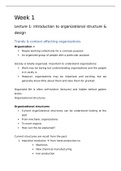
Lecture 1: Introduction to organizational structure &
design
Trends & context affecting organizations
Organization =
People working collectively for a common purpose
An organized group of people with a particular purpose
Society is totally organized. Important to understand organizations:
Work may be boring but understanding organizations and the people
in it rarely is
However, organizations may be important and exciting, but we
generally know little about them and take them for granted
Organized life is often self-evident (lectures) and hidden behind golden
bricks
Organizational structures
Organizational structures
Current organizational structures can be understood looking at the
past
From mechanic organizations
To more organic
How can this be explained?
Current structures are result from the past:
1. Industrial revolution from hand production to:
Machines
New chemical manufacturing
Iron production
, Increased use of steam water and power
2. Evidence based medicine
New diagnostic & treatment options
3. Resulted in
Larger organizations
More complex products
More specialization
More demand, higher productivity
Organizations as machines:
Mechanistic model
Fayol’s approach is strongly task-orientated, as are other theories of
the time, such as taylor scientific management
Model aimed at efficiency and productivity
Formalized, central and complex
Stable and simple environment
Organic organizations:
Organic model
Task, authority and routines are constantly redefined
Flat organizations
Informal, decentralized, simple
Complex & dynamic environment
Bureaucracy
Bureaucracy = Organizational structure characterized by regulatory
procedures, division of responsibility, hierarchy and impersonal
relationships
Has many negative connotations
, Operating principles:
1. Rationalization (procedures, rules)
2. Formality (focus on standardization of processes)
3. Specialization
4. Hierarchy
5. Universal access, but no individual control
Max weber: “superior to any other form in precision, stability, discipline
and relianility”
High degree of calculability of results
Specialization:” you have one job”
Work regulated by rules and procedures
Top-Down management (hierarchy) of low-skilled workers
Critiques on bureaucracy
Dehumanizing effects on employees, customers, patients etc.
Little room for human beings (powerlesnness, meaninlesness. Self-
alienation
Inflexible/rigid
Inefficient and viscous
Differentiation & disintegration
Limited rationality (goal rationality)
Limited morality (value rationality)
Traditional: bureaus without participation by the governed. Organizations
could be belastingdiesnt, UPS, hospital, etc.
Hospitals are bureaucratic because
Standardization of processes: clinical guideline practices, care
pathways
Lecture 1: Introduction to organizational structure &
design
Trends & context affecting organizations
Organization =
People working collectively for a common purpose
An organized group of people with a particular purpose
Society is totally organized. Important to understand organizations:
Work may be boring but understanding organizations and the people
in it rarely is
However, organizations may be important and exciting, but we
generally know little about them and take them for granted
Organized life is often self-evident (lectures) and hidden behind golden
bricks
Organizational structures
Organizational structures
Current organizational structures can be understood looking at the
past
From mechanic organizations
To more organic
How can this be explained?
Current structures are result from the past:
1. Industrial revolution from hand production to:
Machines
New chemical manufacturing
Iron production
, Increased use of steam water and power
2. Evidence based medicine
New diagnostic & treatment options
3. Resulted in
Larger organizations
More complex products
More specialization
More demand, higher productivity
Organizations as machines:
Mechanistic model
Fayol’s approach is strongly task-orientated, as are other theories of
the time, such as taylor scientific management
Model aimed at efficiency and productivity
Formalized, central and complex
Stable and simple environment
Organic organizations:
Organic model
Task, authority and routines are constantly redefined
Flat organizations
Informal, decentralized, simple
Complex & dynamic environment
Bureaucracy
Bureaucracy = Organizational structure characterized by regulatory
procedures, division of responsibility, hierarchy and impersonal
relationships
Has many negative connotations
, Operating principles:
1. Rationalization (procedures, rules)
2. Formality (focus on standardization of processes)
3. Specialization
4. Hierarchy
5. Universal access, but no individual control
Max weber: “superior to any other form in precision, stability, discipline
and relianility”
High degree of calculability of results
Specialization:” you have one job”
Work regulated by rules and procedures
Top-Down management (hierarchy) of low-skilled workers
Critiques on bureaucracy
Dehumanizing effects on employees, customers, patients etc.
Little room for human beings (powerlesnness, meaninlesness. Self-
alienation
Inflexible/rigid
Inefficient and viscous
Differentiation & disintegration
Limited rationality (goal rationality)
Limited morality (value rationality)
Traditional: bureaus without participation by the governed. Organizations
could be belastingdiesnt, UPS, hospital, etc.
Hospitals are bureaucratic because
Standardization of processes: clinical guideline practices, care
pathways