Electric Circuits:
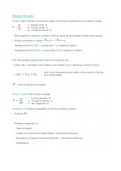
Voltage: Work done per unit positive charge OR Energy transferred per unit positive charge
W • V : Voltage (Volts, V)
V = • W : Energy (Joule, J)
Q
• Q : Charge (Coulomb, C)
• What happens to electron in resistor: Electron gives o heat energy & loses kinetic energy
• Energy conversion in resistor: Ekinetic ! Ethermal
• Voltage across BATTERY = energy given TO charges by battery
• Voltage across RESISTOR = energy taken FROM charges by resistor
EMF:Total energy supplied per coulomb of charge by cell.
• Taken with a voltmeter across battery when battery is NOT delivering current to circuit.
• Vext: Vload measured across battery when current is owing
• emf = Vext + Vint • Vint: Inside battery
r = internal resistance of battery
Electric current: Rate of ow of charge
q • I : Current (Ampere, A)
I= • q : Charge (Coulomb, C)
¢t • t : Time (Seconds, s)
Resistance: A material's opposition to the ow of electric current
• R (Ohms, « )
• Resistance depends on:
- Type of material
- Length of conductor (Increased length = decreased resistance)
- Diameter of conductor (Increased diameter = decreased resistance)
- Temperature
fl
, Ohm's Law: Current through conductor is directly proportional to potential di erence across the
conductor at a constant temperature
V
R=
I
Rheostat: Variable resistor
or
Ohmic conductors: Have constant resistance no matter what the voltage across or current through it
is.
Non-ohmic conductors: Have varying resistance that depends on current through it
Series circuit:
• Resistance in series: Rseries = R1 + R2:::
• Why Vext decreases when resistor in series is removed:
Rext decreases (De nition of R)
I increases (De nition of R)
Vint increases (Vint = I.r) (r is constant)
emf = Vext + Vint
Vext = emf - Vint (emf constant)
,Therefore Vext decreases
Parallel circuit:
1 1 1
• Resistance in parallel: = + :::
Rp R1 R2
ff
Voltage: Work done per unit positive charge OR Energy transferred per unit positive charge
W • V : Voltage (Volts, V)
V = • W : Energy (Joule, J)
Q
• Q : Charge (Coulomb, C)
• What happens to electron in resistor: Electron gives o heat energy & loses kinetic energy
• Energy conversion in resistor: Ekinetic ! Ethermal
• Voltage across BATTERY = energy given TO charges by battery
• Voltage across RESISTOR = energy taken FROM charges by resistor
EMF:Total energy supplied per coulomb of charge by cell.
• Taken with a voltmeter across battery when battery is NOT delivering current to circuit.
• Vext: Vload measured across battery when current is owing
• emf = Vext + Vint • Vint: Inside battery
r = internal resistance of battery
Electric current: Rate of ow of charge
q • I : Current (Ampere, A)
I= • q : Charge (Coulomb, C)
¢t • t : Time (Seconds, s)
Resistance: A material's opposition to the ow of electric current
• R (Ohms, « )
• Resistance depends on:
- Type of material
- Length of conductor (Increased length = decreased resistance)
- Diameter of conductor (Increased diameter = decreased resistance)
- Temperature
fl
, Ohm's Law: Current through conductor is directly proportional to potential di erence across the
conductor at a constant temperature
V
R=
I
Rheostat: Variable resistor
or
Ohmic conductors: Have constant resistance no matter what the voltage across or current through it
is.
Non-ohmic conductors: Have varying resistance that depends on current through it
Series circuit:
• Resistance in series: Rseries = R1 + R2:::
• Why Vext decreases when resistor in series is removed:
Rext decreases (De nition of R)
I increases (De nition of R)
Vint increases (Vint = I.r) (r is constant)
emf = Vext + Vint
Vext = emf - Vint (emf constant)
,Therefore Vext decreases
Parallel circuit:
1 1 1
• Resistance in parallel: = + :::
Rp R1 R2
ff