pvl3701_property_notes_cases_2008.pdf
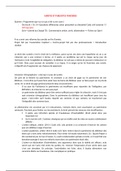
Married couple drafted a mutual will which provided that, on the death of one spouse, the surviving spouse and children would inherit the farm. They provided further that the farm should be partitioned when their oldest surviving child reached age of majority & drawing of lots would determine who got which portion of farm.. Furthermore, they provided that the heir who got the portion with the homestead should pay an amount of money to the other children within 5 years of reaching majority.. Attorney reassured them that the provisions re the div of the farm & pmt of sum of money after their death would be registered against eh title deed of the farm. Conditions contained in the will: - 9 of 95 Downloaded by Phosha Phöshmillý SA () lOMoARcPSD| “As soon as our first child reaches his / her majority, the survivor of the testator shall be bound to subdivide the said land in equal portions & distribute it among the children, such distributions to be made by the survivor & such major child by drawing lots…and we declare & direct that the child who by such lot obtains the portion comprising the homestead of the farm Jakhalskop shall pay the sum of 200 pounds to our other children” within a specified time”.” Applicant applied for an order: (a) instructing Register of Deeds to register transfer of certain farms in favour of the children of the dead spouse and applicant, her surviving spouse, subject to the conditions of the will; (b) allowing applicant, in his capacity as executor testamentary of estate of testatrix, to have farms surveyed into equal portions, & asking Court to appoint some responsible person to act in place of eldest child & to divide farms by way of lots, and also to allow applicant, in his capacity as father & natural guardian, to pass a bond on the portion accruing to such minor child who may obtain the homestead of the farm with the usual conditions of preference to the extent of 100 pounds; (c) costs of application to be paid by the minor children. Judgment: Order granted in terms of (a) and (c). Reason for judgment: Court formulated a test to determine whether one is dealing with real / personal right: “One has to look not so much to the right, but to the correlative obligation. If that obligation is a burden upon the land, a subtraction from dominium (ownership), the corresponding right is real & registrable; if it is not such an obligation, but merely an obligation binding on some person / other, the corresponding right is a personal right, or right in personam, and it cannot as a rule be registered.” In applying above test, court came to conclusion that the provisions that the farm must be divided when oldest surviving child reaches age of majority & that the drawing of lots will determine who gets which portion of the farm place a burden on the land itself (in that the time & manner of division restrict the ordinary rights of co-owners to divide the common property when & in a manner on which they agree). These provisions were regarded as conditions aimed at creating real rights and could be registered. The provisions that the heir who gets the portion of the homestead on it must pay an amount of money to the other heirs was regarded as creating a personal right since it was only an obligations on a specific person to pay a sum of money & a claim for payment of a sum of money is, as a rule, not regarded as a real right. This condition placed an obligation on that person in his / her personal capacity and not as owner of the land. But, the court held that since the latter (above) was so closely related to the real right; it could be registered as an exception. Criticism: 1. It is not possible to identify the most NB real right, ownership (dominium) by means of the “subtraction from dominium (ownership) test”. How can you define ownership by having recourse to the test, if test requires right concerned should limit ownership? Test can only be applied if ownership has ALREADY been determined & identified by means of OTHER criteria, in other words, test can be used only to identify limited real rights to another person’s property (iura in re aliena). 2. Personal rights can also impose restrictions on ownership An owners obligations to pay over a portion of proceeds of his property to another does imply a limitation of the owner’s ownership (dominium), but the corresponding right is not necessarily a real right – Lorentz v Melle. 10 of 95 Downloaded by Phosha Phöshmillý SA () lOMoARcPSD| In both the above, the exercise of owner’s ownership is limited to a certain degree. NOTE: A personal right which limits the exercise of ownership still has as its object, performance by a specific owner. This performance cannot be exacted from the owner’s successors in title. (I.E: S has a personal right to use farm belonging to X & Y for grazing purposes. A limited real right – on the other hand – has as its object the thing itself. The right & the accompanying obligation remain connected with the thing concerned, regardless of who the owner of the thing is. (I.E: M has a personal servitude (limited real right) of habitation over a homestead on a farm belonging to X & Y). SA courts realised that the subtraction from the dominium test cannot be applied w/o qualification. Parties are required to have envisaged that the accompanying obligation would be binding – not only to the present owner, but on his / her successors in title as well. It’s clear that the courts don’t apply the subtraction from the dominium test w/o considering the additional requirements as well. It is not always easy to apply the test to a specific set of facts & the distinction btw real & personal rights is one of the most problematic areas of law of things. SCA confirmed this test in Cape Explosive Works Ltd v Denel (Pty) Ltd. In principle, only real rights may be registered in the deeds registry. S 63 of Deeds Registries Act provides that, excluding provisions in mortgage bonds, leases (incl. amendments, sessions / cancellations thereof) and deeds of grant as contemplated in S 31(1)(c) of the Act, no condition to a deed which purports to create a personal right on immovable property & no condition which does not restrict the exercise of ownership on immovable property, shall be capable of registration. Section authorises registrar to accept such a condition for registration if, in his opinion, it is complementary / ancillary to another registrable conditions / right in the deed. BUT registration of such condition does not convert the right it may contain to a real right. (As in Ex parte Geldenhuys). CATEGORIES OF REAL RIGHTS Ownership Limited real rights Real right over one’s own thing Rights to another person’s thing Most comprehensive real right to a thing Limited, in principle EG: Owner of a piece of land – use it as he wishes EG: Entitlements of usufrutuary (holder of limited real right over land of another) – clearly defined and limited form the outset. OWNERSHIP Definition: Most comprehensive real right a person can have with regard to a thing. In principle, a person can act upon with his thing as he / she pleases. This apparent freedom is restricted however, by the law & rights of others. Defined with ref to it’s: 1. Inviobility; 2. inherent nature 3. entitlements 1. Inviobility Principle that a person cannot lose his ownership w/o his consent, with its proposition that follows that a person cannot pass a better title than he has – RL maxim – nemo plus iurus = no one may transfer more rights to another person than he has himself. 2. Inherent Nature Most comprehensive real right person can have to his thing = refers not only to fact that owner can enforce his ownership against the world at large – but also to the number of entitlements / extent of entitlements flowing from ownership.
Escuela, estudio y materia
- Institución
- Rhodes State College
- Grado
- Pvl3701
Información del documento
- Subido en
- 13 de enero de 2023
- Número de páginas
- 96
- Escrito en
- 2022/2023
- Tipo
- Otro
- Personaje
- Desconocido
Temas
-
pvl3701propertynotescases
-
pvl3701propertynotescases2008pdf
-
pvl3701notescases2008pdf