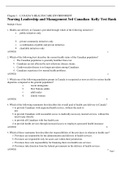
Chapter 1: Nursing Leadership and Management MULTIPLE CHOICE 1. According to Henri Fayol, the functions of planning, organizing, coordinating, and controlling are considered which aspect of management? a. Roles c. Functions b. Process d. Taxonomy ANS: B The management process includes planning, organizing, coordinating, and controlling. Management roles include information processing, interpersonal relationships, and decision making. Management functions include planning, organizing, staffing, dire cting, coordinating, reporting, and budgeting. A taxonomy is a system that orders principles into a grouping or classification. PTS: 1 DIF: Comprehension REF: THE MANAGEMENT PROCESS 2. Which of the following is considered a decisional managerial role? a. Disseminator c. Leader b. Figurehead d. Entrepreneur ANS: D The decisional managerial roles include entrepreneur, disturbance handler, allocator of resources, and negotiator. The information processing managerial roles in clude monitor, disseminator, and spokesperson. The interpersonal managerial roles include figurehead, leader, and liaison. PTS: 1 DIF: Comprehension REF: MANAGERIAL ROLES 3. A nurse manager meets regularly with other nurse managers, participates on the organization‘s committees, and attends meetings sponsored by professional organizations in order to manage relationships. These activities are considered which function of a manager? a. Informing c. Monitoring b. Problem solving d. Networking ANS: D The role functions to manage relationships are networking, supporting, developing and mentoring, managing conflict and team building, motivating and inspiring, recognizing, and rewarding. The role functions to manage the work are planning and organizing, p roblem solving, clarifying roles and objectives, informing, monitoring, consulting, and delegating. PTS: 1 DIF: Application REF: THE MANAGEMENT PROCESS 4. A nurse was recently promoted to a middle -level manager position. The nurse‘s title would most likely be which of the following? a. First-line manager c. Vice president of patient care services b. Director d. Chief nurse executive ANS: B A middle -level manager is called a director. A low managerial -level job is calle d the first -line manager. A nurse in an executive level role is called a chief nurse executive or vice president of patient care services. PTS: 1 DIF: Application REF: THE MANAGEMENT PROCESS 5. A nurse manager who uses Frederick Taylor‘s scientific mana gement approach, would most likely focus on which of the following? a. General principles c. Labor productivity b. Positional authority d. Impersonal relations ANS: C The area of focus for scientific management is labor productivity. In bureaucrat ic theory, efficiency is achieved through impersonal relations within a formal structure and is based on positional authority. Administrative principle theory consists of principles of management that are relevant to any organization. PTS: 1 DIF: Comprehe nsion REF: SCIENTIFIC MANAGEMENT 6. According to Vroom‘s Theory of Motivation, force: a. is the perceived possibility that the goal will be achieved. b. describes the amount of effort one will exert to reach one‘s goal. c. describes people who have free will but choose to comply with orders they are given. d. is a naturally forming social group that can become a contributor to an organization. ANS: B According to Vroom‘s Theory of Motivation, Force describes the amount of effort one will exert to reach one‘s goal. Valence speaks to the level of attractiveness or unattractiveness of the goal. Expectancy is the perceived possibility that the goal will be achieved. Vroom‘s Theory of Motivation can be demonstrated in the form of an equation: Force = Valence Expectancy (Vroom, 1964). The theory proposes that this equation can help to predict the motivation, or force, of an individual as described by Vroom. PTS: 1 DIF: Comprehension REF: TABLE 1 -2 MANAGEMENT THEORIES 7. According to R. N. Lussier, motivation: a. is unconsciously demonstrated by people. b. occurs externally to influence behavior. c. is determined by others‘ choices. d. occurs internally to influence behavior. ANS: D Motivation is a process that occurs internally to influence and direct our behavior in order to satisfy needs. Motivation is not explicitly demonstrated by people, but rather it is interpreted from their behavior. Motivation is whatever influences our ch oices and creates direction, intensity, and persistence in our behavior. PTS: 1 DIF: Comprehension REF: MOTIVATION THEORIES 8. According to R. N. Lussier, there are content motivation theories and process mo tivation theories. Which of the following is considered a process motivation theory? a. Equity theory b. Hierarchy of needs theory c. Existence -relatedness -growth theory d. Hygiene maintenance and motivation factors ANS: A The process motivation theories are equity theory and expectancy theory. The content motivation theories include Maslow‘s hierarchy of needs theory, Aldefer‘s existence -relatedness -growth (ERG) theory, and Herzberg‘s hygiene maintenance factors and motivat ion factors. PTS: 1 DIF: Comprehension REF: MOTIVATION THEORIES 9. The theory that includes maintenance and motivation factors is: a. Maslow‘s hierarchy of needs. c. McGregor‘s theory X and theory Y. b. Herzberg‘s two -factor theory. d. Ouchi‘ s theory Z. ANS: B The two -factor theory of motivation includes motivation and maintenance factors. Maslow‘s hierarchy of needs includes the following needs: physiological, safety, security, belonging, and self-actualization. In theory X, employees pref er security, direction, and minimal responsibility. In theory Y, employees enjoy their work, show self -control and discipline, are able to contribute creatively, and are motivated by ties to the group, organization, and the work itself. The focus of theory Z is collective decision making and long -term employment that involves slower promotions and less direct supervision. PTS: 1 DIF: Comprehension REF: TWO -FACTOR THEORY 10. A nurse is appointed to a leadership position in the local hospital. The nurse‘ s position would be considered which of the following? a. Informal leadership c. Leadership b. Formal leadership d. Management ANS: B Formal leadership is based on occupying a position in an organization. Informal leadership is shown by an individual who demonstrates leadership outside the scope of a formal leadership role or as a member of a group. Leadership is a process of influence whereby the leader influences others toward goal achievement. Management is a pro cess to achieve organizational goals. PTS: 1 DIF: Application REF: DEFINITION OF LEADERSHIP 11. A nursing instructor is evaluating whether the nursing students understand the three fundamental qualities that leaders share. According to Bennis and Nanus, the fundamental qualities of effective leaders are: a. guided vision, passion, and integrity. b. knowledge of self, honesty, and maturity. c. intelligence, self -confidence, and determination. d. honesty, self -awareness, and sociability. ANS: A Bennis and Nanus list guided vision, passion, and integrity as fundamental qualities of effective leaders. Knowledge of self, honesty and maturity; intelligence, self -confidence and determination; self-awareness and sociability are all desirable traits in leaders as well as in others. PTS: 1 DIF: Application REF: LEADERSHIP CHARACTERISTICS 12. The six traits identified by Kirkpatrick and Locke that separate leaders from non -leaders were: a. respectability, trustworthiness, flexibility, self -confidence, intelligence, sociability. b. self-confidence, progression of experiences, influence of others, personal life factors, honesty, drive. c. intelligence, self -confidence, determination, integri ty, sociability, honesty. d. drive, desire to lead, honesty, self -confidence, cognitive ability, knowledge of business. ANS: D Research by Kirkpatrick and Locke concluded that leaders possess six traits: dri ve, desire to lead, honesty, self -confidence, cognitive ability, and knowledge of the business. Woods identified five dominant factors that influenced leadership development: self -confidence, innate qualities, progression of experience, influence of signif icant others, and personal life factors. Stogdill identified the following traits of a leader: intelligence, self -confidence, determination, integrity, and sociability. Murphy and DeBack identified the following leader characteristics: caring, respectabili ty, trustworthiness, and flexibility. PTS: 1 DIF: Comprehension REF: LEADERSHIP CHARACTERISTICS 13. A nurse manager who uses a leadership style that is participatory and where authority is delegated to others is most likely using which of the followi ng leadership styles? a. Autocratic c. Laissez -faire b. Democratic d. Employee -centered ANS: B Democratic leadership is participatory, and authority is delegated to others. Au tocratic leadership involves centralized decision making, with the leader making decisions and using power to command and control others. Laissez -faire leadership is passive and permissive, and the leader defers decision making. Employee -centered leadershi p focuses on the human needs of subordinates. PTS: 1 DIF: Application REF: BEHAVIORAL APPROACH 14. A characteristic of the consideration dimension of leadership behavior is: a. focus on the work to be done. c. focus on production. b. focus on the task. d. focus on the employee. ANS: D The leadership dimension of consideration involves activities that focus on the employee. Initiating structures of leadership involves an emphasis on the work to be done, and a focus on the task and production. PTS: 1 DIF: Comprehension REF: BEHAVIORAL APPROACH 15. The leadership theory that considers follower readiness as a factor in determining leadership style is: a. contingency. c. situational. b. path goal. d. charismatic. ANS: C Situational leadership considers the follower readiness as a factor in determining leadership style. Contingency theory views the pattern of leader behavior as dependent on the interaction of the personality of the leader and the needs of the situation. In path goal theory, the leader works to motivate followers and influence goal accomplishment. Charismatic leadership has an inspirational quality that promotes an emotional connection from followers. PTS: 1 DIF: Comprehension REF: HERSEY AND BLANCHARD'S SITUATIONAL THEORY 16. In contingency theory, the feelings and attitudes of followers regarding acceptance, trust, and credibility of the leader are called: a. task structure. c. low task structure.
Examen
Test Bank For Nursing Leadership & Management, 3rd Edition By Patricia Kelly Chapter 1-31
Test Bank Nursing Leadership & Management, 3rd Edition By Patricia Kelly Chapter 1-31
Institución
Nursing Leadership & Management, 3rd
Grado
Nursing Leadership & Management, 3rd
Ups! No podemos cargar tu documento ahora. Inténtalo de nuevo o contacta con soporte.
Libro relacionado
Nursing Leadership and Management
- 2015
- 9780176729004
- Desconocido
Escuela, estudio y materia
- Institución
- Nursing Leadership & Management, 3rd
- Grado
- Nursing Leadership & Management, 3rd
Información del documento
- Subido en
- 11 de enero de 2023
- Número de páginas
- 282
- Escrito en
- 2022/2023
- Tipo
- Examen
- Contiene
- Preguntas y respuestas
Temas
-
test bank for nursing leadership amp management
-
3rd edition by patricia kelly chapter 1 31
Vista previa del contenido
$18.49
Accede al documento completo:
100% de satisfacción garantizada
Inmediatamente disponible después del pago
Tanto en línea como en PDF
No estas atado a nada

Documento también disponible en un lote
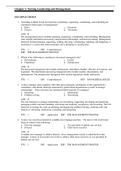
Package deal
Nursing Top 20 Test Banks Accounring Test Banks |100% Money Back Guarantee If you Not Satisfied
11
2023
$ 237.39
Más información