UNIT 2: Learning Aim A
P1: Correctly prepare and standardise a solution for titration or colorimetry
The aim of calibration is to ensure that the apparatus is reliable in terms of
measurements and can ensure consistent readings. In this calibration the aim is to
calibrate a Balance, Volumetric Pipette and pH meter.
External Calibration Using ICM (Calibration of Balance)
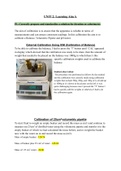
To be able to calibrate the balance, I had to press the ‘T’ button until ‘CAL’ appeared
in display which showed that the calibration was ready to be done, then the amount of
weight that needed to be placed on the balance was 1000g in which there’s this
specific calibration weights used to calibrate the
balance.
Student observation:
-The procedure was performed as follows by the method
and the calibration was correctly made using calibration
weights that include 500g, 200g, and 100g (x3), all add up
to 1000g as it’s shown in the picture on the left, it was
quite challenging because once I pressed the “T” button I
had to quickly add the weights or otherwise I had to do
the calibration again.
Calibration of 25cm3 volumetric pipette
To start I had to weight an empty beaker and record this mass as (m1) and continue to
measure out 25cm3 of distilled water using the volumetric pipette and transfer it to the
empty beaker of which we had calculated the mass before, and re-weight the beaker
now with the water on ot and record the mass as (m2).
Mass of empty beaker - 120.76
Mass of beaker plus 25 cm3 of water - 145.62
Mass of 25 cm3 water - 24.86
, Calculation of mass added (m2 - m1) 145.62 - 120.76 = 24.86g
Student observation:
I could not obtain any picture of the procedure, but from the observation that I did, this
calibration required me to focus because, I had to this calibration around 3 times because the
use of the pipette pump is hard, I had to get used to the technique of rolling it up slowly, to
get the volumetric pipette full, and I had to get used to the technique and the reading from the
pipette at eye level to see if the reading was 25cm3 where the line marks.
Calibration of pH meter
To start the calibration of the pH meter I have to prepare a beaker with the pH 7 buffer
solution which was provided to me, and then use the
pH meter pressing the button in the center ‘ON’
appears and then press the button again and hold on
the button once ‘OFF’ appear and wait to ‘CAL’ to
⏳
display in the pH meter once it appears, a symbol of
hourglass ( ) also appears in the left side of the pH
meter and I had to wait for it to disappear and then
insert the pH meter into the buffer solution, then it
will start reading the pH.
Then, I wait for the pH meter to read the pH and once
the hourglass disappears I have to save the pH read, I
did this again pressing the button in the center and it
was saved.
Student observation:
The calibration of the pH meter using the buffer 7 was quite challenging, it was the
first time carrying it out and if was hard to get the calibration step in the pH meter I
had to press the ‘off’ and ‘CAL’ bottom multiple times, till I actually get it, I did this
calibration once, only using buffer 7, after carrying out this calibration I found out by
a teacher feedback that I had to use buffer 7 and buffer 4 and try the calibration on
both, once in 7 and 4 multiple times, to see if the pH meter was calibrated correctly.
P1: Correctly prepare and standardise a solution for titration or colorimetry
The aim of calibration is to ensure that the apparatus is reliable in terms of
measurements and can ensure consistent readings. In this calibration the aim is to
calibrate a Balance, Volumetric Pipette and pH meter.
External Calibration Using ICM (Calibration of Balance)
To be able to calibrate the balance, I had to press the ‘T’ button until ‘CAL’ appeared
in display which showed that the calibration was ready to be done, then the amount of
weight that needed to be placed on the balance was 1000g in which there’s this
specific calibration weights used to calibrate the
balance.
Student observation:
-The procedure was performed as follows by the method
and the calibration was correctly made using calibration
weights that include 500g, 200g, and 100g (x3), all add up
to 1000g as it’s shown in the picture on the left, it was
quite challenging because once I pressed the “T” button I
had to quickly add the weights or otherwise I had to do
the calibration again.
Calibration of 25cm3 volumetric pipette
To start I had to weight an empty beaker and record this mass as (m1) and continue to
measure out 25cm3 of distilled water using the volumetric pipette and transfer it to the
empty beaker of which we had calculated the mass before, and re-weight the beaker
now with the water on ot and record the mass as (m2).
Mass of empty beaker - 120.76
Mass of beaker plus 25 cm3 of water - 145.62
Mass of 25 cm3 water - 24.86
, Calculation of mass added (m2 - m1) 145.62 - 120.76 = 24.86g
Student observation:
I could not obtain any picture of the procedure, but from the observation that I did, this
calibration required me to focus because, I had to this calibration around 3 times because the
use of the pipette pump is hard, I had to get used to the technique of rolling it up slowly, to
get the volumetric pipette full, and I had to get used to the technique and the reading from the
pipette at eye level to see if the reading was 25cm3 where the line marks.
Calibration of pH meter
To start the calibration of the pH meter I have to prepare a beaker with the pH 7 buffer
solution which was provided to me, and then use the
pH meter pressing the button in the center ‘ON’
appears and then press the button again and hold on
the button once ‘OFF’ appear and wait to ‘CAL’ to
⏳
display in the pH meter once it appears, a symbol of
hourglass ( ) also appears in the left side of the pH
meter and I had to wait for it to disappear and then
insert the pH meter into the buffer solution, then it
will start reading the pH.
Then, I wait for the pH meter to read the pH and once
the hourglass disappears I have to save the pH read, I
did this again pressing the button in the center and it
was saved.
Student observation:
The calibration of the pH meter using the buffer 7 was quite challenging, it was the
first time carrying it out and if was hard to get the calibration step in the pH meter I
had to press the ‘off’ and ‘CAL’ bottom multiple times, till I actually get it, I did this
calibration once, only using buffer 7, after carrying out this calibration I found out by
a teacher feedback that I had to use buffer 7 and buffer 4 and try the calibration on
both, once in 7 and 4 multiple times, to see if the pH meter was calibrated correctly.