WORK-ENERGY THEOREM
Work is done on an object when the object moves in the same plane as the force.
If a force is applied to an object at 90o to the motion of the object then that force does no
work on the object.
When a force is applied at an angle (θ) to an object then then work is done by the
component of the force that causes the object to move.
This is given by the following equation: 𝑊 = 𝐹∆𝑥𝑐𝑜𝑠 𝜃 W = work done (J)
o F = force applied (N)
o Δx = displacement (m)
o θ = angle of force to the direction of motion
Work is a scalar quantity therefore it has magnitude but not direction.
Work can be a negative value when the energy of the system decreases and positive when the
energy of the system increases.
Net work on an object can be calculated by applying the definition of work to each force acting on
the object while it is being displaced and then adding up each contribution.
Example
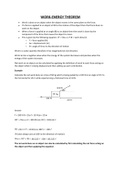
Calculate the net work done on a box of 50 kg which is being pulled by a 100 N at an angle of 250 to
the horizontal for 20 m while experiencing a frictional force of 10 N.
Answer
F = 100 N θ = 25o 𝑓 = 10 N Δx = 20 m
𝑊𝐹 = 𝐹∆𝑥𝑐𝑜𝑠 𝜃 = 100 20 (cos 25°) = 1812,62 𝐽
𝑊𝑓 = 𝑓∆𝑥𝑐𝑜𝑠 𝜃 = 10 20 (cos 180°) = −200 𝐽
(Friction always acts at 180o to the direction of motion)
𝑊𝑛𝑒𝑡 = 𝑊𝐹 + 𝑊𝑓 = 1812,62 + −200 = 1612,62 𝐽
The net work done on an object can also be calculated by first calculating the net force acting on
the object and then applying the equation.
Work is done on an object when the object moves in the same plane as the force.
If a force is applied to an object at 90o to the motion of the object then that force does no
work on the object.
When a force is applied at an angle (θ) to an object then then work is done by the
component of the force that causes the object to move.
This is given by the following equation: 𝑊 = 𝐹∆𝑥𝑐𝑜𝑠 𝜃 W = work done (J)
o F = force applied (N)
o Δx = displacement (m)
o θ = angle of force to the direction of motion
Work is a scalar quantity therefore it has magnitude but not direction.
Work can be a negative value when the energy of the system decreases and positive when the
energy of the system increases.
Net work on an object can be calculated by applying the definition of work to each force acting on
the object while it is being displaced and then adding up each contribution.
Example
Calculate the net work done on a box of 50 kg which is being pulled by a 100 N at an angle of 250 to
the horizontal for 20 m while experiencing a frictional force of 10 N.
Answer
F = 100 N θ = 25o 𝑓 = 10 N Δx = 20 m
𝑊𝐹 = 𝐹∆𝑥𝑐𝑜𝑠 𝜃 = 100 20 (cos 25°) = 1812,62 𝐽
𝑊𝑓 = 𝑓∆𝑥𝑐𝑜𝑠 𝜃 = 10 20 (cos 180°) = −200 𝐽
(Friction always acts at 180o to the direction of motion)
𝑊𝑛𝑒𝑡 = 𝑊𝐹 + 𝑊𝑓 = 1812,62 + −200 = 1612,62 𝐽
The net work done on an object can also be calculated by first calculating the net force acting on
the object and then applying the equation.