1
Mathematics – Grade 12 Notes
Algebra - Polynomials
Content:
Polynomials:
1.1 Important Definitions and Notes for Polynomials
1.2 Factoring Method 1: Sum and Difference of Two Cubes
1.3 Factoring Method 2: Grouping
1.4 Division of Polynomials Definition
1.5 Factoring Method 3: Long Division
1.6 The Remainder Theorem
1.7 The Factor Theorem
1.8 Factoring Method 4: Using the Factor Theorem
1.1 Important Definitions and Notes for Polynomials
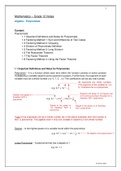
Polynomial – It is a function where each term within the function consists of some constant
multiplied by a variable raised to some exponent (a power). Furthermore, the exponent of each
variable must be a whole number (i.e. 0; 1; 2…∞)! The coefficients can be any real number.
All exponents are whole numbers.
(The exponent of the variable for ½ is
1 0). Therefore this is a polynomial.
e.g. 2𝑥 5 + 9𝑥 1 −
2
Raised to the power of 1/2 (square root
Raised to the power of -1,
1
is the same as raising to the power of ½),
therefore, NOT a 5
polynomial. e.g. 2𝑥 −1 + 4𝑥 3 − 10√𝑥 × 𝑥 8 therefore, NOT a polynomial.
Raised to the power of Raised to the power of -8, therefore,
1/3, therefore, NOT a NOT a polynomial.
polynomial.
If any of the exponents are not a whole number (as in the above example) then the function is
NOT a polynomial. This applies even if only one variable is raised to a non-whole number.
Degree – Is the highest power of a variable found within the polynomial.
1
e.g. 9𝑥 2 + 12𝑥 7 − 19 ÷ 4 𝑥 The degree of this polynomial is 7.
Linear Polynomial – A polynomial that has a degree of 1.
e.g. 8𝑥 + 1
Pia Eklund 2023
, 2
Quadratic Polynomial – A polynomial that has a degree of 2.
1
e.g. 24𝑥 2 − 3 𝑥 + 7
Cubic Polynomial – A polynomial that has a degree of 3.
e.g. 6𝑥 3 − 2𝑥
Zeros of a Polynomial – The values that when substituted in the place of x results in the entire
polynomial being equal to 0.
e.g. 4𝑥 2 − 4 = 0 when 𝑥 = 1 or 𝑥 = −1
4(1)2 − 4 = 4 − 4 = 0
4(−1)2 − 4 = 4 − 4 = 0
Example 1 – Foundations
Consider the polynomial ℎ(𝑥) = (3𝑥 − 1)(2𝑥 2 − 9𝑥 − 5). Determine the following:
a) Degree of polynomial.
b) Coefficient of 𝑥 2 .
c) The constant term.
d) The zeros of the polynomial.
a) Be very careful, 𝑥 2 is NOT the highest power!
In order to determine the highest power we need to expand the expression.
ℎ(𝑥) = (3𝑥 − 1)(2𝑥 2 − 9𝑥 − 5) Expand the expression by
= 6𝑥 3 − 27𝑥 2 − 15𝑥 − 2𝑥 2 + 9𝑥 + 5 multiplying the terms together
= 6𝑥 3 − 29𝑥 2 − 6𝑥 + 5 and then simplify.
∴ The highest power is 3 and thus the degree of the polynomial is 3.
b) Once again, be careful, use the expanded version of the expression to find the coefficient.
ℎ(𝑥) = 6𝑥 3 − 29𝑥 2 − 6𝑥 + 5
The coefficient of 𝑥 2 is −29.
c) Once again, be careful, use the expanded version of the expression to find the constant (i.e.
the term that does not change when 𝑥 is replaced by a value).
ℎ(𝑥) = 6𝑥 3 − 29𝑥 2 − 6𝑥 + 5
The constant is 5.
d) In this case, using the un-expanded version of the polynomial will be easier to factorise and
hence find the zeros in comparison with the expanded version. 2 1
To find the zeros, we equate the polynomial to 0 and solve for x:
1 5
0 = (3𝑥 − 1)(2𝑥 2 − 9𝑥 − 5) Used cross-factor method.
You can use any method you
know to factor.
2 × 5 = 10
1×1 =1
Pia Eklund 2023
−10 + 1 = −9
Mathematics – Grade 12 Notes
Algebra - Polynomials
Content:
Polynomials:
1.1 Important Definitions and Notes for Polynomials
1.2 Factoring Method 1: Sum and Difference of Two Cubes
1.3 Factoring Method 2: Grouping
1.4 Division of Polynomials Definition
1.5 Factoring Method 3: Long Division
1.6 The Remainder Theorem
1.7 The Factor Theorem
1.8 Factoring Method 4: Using the Factor Theorem
1.1 Important Definitions and Notes for Polynomials
Polynomial – It is a function where each term within the function consists of some constant
multiplied by a variable raised to some exponent (a power). Furthermore, the exponent of each
variable must be a whole number (i.e. 0; 1; 2…∞)! The coefficients can be any real number.
All exponents are whole numbers.
(The exponent of the variable for ½ is
1 0). Therefore this is a polynomial.
e.g. 2𝑥 5 + 9𝑥 1 −
2
Raised to the power of 1/2 (square root
Raised to the power of -1,
1
is the same as raising to the power of ½),
therefore, NOT a 5
polynomial. e.g. 2𝑥 −1 + 4𝑥 3 − 10√𝑥 × 𝑥 8 therefore, NOT a polynomial.
Raised to the power of Raised to the power of -8, therefore,
1/3, therefore, NOT a NOT a polynomial.
polynomial.
If any of the exponents are not a whole number (as in the above example) then the function is
NOT a polynomial. This applies even if only one variable is raised to a non-whole number.
Degree – Is the highest power of a variable found within the polynomial.
1
e.g. 9𝑥 2 + 12𝑥 7 − 19 ÷ 4 𝑥 The degree of this polynomial is 7.
Linear Polynomial – A polynomial that has a degree of 1.
e.g. 8𝑥 + 1
Pia Eklund 2023
, 2
Quadratic Polynomial – A polynomial that has a degree of 2.
1
e.g. 24𝑥 2 − 3 𝑥 + 7
Cubic Polynomial – A polynomial that has a degree of 3.
e.g. 6𝑥 3 − 2𝑥
Zeros of a Polynomial – The values that when substituted in the place of x results in the entire
polynomial being equal to 0.
e.g. 4𝑥 2 − 4 = 0 when 𝑥 = 1 or 𝑥 = −1
4(1)2 − 4 = 4 − 4 = 0
4(−1)2 − 4 = 4 − 4 = 0
Example 1 – Foundations
Consider the polynomial ℎ(𝑥) = (3𝑥 − 1)(2𝑥 2 − 9𝑥 − 5). Determine the following:
a) Degree of polynomial.
b) Coefficient of 𝑥 2 .
c) The constant term.
d) The zeros of the polynomial.
a) Be very careful, 𝑥 2 is NOT the highest power!
In order to determine the highest power we need to expand the expression.
ℎ(𝑥) = (3𝑥 − 1)(2𝑥 2 − 9𝑥 − 5) Expand the expression by
= 6𝑥 3 − 27𝑥 2 − 15𝑥 − 2𝑥 2 + 9𝑥 + 5 multiplying the terms together
= 6𝑥 3 − 29𝑥 2 − 6𝑥 + 5 and then simplify.
∴ The highest power is 3 and thus the degree of the polynomial is 3.
b) Once again, be careful, use the expanded version of the expression to find the coefficient.
ℎ(𝑥) = 6𝑥 3 − 29𝑥 2 − 6𝑥 + 5
The coefficient of 𝑥 2 is −29.
c) Once again, be careful, use the expanded version of the expression to find the constant (i.e.
the term that does not change when 𝑥 is replaced by a value).
ℎ(𝑥) = 6𝑥 3 − 29𝑥 2 − 6𝑥 + 5
The constant is 5.
d) In this case, using the un-expanded version of the polynomial will be easier to factorise and
hence find the zeros in comparison with the expanded version. 2 1
To find the zeros, we equate the polynomial to 0 and solve for x:
1 5
0 = (3𝑥 − 1)(2𝑥 2 − 9𝑥 − 5) Used cross-factor method.
You can use any method you
know to factor.
2 × 5 = 10
1×1 =1
Pia Eklund 2023
−10 + 1 = −9