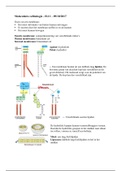
Selection at a Single Gene
Population Genetics
Dynamics of alleles at one or few loci Predict allele frequency change
Frequency change Infer population parameters/processes
Directed effects: selection
Stochastic effects: genetic drift
Quantitative Genetics
Genetic contribution to phenotypic variation
No direct representation of genes and alleles
Variance components: genetic and environmental
Phylogenetics
Long term evolution
DNA substitutions
Calculate species distances
Reconstruct trees
Discrete Traits Continuous traits
One or few loci Most often polygenic, multifactorial
Large alleic effects Meristic traits: quantitative but not
Discontinuous distribution infinite range (eg. number of eggs laid)
Threshold traits: small number of discrete
phenotypic classes (eg. Type II diabetes –
people have a combination of alleles at
different loci continuous range for
varying levels of libability)
Small alleic effects
Central Limit Theorem
Single-gene traits
Antibiotic resistance to bacteria
Resistance to insecticides, pesticides
Plant heavy metal tolerance
Human resistance to malaria (sickle cells)
Human genetic diseases (cystic fibrosis, Huntingtons)
Peppered moth Biston betularia
2 morphs = typica (camouflaged among lichen, conspicuous on dark bark) and
carbonaria (camouflaged on dark bark, conspicuous among lichen)
, During Industrial Revolution (1800s) – heavy air pollution led to soot deposition on
trees, sulphur dioxide killed lichens = result was that trees turned dark
Tree colour and predation effects observed through a mark-recapture experiment:
in polluted areas carbonaria had higher %capture than typical (vice versa in clean
areas) (Kettlewell, 1956)
Melanic carbonaria form had increased survival and the dark phenotype spread
Manchester: (1848) First carbonaria found, by 1895 98% moth carbonaria
Rapid evolution still contiguous today (post-industrial revolution – air is cleaner
Forming a Model (ie. a mathematical description of biology)
Moth pigmentation has a simple genetic determinism – one locus, 2 alleles
Carbonaria is dominant (CC or Cc), typical is recessive (cc)
Modelling frequency of C alleles over time – predict evolution (eg. frequency of C in
the future), estimate force of selection, test biological
scenarios
1. Define a life cycle
- Between the change in frequencies of individuals
within a population, life cycle events of organisms
(and alleles) occur (eg. at time t = 13/24 typica, at
time t+1 = 8/24 typica)
- What is happening between time t and t+1?
Reproduction, Survival, Dispersal, Cooperation –
how and where does selection intervene?
- Non-overlapping generations = Birth Survival
Reproduction Death
2. Tracking Frequencies
Genotypic frequency change through selection
- Relative fitness: Probability of survival
relative to reference genotype
- Probability of survival relative to population
average
- Frequencies of p + q of alleles C and c assumed
to affect survival
- Frequencies of C and c among survivors
obtained by multiplying frequencies
before selection by probabilities of
survival = pw1 and qw2
, - Dividing these by proportion of population that has survived ensures frequencies
add up to 1
- Proportion of survivors = mean fitness of population: wbar = pw 1 + qw2
- New frequencies: p’= pw1/wbar q’=qw2/wbar
Alleic frequency change through selection
Fitting the model to data
Manchester: carbonaria from 1% to 98% in 47 years
q20 = 99% = 0.99
q0 = sqrt(0.99) = ~0.995
p0 = 1-q0 = 0.005
Selective advantage (s) what is s, the
relative reduction in typical survival?
In more general terms…
Frequency dynamics
Frequency of A changes fastest when:
- Selection is strong
- When frequencies are intermediate
- For recessive A alleles (h=1) , when p is large
- For dominant alleles (h=0), when p is small
For models to predict dynamics of allele frequencies
and to infer parameters (fit models to data), model assumptions must be met
Population Genetics
Dynamics of alleles at one or few loci Predict allele frequency change
Frequency change Infer population parameters/processes
Directed effects: selection
Stochastic effects: genetic drift
Quantitative Genetics
Genetic contribution to phenotypic variation
No direct representation of genes and alleles
Variance components: genetic and environmental
Phylogenetics
Long term evolution
DNA substitutions
Calculate species distances
Reconstruct trees
Discrete Traits Continuous traits
One or few loci Most often polygenic, multifactorial
Large alleic effects Meristic traits: quantitative but not
Discontinuous distribution infinite range (eg. number of eggs laid)
Threshold traits: small number of discrete
phenotypic classes (eg. Type II diabetes –
people have a combination of alleles at
different loci continuous range for
varying levels of libability)
Small alleic effects
Central Limit Theorem
Single-gene traits
Antibiotic resistance to bacteria
Resistance to insecticides, pesticides
Plant heavy metal tolerance
Human resistance to malaria (sickle cells)
Human genetic diseases (cystic fibrosis, Huntingtons)
Peppered moth Biston betularia
2 morphs = typica (camouflaged among lichen, conspicuous on dark bark) and
carbonaria (camouflaged on dark bark, conspicuous among lichen)
, During Industrial Revolution (1800s) – heavy air pollution led to soot deposition on
trees, sulphur dioxide killed lichens = result was that trees turned dark
Tree colour and predation effects observed through a mark-recapture experiment:
in polluted areas carbonaria had higher %capture than typical (vice versa in clean
areas) (Kettlewell, 1956)
Melanic carbonaria form had increased survival and the dark phenotype spread
Manchester: (1848) First carbonaria found, by 1895 98% moth carbonaria
Rapid evolution still contiguous today (post-industrial revolution – air is cleaner
Forming a Model (ie. a mathematical description of biology)
Moth pigmentation has a simple genetic determinism – one locus, 2 alleles
Carbonaria is dominant (CC or Cc), typical is recessive (cc)
Modelling frequency of C alleles over time – predict evolution (eg. frequency of C in
the future), estimate force of selection, test biological
scenarios
1. Define a life cycle
- Between the change in frequencies of individuals
within a population, life cycle events of organisms
(and alleles) occur (eg. at time t = 13/24 typica, at
time t+1 = 8/24 typica)
- What is happening between time t and t+1?
Reproduction, Survival, Dispersal, Cooperation –
how and where does selection intervene?
- Non-overlapping generations = Birth Survival
Reproduction Death
2. Tracking Frequencies
Genotypic frequency change through selection
- Relative fitness: Probability of survival
relative to reference genotype
- Probability of survival relative to population
average
- Frequencies of p + q of alleles C and c assumed
to affect survival
- Frequencies of C and c among survivors
obtained by multiplying frequencies
before selection by probabilities of
survival = pw1 and qw2
, - Dividing these by proportion of population that has survived ensures frequencies
add up to 1
- Proportion of survivors = mean fitness of population: wbar = pw 1 + qw2
- New frequencies: p’= pw1/wbar q’=qw2/wbar
Alleic frequency change through selection
Fitting the model to data
Manchester: carbonaria from 1% to 98% in 47 years
q20 = 99% = 0.99
q0 = sqrt(0.99) = ~0.995
p0 = 1-q0 = 0.005
Selective advantage (s) what is s, the
relative reduction in typical survival?
In more general terms…
Frequency dynamics
Frequency of A changes fastest when:
- Selection is strong
- When frequencies are intermediate
- For recessive A alleles (h=1) , when p is large
- For dominant alleles (h=0), when p is small
For models to predict dynamics of allele frequencies
and to infer parameters (fit models to data), model assumptions must be met