Segmentation Gene Function and Regulation
Enhancers and Suppressors
Enhancers and suppressors bind cell-
specific TFs and act additively
Low affinity enhancers/suppressors require
high TF concentrations
High affinity enhancers/suppressors
require low TF concentrations
Segmentation Genes
Cell fate commitment in Drosophila has 2 steps: specification and determination –
Fate of cell depends on protein gradients (early in development – flexible
specification, altered in response to signals from other cells)
Transition from specification to determination mediated by segmentation genes
that divide early embryo into a repeating series of segmental primordia along the
AP axis
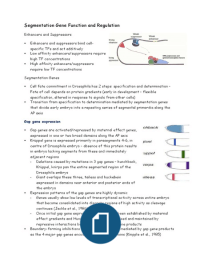
Gap gene expression
Gap genes are activated/repressed by maternal effect genes,
expressed in one or two broad domains along the AP axis
Krüppel gene is expressed primarily in parasegments 4-6, in
centre of Drosophila embryo – absence of this protein results
in embryo lacking segments from these and immediately
adjacent regions
- Deletions caused by mutations in 3 gap genes – hunchback,
Krüppel, knirps pan the entire segmented region of the
Drosophila embryo
- Giant overlaps these three, tailess and huckebein
expressed in domains near anterior and posterior ends of
the embryo
Expression patterns of the gap genes are highly dynamic
- Genes usually show low levels of transcriptional activity across entire embryo
that become consolidated into discrete regions of high activity as cleavage
continues (Jackle et al., 1986)
- Once initial gap gene expression patterns have been established by maternal
effect gradients and Hunchback, they are stabilised and maintained by
repressive interactions between different gap gene products
Boundary-forming inhibitions thought to be directly mediated by gap gene products
as the 4 major gap genes encode DNA-binding proteins (Knipple et al., 1985)
, - Major mechanism for stabilisation: strong mutual repression between pairs of
non-adjacent gap genes
- Gene misexpression experiments show that Giant and Kruppel are strong mutual
repressors, as are Hunchback and Knirps (Clyde et al., 2003)
- Eg. if hunchback is absent, posterior domain of knirps expands toward the
anterior; if hunchback is misexpressed in nuclei that normally express knirps,
strong repression is detected
- System of strong mutual repression results in the precise placement of gap
protein domains but permits overlaps between adjacent gap genes
- Quantitative data by Jaeger et al. (2004) also indicated that inhibitory
interactions are unidirectional, with each protein having a strong effect on the
anterior border of repressed genes (may explain the “creeping” of gap gene
expression patterns)
Gap genes regulate pair-rule expression
Each stripe is activated by specific gap gene combination
Primary pair-rule genes: hairy, even-skipped, runt – each is expressed in 7 stripes,
all build striped patterns from scratch, using distinct enhancers and regulatory
mechanisms for each stripe
Enhancers are often modular: control over expression in each stripe is located in a
discrete region of DNA and DNA regions often contain binding sites recognised by
gap proteins – different concentrations of gap proteins determine whether a pair-
rule gene is transcribed
Stripe-specific regulatory elements of even-
skipped
Enhancer composed of modular units arranges
such that each uni regulates a separate stripe
or pair of stripes
For example, even-skipped stripe 2 is
controlled by a 500bp region that is activated
by Bicoid and Hunchback and repressed by
both Giant and Krüppel proteins (Janssens et al.,
2006)
- Anterior border is maintained by repressive
influences from Giant, while posterior border
maintained by Krüppel
- DNase I footprinting showed minimal enhancer
region for this stripe contains 5 binding sites
, for Bicoid, 1 for Hunchback, 3 for Krüppel, 3
for Giant
- Region though to act as a switch that can
directly sense concentrations of proteins to
turn transcription on/off
Importance of enhancer elements can be shown
by genetic and biochemical means
- Mutation in a particular enhancer can delete
its particular stipe and no other
- If a reporter gene (eg. lacZ encoding for β-galactosidase) is fused to one of
the enhancers, reporter gene is expressed only in that particular stripe (Fujioka
et al., 1999)
- Placement of stripes can be altered by deleting the gap genes that regulated
them
Stripe placement is a result of: modular cis-regulatory enhancer elements of pair-
rule genes + trans-regulatory gap gene and maternal gene proteins that bind to the
enhancer sites
Specific promoter regions of the even-skipped
- Once initiated by gap gene proteins,
(eve) gene control specific transcription bands
the transcription pattern of primarly
in the embryo
pair-rule genes becomes stabilised by
interactions among their products Reporter β-galactosidase gene fused to
(Levine and Harding, 1989) different regions of the eve promoter and
- Primary pair-rule genes also from injected into fly oocytes.
context that allows or inhibits Embryos stained for presence of protein
expression of later-acting secondary
pair-rule genes (eg. fushi tarazu (ftz) - Wild-type embryos containing enhancer
region specific for stripe 1, stripe 5 or both
– too many segments)
Early in division cycle 14, ftz mRNA and regions
- Enhancer region for stripes 1 and 5 was
its protein seen throughout segmented
injected into an embryo deficient in giant –
portion of the embryo posterior border of stripe 5 missing
- Proteins from primary pair-rule genes
(Fujioka et al., 1999)
begin to interact with the ftz
enhancer, the ftz gene is repressed in
certain bands of nuclei to create interstripe regions
- Meanwhile, Ftz protein interacts with its own promoter to stimulate more
transcription of ftz where it is already present (Edgar et al., 1986)
8 known pair-rule genes are all expressed in striped patterns, but patterns not
coincident with each other
- Rather, each row of nuclei within a parasegment has its own array of pair-rule
products that disintiguishes it from any other row
Enhancers and Suppressors
Enhancers and suppressors bind cell-
specific TFs and act additively
Low affinity enhancers/suppressors require
high TF concentrations
High affinity enhancers/suppressors
require low TF concentrations
Segmentation Genes
Cell fate commitment in Drosophila has 2 steps: specification and determination –
Fate of cell depends on protein gradients (early in development – flexible
specification, altered in response to signals from other cells)
Transition from specification to determination mediated by segmentation genes
that divide early embryo into a repeating series of segmental primordia along the
AP axis
Gap gene expression
Gap genes are activated/repressed by maternal effect genes,
expressed in one or two broad domains along the AP axis
Krüppel gene is expressed primarily in parasegments 4-6, in
centre of Drosophila embryo – absence of this protein results
in embryo lacking segments from these and immediately
adjacent regions
- Deletions caused by mutations in 3 gap genes – hunchback,
Krüppel, knirps pan the entire segmented region of the
Drosophila embryo
- Giant overlaps these three, tailess and huckebein
expressed in domains near anterior and posterior ends of
the embryo
Expression patterns of the gap genes are highly dynamic
- Genes usually show low levels of transcriptional activity across entire embryo
that become consolidated into discrete regions of high activity as cleavage
continues (Jackle et al., 1986)
- Once initial gap gene expression patterns have been established by maternal
effect gradients and Hunchback, they are stabilised and maintained by
repressive interactions between different gap gene products
Boundary-forming inhibitions thought to be directly mediated by gap gene products
as the 4 major gap genes encode DNA-binding proteins (Knipple et al., 1985)
, - Major mechanism for stabilisation: strong mutual repression between pairs of
non-adjacent gap genes
- Gene misexpression experiments show that Giant and Kruppel are strong mutual
repressors, as are Hunchback and Knirps (Clyde et al., 2003)
- Eg. if hunchback is absent, posterior domain of knirps expands toward the
anterior; if hunchback is misexpressed in nuclei that normally express knirps,
strong repression is detected
- System of strong mutual repression results in the precise placement of gap
protein domains but permits overlaps between adjacent gap genes
- Quantitative data by Jaeger et al. (2004) also indicated that inhibitory
interactions are unidirectional, with each protein having a strong effect on the
anterior border of repressed genes (may explain the “creeping” of gap gene
expression patterns)
Gap genes regulate pair-rule expression
Each stripe is activated by specific gap gene combination
Primary pair-rule genes: hairy, even-skipped, runt – each is expressed in 7 stripes,
all build striped patterns from scratch, using distinct enhancers and regulatory
mechanisms for each stripe
Enhancers are often modular: control over expression in each stripe is located in a
discrete region of DNA and DNA regions often contain binding sites recognised by
gap proteins – different concentrations of gap proteins determine whether a pair-
rule gene is transcribed
Stripe-specific regulatory elements of even-
skipped
Enhancer composed of modular units arranges
such that each uni regulates a separate stripe
or pair of stripes
For example, even-skipped stripe 2 is
controlled by a 500bp region that is activated
by Bicoid and Hunchback and repressed by
both Giant and Krüppel proteins (Janssens et al.,
2006)
- Anterior border is maintained by repressive
influences from Giant, while posterior border
maintained by Krüppel
- DNase I footprinting showed minimal enhancer
region for this stripe contains 5 binding sites
, for Bicoid, 1 for Hunchback, 3 for Krüppel, 3
for Giant
- Region though to act as a switch that can
directly sense concentrations of proteins to
turn transcription on/off
Importance of enhancer elements can be shown
by genetic and biochemical means
- Mutation in a particular enhancer can delete
its particular stipe and no other
- If a reporter gene (eg. lacZ encoding for β-galactosidase) is fused to one of
the enhancers, reporter gene is expressed only in that particular stripe (Fujioka
et al., 1999)
- Placement of stripes can be altered by deleting the gap genes that regulated
them
Stripe placement is a result of: modular cis-regulatory enhancer elements of pair-
rule genes + trans-regulatory gap gene and maternal gene proteins that bind to the
enhancer sites
Specific promoter regions of the even-skipped
- Once initiated by gap gene proteins,
(eve) gene control specific transcription bands
the transcription pattern of primarly
in the embryo
pair-rule genes becomes stabilised by
interactions among their products Reporter β-galactosidase gene fused to
(Levine and Harding, 1989) different regions of the eve promoter and
- Primary pair-rule genes also from injected into fly oocytes.
context that allows or inhibits Embryos stained for presence of protein
expression of later-acting secondary
pair-rule genes (eg. fushi tarazu (ftz) - Wild-type embryos containing enhancer
region specific for stripe 1, stripe 5 or both
– too many segments)
Early in division cycle 14, ftz mRNA and regions
- Enhancer region for stripes 1 and 5 was
its protein seen throughout segmented
injected into an embryo deficient in giant –
portion of the embryo posterior border of stripe 5 missing
- Proteins from primary pair-rule genes
(Fujioka et al., 1999)
begin to interact with the ftz
enhancer, the ftz gene is repressed in
certain bands of nuclei to create interstripe regions
- Meanwhile, Ftz protein interacts with its own promoter to stimulate more
transcription of ftz where it is already present (Edgar et al., 1986)
8 known pair-rule genes are all expressed in striped patterns, but patterns not
coincident with each other
- Rather, each row of nuclei within a parasegment has its own array of pair-rule
products that disintiguishes it from any other row