Phylum Mollusca (Molluscus = soft (Latin))
93,000 described species, 200,000 estimated species, 70,000 known fossils (Brusca
& Brusca, 2003)
Humans have had a historic relationship with molluscs – using them as food, tools,
tribal/cultural decorations
Size range: microscopic, planktonic size to metres (Giant calm Tridacnidae ~1m,
Giant squid Architeuthis up to 20m)
Occupy all major habitats (marine, freshwater, terrestrial) and extreme
environments (deep water and hot vents)
Phylogeny
Mollusca are amongst the earliest
Metazoans known
Late Precambrian (650-540 mya) rocks
contain bilaterally symmetrical, benthic
animals with a univalved shell (Kimberella)
and lots of trace fossils
Although members of seven classes differ
enormously in superficial appearance – all share a fundamental bauplan
*Still have polytomy yet to be resolved
Many initial attempts at classification was a result of shell characters rather than
anatomy, resulting in a convoluted taxonomic history and many synonyms for various
groups
Mollusca related to Annelida in Trochozoa group (of the Spiralia/Lophotrochonzoa)
largely grouped due to the trochophore larval stage (though cephalopods have lost
this –Edgecombe et al., 2011)
Molluscs and annelids are closely related implies molluscs were primitively
segemented coelomates, received some support from recent 18S rDNA gene
sequence data
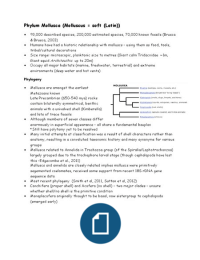
Most recent phylogeny (Smith et al, 2011, Sutton et al, 2012)
Conchifera (proper shell) and Acofera (no shell) – two major clades – unsure
whether shell/no shell is the primitive condition
Monoplacofera originally thought to be basal, now sistergroup to cephalopods
(emerged early)
,Bauplan + Characteristics (Harrison et al., 1994)
1. Embryogeny typically protostomous ,
with spiral cleavage and one/2
trochophore larval stages
Fertilisation may be
external/internal
Embryonic development affects
shell pattern (eg. snail Limnaea (check genetics textbook)
Veliger larvae (unique to certain molluscs) possess sensory organs and produce
a small shell (evolution of metamorphosis
2. Bilaterally symmetrical, coelomate protostomes but coelom generally exists only as
vestiges around the heart (pericardial
chamber), the gonads, parts of the nephridia
(kidney) and occasionally part of the intestine
(perivisceral coelom)
Principal body cavity = haemocoel
composed of several large sinuses of the
open circulatory system (heart + few
large vessels)
Body consists of 3 distinguishable regions
Head: may bear various sensory structures eg. eyes, statocysts, tentacles
Ventral foot: locomotion
Dorsal central visceral mass
3. Body is covered by thick epidermal-cuticular sheet of skin (mantle/pallium) which
plays critical role in body organisation
Secretes hard calcareous skeleton either as
minute sclerites/plastes embedded in the body
wall or as solid internal/external shell
All molluscs have solid calcareous (aragonite or
calcite) shell except Aplacophora – vary greatly
in shape and size correlated to specific
behaviour/habitat eg. shells wi th low spires are
more stable in areas of heavy wave
shock/vertical rock surfaces, heavy ribbing in bivalves may protect from
predators
Molluscs can have 1, 2, 8 or 0 shells, Nacreous layers lost in many groups
Shell colour patterns and sculpturing – evolutionary origin and function not
really known – some view molluscan pigments as metabolic by-products eg.
prophyrins, pyrroles (source?)
Highly muscular; grows during development to form 1 or 2 folds
, 4. Surrounding or posterior to visceral mass is the mantle cavity – space between
visceral mass and folds of mantle itself
Functions as a respiratory chamber
Houses the gills (ctenidia), openings of the
gut, nephridial systems (anus) and opening
of the reproductive system, special patches
of sensory epithelium (osphradia)
In aquatic forms, water is circulated
through this cavity, passing over ctenidia,
excretory pores, anus etc.
Both the mantle and mantle can vary enormously in shape, position and structure
In bivalves, it is usually part of the feeding structure
In cephalopods and some bivalves (scallops) function as locomotion organs
Gastropods have reduced mantle cavity
5. Molluscan gut is complete and regionally specialised with associated glands and well
distinct ceca
Buccal region of foregut bears unique molluscan
structure radula
Ribbon of recurved chitinous teeth supported by a
muscular structure (odnotophore)
Radula is generally used for feeding, functions as a
scraper – specialised depending on diet (example?)
Teeth are constantly produced by odontoblasts
Number and arrangement of the teeth is a
taxonomic character
Excretory system consists of one or more pairs of
large complex kidneys (metanephridia)
6. Nervous system typically includes a dorsal cerebral ganglion, cirumenteric nerve
ring, two pairs of longitudinal ladder-like nerve cords, several paired ganglia showing
various degrees of fusion
The Classes
Bivalvia
Mantle cavity contains pair of very large
gills used to capture food particles suspended in inhalant water current
93,000 described species, 200,000 estimated species, 70,000 known fossils (Brusca
& Brusca, 2003)
Humans have had a historic relationship with molluscs – using them as food, tools,
tribal/cultural decorations
Size range: microscopic, planktonic size to metres (Giant calm Tridacnidae ~1m,
Giant squid Architeuthis up to 20m)
Occupy all major habitats (marine, freshwater, terrestrial) and extreme
environments (deep water and hot vents)
Phylogeny
Mollusca are amongst the earliest
Metazoans known
Late Precambrian (650-540 mya) rocks
contain bilaterally symmetrical, benthic
animals with a univalved shell (Kimberella)
and lots of trace fossils
Although members of seven classes differ
enormously in superficial appearance – all share a fundamental bauplan
*Still have polytomy yet to be resolved
Many initial attempts at classification was a result of shell characters rather than
anatomy, resulting in a convoluted taxonomic history and many synonyms for various
groups
Mollusca related to Annelida in Trochozoa group (of the Spiralia/Lophotrochonzoa)
largely grouped due to the trochophore larval stage (though cephalopods have lost
this –Edgecombe et al., 2011)
Molluscs and annelids are closely related implies molluscs were primitively
segemented coelomates, received some support from recent 18S rDNA gene
sequence data
Most recent phylogeny (Smith et al, 2011, Sutton et al, 2012)
Conchifera (proper shell) and Acofera (no shell) – two major clades – unsure
whether shell/no shell is the primitive condition
Monoplacofera originally thought to be basal, now sistergroup to cephalopods
(emerged early)
,Bauplan + Characteristics (Harrison et al., 1994)
1. Embryogeny typically protostomous ,
with spiral cleavage and one/2
trochophore larval stages
Fertilisation may be
external/internal
Embryonic development affects
shell pattern (eg. snail Limnaea (check genetics textbook)
Veliger larvae (unique to certain molluscs) possess sensory organs and produce
a small shell (evolution of metamorphosis
2. Bilaterally symmetrical, coelomate protostomes but coelom generally exists only as
vestiges around the heart (pericardial
chamber), the gonads, parts of the nephridia
(kidney) and occasionally part of the intestine
(perivisceral coelom)
Principal body cavity = haemocoel
composed of several large sinuses of the
open circulatory system (heart + few
large vessels)
Body consists of 3 distinguishable regions
Head: may bear various sensory structures eg. eyes, statocysts, tentacles
Ventral foot: locomotion
Dorsal central visceral mass
3. Body is covered by thick epidermal-cuticular sheet of skin (mantle/pallium) which
plays critical role in body organisation
Secretes hard calcareous skeleton either as
minute sclerites/plastes embedded in the body
wall or as solid internal/external shell
All molluscs have solid calcareous (aragonite or
calcite) shell except Aplacophora – vary greatly
in shape and size correlated to specific
behaviour/habitat eg. shells wi th low spires are
more stable in areas of heavy wave
shock/vertical rock surfaces, heavy ribbing in bivalves may protect from
predators
Molluscs can have 1, 2, 8 or 0 shells, Nacreous layers lost in many groups
Shell colour patterns and sculpturing – evolutionary origin and function not
really known – some view molluscan pigments as metabolic by-products eg.
prophyrins, pyrroles (source?)
Highly muscular; grows during development to form 1 or 2 folds
, 4. Surrounding or posterior to visceral mass is the mantle cavity – space between
visceral mass and folds of mantle itself
Functions as a respiratory chamber
Houses the gills (ctenidia), openings of the
gut, nephridial systems (anus) and opening
of the reproductive system, special patches
of sensory epithelium (osphradia)
In aquatic forms, water is circulated
through this cavity, passing over ctenidia,
excretory pores, anus etc.
Both the mantle and mantle can vary enormously in shape, position and structure
In bivalves, it is usually part of the feeding structure
In cephalopods and some bivalves (scallops) function as locomotion organs
Gastropods have reduced mantle cavity
5. Molluscan gut is complete and regionally specialised with associated glands and well
distinct ceca
Buccal region of foregut bears unique molluscan
structure radula
Ribbon of recurved chitinous teeth supported by a
muscular structure (odnotophore)
Radula is generally used for feeding, functions as a
scraper – specialised depending on diet (example?)
Teeth are constantly produced by odontoblasts
Number and arrangement of the teeth is a
taxonomic character
Excretory system consists of one or more pairs of
large complex kidneys (metanephridia)
6. Nervous system typically includes a dorsal cerebral ganglion, cirumenteric nerve
ring, two pairs of longitudinal ladder-like nerve cords, several paired ganglia showing
various degrees of fusion
The Classes
Bivalvia
Mantle cavity contains pair of very large
gills used to capture food particles suspended in inhalant water current