Phylum Cnidaria (Corals)
Coral – has no formal taxonomic meaning/no strict evolutionary or phylogenetic
meaning (found in ancient mythology)
Largely used to day to refer to a group of cnidarians that possess skeletons (a
grade of cnidarians, not a clade)
Jellyfish, Anemones, Corals/ hydra – 11,000 extant species
Cnidarians have longest fossil histories around 600 Mya
Belongs to Phylum Coelenterata, Subphylum Cnidaria
With two layers of cells
Outer layer=ectoderm or epidermis
Inner layer = endoderm or gastrodermis
No mesoderm, hence no organs
Between two layers is jelly-like mesoglea
Layers are true tissues – coelenterates are simplest organisms at tissue grade of
organisation
General Characteristics
Tendency to form colonies by asexual reproduction
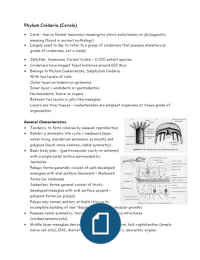
Exhibit a dimorphic life cycle = medusoid (open
water living, manubrium extension as mouth) and
polypoid (much more common, radial symmetry)
Basic body plan – (gastrovascular cavity or enteron)
with a single (oral) orifice surrounded by
tentacles
Pelagic forms generally consist of well-developed
mesoglea with oral surface downward – Medusoid
forms (ie. medusae)
Sedentary forms general consist of thinly-
developed mesoglea with oral surface upward –
polypoid forms (ie. polyps)
Polyps may remain solitary or build colonies by
incomplete building of new “daughter polyps (eg. modular growth)
Possess radial symmetry, tentacles, stinging/adhesive structures
(cnidae/nematocysts)
Middle layer mesoglea derived primarily from ectoderm, lack cephalisation (simple
nerve net only), CNS, discrete respiratory, circulatory, excretory organs
, Reproduction: alternation of generations : asexual polyp stage and sexual medusoid
stage
At certain times of year medusa produced by repeated transverse fission by
monodisc/polydisc strobilation
Essence of cnidarian bauplan is radial symmetry – associated with various
architectural and strategic constraints: cnidarians are either sessile, sedentary or
pelagic – do not engage in the active unidirectional movement seen in bilateral,
cephalised creatures – typically find a ring of tentacles that can collect food from
any direction and a diffuse noncentralised nerve net with radially distributed sense
organs
In spite of limitations of a diploblastic, radially symmetrical bauplan, cnidarians are
a very successful and diverse group – much of their success has resulted from the
apparent evolutionary plasticity of their dimorphic life histories, alternation
between polypoid and medusoid phases
Polyps and medusa are variations of the basic cnidarian bauplan – two stages are
different ecologically, presence in a single life history allows an individual species to
exploit different environments and resources – dimorphic life cycle is unique to
Cnidaria
Nematocysts or Cnidoblastes – unique stinging cells, prey capture, defence,
attachment, intrinsic cell specialisation
Cnidarian nerve net – simple nerve net in the single polyp of a hydra – lacks a
centralised structure
Phylogeny
Anthozoa – includes corals and anemones (no medusoid
stage in life cycles)
Medusozoa – includes jellyfish and hydroids –
medusoid stage in life cycles predominant
Scyphozoa – true jellyfish
Staurozoa- stalked jellyfish
Cubozoa – box jellyfish, sea wasps
Hydrozoa – includes hydroids, hydra-like animals and
siphonophores
Uncertain cnidarian position – parasitic groups perhaps closest to hydrozoans
Myxozoa – 1200 species of tiny parasites, previously classified among the protists –
morphological data, 18S ribosomal gene sequences, presence of HOX genes provide
evidence that ally them with Cnidaria (offshoot hydrozoan order Trachylina) –
, hypothesis: modified nematocysts = coiled polar filaments housed within the polar
capsules – infect annelids and various poikilothermic vertebrates, especially fishes,
nematocysts presumably used for attachment to the host
Polypoidzoa
Anthozoan Body Plan
Anthozoans distinguished by radial internal divisions
of their gastovascular cavity
Sub-group Actinia (sea anemones) have no skeleton
Sub-group Sclearactinia have skeletons of aragonite –
form of calcium carbonate
Body wall skeletalised and radial divisions are
skeletalised as septa
Skeletal elelments correspond closely with polyp plan
Skeletal part of body plan is a corallite
Colonial Corals and Implications of modular growth
Colonies grow by cloning of the coral polyp together with its skeleton
Clones retained as adjoined neighbours (clonoteny)
Cloning within colonies can take place from within the polyp wall (intratentacular) or
outside the polyp wall (extratentacular) – each retained clone can be considered as
a module of colonial growth
Basic unit of colonial (modular growth) in scleractinians is the polyp + corallite =
zooid
Clonoteny makes it possible for zooids to have different forms and functions
Colony growth and form can be analysed as a function of population dynamics of a
colony’s zooids (zooid demography)
Clonopary generates ramets (shed clones) belonging to a single genotype (ie. genet)
Cloning (clonoteny or clonopary) makes possible extreme longevity or immortality of
genets
Modularity = great plasticity of colony shape in response to environmental factors
Within species, colonies can show differential growth
Sexual reproduction external fertilisation mass spawning of eggs and sperm
(some hermaphroiditic bundles)
Nutrition, Photosymbiosis, Mutualism
A. Heterotrophy
- Corals carnivorous
Coral – has no formal taxonomic meaning/no strict evolutionary or phylogenetic
meaning (found in ancient mythology)
Largely used to day to refer to a group of cnidarians that possess skeletons (a
grade of cnidarians, not a clade)
Jellyfish, Anemones, Corals/ hydra – 11,000 extant species
Cnidarians have longest fossil histories around 600 Mya
Belongs to Phylum Coelenterata, Subphylum Cnidaria
With two layers of cells
Outer layer=ectoderm or epidermis
Inner layer = endoderm or gastrodermis
No mesoderm, hence no organs
Between two layers is jelly-like mesoglea
Layers are true tissues – coelenterates are simplest organisms at tissue grade of
organisation
General Characteristics
Tendency to form colonies by asexual reproduction
Exhibit a dimorphic life cycle = medusoid (open
water living, manubrium extension as mouth) and
polypoid (much more common, radial symmetry)
Basic body plan – (gastrovascular cavity or enteron)
with a single (oral) orifice surrounded by
tentacles
Pelagic forms generally consist of well-developed
mesoglea with oral surface downward – Medusoid
forms (ie. medusae)
Sedentary forms general consist of thinly-
developed mesoglea with oral surface upward –
polypoid forms (ie. polyps)
Polyps may remain solitary or build colonies by
incomplete building of new “daughter polyps (eg. modular growth)
Possess radial symmetry, tentacles, stinging/adhesive structures
(cnidae/nematocysts)
Middle layer mesoglea derived primarily from ectoderm, lack cephalisation (simple
nerve net only), CNS, discrete respiratory, circulatory, excretory organs
, Reproduction: alternation of generations : asexual polyp stage and sexual medusoid
stage
At certain times of year medusa produced by repeated transverse fission by
monodisc/polydisc strobilation
Essence of cnidarian bauplan is radial symmetry – associated with various
architectural and strategic constraints: cnidarians are either sessile, sedentary or
pelagic – do not engage in the active unidirectional movement seen in bilateral,
cephalised creatures – typically find a ring of tentacles that can collect food from
any direction and a diffuse noncentralised nerve net with radially distributed sense
organs
In spite of limitations of a diploblastic, radially symmetrical bauplan, cnidarians are
a very successful and diverse group – much of their success has resulted from the
apparent evolutionary plasticity of their dimorphic life histories, alternation
between polypoid and medusoid phases
Polyps and medusa are variations of the basic cnidarian bauplan – two stages are
different ecologically, presence in a single life history allows an individual species to
exploit different environments and resources – dimorphic life cycle is unique to
Cnidaria
Nematocysts or Cnidoblastes – unique stinging cells, prey capture, defence,
attachment, intrinsic cell specialisation
Cnidarian nerve net – simple nerve net in the single polyp of a hydra – lacks a
centralised structure
Phylogeny
Anthozoa – includes corals and anemones (no medusoid
stage in life cycles)
Medusozoa – includes jellyfish and hydroids –
medusoid stage in life cycles predominant
Scyphozoa – true jellyfish
Staurozoa- stalked jellyfish
Cubozoa – box jellyfish, sea wasps
Hydrozoa – includes hydroids, hydra-like animals and
siphonophores
Uncertain cnidarian position – parasitic groups perhaps closest to hydrozoans
Myxozoa – 1200 species of tiny parasites, previously classified among the protists –
morphological data, 18S ribosomal gene sequences, presence of HOX genes provide
evidence that ally them with Cnidaria (offshoot hydrozoan order Trachylina) –
, hypothesis: modified nematocysts = coiled polar filaments housed within the polar
capsules – infect annelids and various poikilothermic vertebrates, especially fishes,
nematocysts presumably used for attachment to the host
Polypoidzoa
Anthozoan Body Plan
Anthozoans distinguished by radial internal divisions
of their gastovascular cavity
Sub-group Actinia (sea anemones) have no skeleton
Sub-group Sclearactinia have skeletons of aragonite –
form of calcium carbonate
Body wall skeletalised and radial divisions are
skeletalised as septa
Skeletal elelments correspond closely with polyp plan
Skeletal part of body plan is a corallite
Colonial Corals and Implications of modular growth
Colonies grow by cloning of the coral polyp together with its skeleton
Clones retained as adjoined neighbours (clonoteny)
Cloning within colonies can take place from within the polyp wall (intratentacular) or
outside the polyp wall (extratentacular) – each retained clone can be considered as
a module of colonial growth
Basic unit of colonial (modular growth) in scleractinians is the polyp + corallite =
zooid
Clonoteny makes it possible for zooids to have different forms and functions
Colony growth and form can be analysed as a function of population dynamics of a
colony’s zooids (zooid demography)
Clonopary generates ramets (shed clones) belonging to a single genotype (ie. genet)
Cloning (clonoteny or clonopary) makes possible extreme longevity or immortality of
genets
Modularity = great plasticity of colony shape in response to environmental factors
Within species, colonies can show differential growth
Sexual reproduction external fertilisation mass spawning of eggs and sperm
(some hermaphroiditic bundles)
Nutrition, Photosymbiosis, Mutualism
A. Heterotrophy
- Corals carnivorous