Arthopod Phylogeny
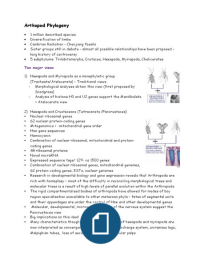
1 million described species
Diversification of limbs
Cambrian Radiation – Chenjiang fossils
Sister groups still in debate – almost all possible relationships have been proposed –
long history of controversy
5 subphylums: Trilobitomorpha, Crutacea, Hexapoda, Myriapoda, Chelicerates
Two major views
1) Hexapods and Myriapods as a monophyletic group
(Tracheata/Atelocerata) – Traditional views
- Morphological analyses obtain this view (first proposed by
Snodgrass)
- Analysis of histone H3 and U2 genes support the Mandibulata
+ Atelocerata view
2) Hexapods and Crustaceans (Tetraconata /Pancrustacea)
Nuclear ribosomal genes
62 nuclear protein-coding genes
Mitogenomics + mitochondrial gene order
Hox gene sequences
Hemocyanin
Combination of nuclear ribosomal, mitochondrial and protein-
coding genes
48 ribosomal proteins
Novel microRNA
Expressed sequence tags/ 129- ca 1500 genes
Combination of nuclear ribosomal genes, mitochondrial genomes,
62 protein-coding genes, ESTs, nuclear genomes
Research in developmental biology and gene expression reveals that Arthropoda are
rich with homoplasy – most of the difficulty in reconciling morphological trees and
molecular trees is a result of high levels of parallel evolution within the Arthropoda
The rigid compartmentalised bodies of arthropods have allowed for modes of boy
region specialisation unavailable to other metazoan phyla – fates of segmental units
and their appendages are under the control of Hox and other developmental genes
Molecular, developmental, microscopic anatomy of the nervous system suggest the
Pancrustacea view
Big implications on this idea!
Many characteristics thought to be synapomorphies of hexapods and myriapods are
now interpreted as convergences (eg. Tracheal gas exchange system, uniramous legs,
Malpighian tubes, loss of second antennae + mandibular palps
, Crustacea are paraphyletic and that hexapods are derived lineages emerging out of
a crustaceamorph stem line (insects are flying crustacean, just as birds are flying
reptiles
(Brusca and Brusca…)
Emerging Views of Arthropod Relationships
Phylogenetic studies of the arthropods have a long history of controversy – 5
principal competing hypotheses of arthropod phylogeny
All modern analyses agree that arthropods are a monphyletic taxon
Morphological analyses obtain Snodgrass view of relationships – retaining the
traditional groupings of Atelocerata and Mandibulata, often combing triolobites
and chelicerates in a clade
- An analysis of sequences from histone H3 and U2 genes (Edgecombe et al., 2000)
Fossils included into analysis, different results arise – Crustacea tend to arise at
the very base of the arthropod tree as a paraphyletic sequence of taxa from which
other subphyla emerge
- Molecular phylogenetic studies from at least 5 nuclear genes, as well as
mitochondrial gene arrangements support this view, agree that hexapods are not
the sister group to the myriapods but are most closely related to crustacenas
Developmental studies and gene expression – Arthropoda are rich with homoplasy,
difficult to reconcile morphological and molecular trees is a result of high levels of
parallel evolution
- Rigid compartmentalisation and arthropods allowed for modes of body region
specialisation unavailable to other metazoan phyla
- Under control of Hox and developmental genes – genes select critical
developmental pathways to be followed by groups of cells duriong morphogenesis
- Hox genes can either suppress limb development or modify to create alternative
morphologies
- Eg. Pax-6 dictate location of eyes in all animal phyla (protostomes,
deuterostomes)
Neurological Features
, Suggest hexapoda more closely related to Crustacea than Myriapoda – provide
evidenc that hexapoda arose from within Crustacea
Compound eyes in hexapods and crustaceans: each ommatidium consists of a
cuticular corneal lens is secreted by two cells (Hexapoda=primary pigment cells,
Crustacean: corneagen cells
Common anatomical plan constitutes strong evidence for of a close relationship
tetraconata
As early as 1998 – Strausfeld developed phylogeny of Arthropoda based on 100
anatomical features of cerebral ganglia
Development of CNS: CNS begins with the delamination of enlarged cells
(neuroblasts) from the neuroectoderm – neuroblasts aggregate to form the
segmental ganglia – no stem cell neuroblasts identified in myriapods
- So r 29 -31 neuroblasts identified in each segment of hexapods and 25-30 in
crustacean segments, many of which appear to be homologous between the 2
subsubphyla
Molecular phylogenetics
Analyses (many) on 18S ribosomal DNA – gene is problematic as it gives bizarre
results
Recent studies with 12SrDNA, 28srDNA, elongation factor-1a ,(EF-1a) and ubiquitin
have all corroborated the 18S rDNA results for within-arthropod relationshops
Linear arrangement of mitochondrial genes by JL Boore also support Hexapoda and
Crustacea sister-group relationship through finding unique gene arrangments
Mandibulata or Paradoxopoda?
Mandibles: post-tritocerebral appendage main
mouthpart of adult head, embedded in chewing
chamber between labrum and hypopharynx
DACHSHUND Expression
Mite Hox genes at head line up with fangs of
chelicerates
Paradoxapoda group thought to arise due to
systematic error
1 million described species
Diversification of limbs
Cambrian Radiation – Chenjiang fossils
Sister groups still in debate – almost all possible relationships have been proposed –
long history of controversy
5 subphylums: Trilobitomorpha, Crutacea, Hexapoda, Myriapoda, Chelicerates
Two major views
1) Hexapods and Myriapods as a monophyletic group
(Tracheata/Atelocerata) – Traditional views
- Morphological analyses obtain this view (first proposed by
Snodgrass)
- Analysis of histone H3 and U2 genes support the Mandibulata
+ Atelocerata view
2) Hexapods and Crustaceans (Tetraconata /Pancrustacea)
Nuclear ribosomal genes
62 nuclear protein-coding genes
Mitogenomics + mitochondrial gene order
Hox gene sequences
Hemocyanin
Combination of nuclear ribosomal, mitochondrial and protein-
coding genes
48 ribosomal proteins
Novel microRNA
Expressed sequence tags/ 129- ca 1500 genes
Combination of nuclear ribosomal genes, mitochondrial genomes,
62 protein-coding genes, ESTs, nuclear genomes
Research in developmental biology and gene expression reveals that Arthropoda are
rich with homoplasy – most of the difficulty in reconciling morphological trees and
molecular trees is a result of high levels of parallel evolution within the Arthropoda
The rigid compartmentalised bodies of arthropods have allowed for modes of boy
region specialisation unavailable to other metazoan phyla – fates of segmental units
and their appendages are under the control of Hox and other developmental genes
Molecular, developmental, microscopic anatomy of the nervous system suggest the
Pancrustacea view
Big implications on this idea!
Many characteristics thought to be synapomorphies of hexapods and myriapods are
now interpreted as convergences (eg. Tracheal gas exchange system, uniramous legs,
Malpighian tubes, loss of second antennae + mandibular palps
, Crustacea are paraphyletic and that hexapods are derived lineages emerging out of
a crustaceamorph stem line (insects are flying crustacean, just as birds are flying
reptiles
(Brusca and Brusca…)
Emerging Views of Arthropod Relationships
Phylogenetic studies of the arthropods have a long history of controversy – 5
principal competing hypotheses of arthropod phylogeny
All modern analyses agree that arthropods are a monphyletic taxon
Morphological analyses obtain Snodgrass view of relationships – retaining the
traditional groupings of Atelocerata and Mandibulata, often combing triolobites
and chelicerates in a clade
- An analysis of sequences from histone H3 and U2 genes (Edgecombe et al., 2000)
Fossils included into analysis, different results arise – Crustacea tend to arise at
the very base of the arthropod tree as a paraphyletic sequence of taxa from which
other subphyla emerge
- Molecular phylogenetic studies from at least 5 nuclear genes, as well as
mitochondrial gene arrangements support this view, agree that hexapods are not
the sister group to the myriapods but are most closely related to crustacenas
Developmental studies and gene expression – Arthropoda are rich with homoplasy,
difficult to reconcile morphological and molecular trees is a result of high levels of
parallel evolution
- Rigid compartmentalisation and arthropods allowed for modes of body region
specialisation unavailable to other metazoan phyla
- Under control of Hox and developmental genes – genes select critical
developmental pathways to be followed by groups of cells duriong morphogenesis
- Hox genes can either suppress limb development or modify to create alternative
morphologies
- Eg. Pax-6 dictate location of eyes in all animal phyla (protostomes,
deuterostomes)
Neurological Features
, Suggest hexapoda more closely related to Crustacea than Myriapoda – provide
evidenc that hexapoda arose from within Crustacea
Compound eyes in hexapods and crustaceans: each ommatidium consists of a
cuticular corneal lens is secreted by two cells (Hexapoda=primary pigment cells,
Crustacean: corneagen cells
Common anatomical plan constitutes strong evidence for of a close relationship
tetraconata
As early as 1998 – Strausfeld developed phylogeny of Arthropoda based on 100
anatomical features of cerebral ganglia
Development of CNS: CNS begins with the delamination of enlarged cells
(neuroblasts) from the neuroectoderm – neuroblasts aggregate to form the
segmental ganglia – no stem cell neuroblasts identified in myriapods
- So r 29 -31 neuroblasts identified in each segment of hexapods and 25-30 in
crustacean segments, many of which appear to be homologous between the 2
subsubphyla
Molecular phylogenetics
Analyses (many) on 18S ribosomal DNA – gene is problematic as it gives bizarre
results
Recent studies with 12SrDNA, 28srDNA, elongation factor-1a ,(EF-1a) and ubiquitin
have all corroborated the 18S rDNA results for within-arthropod relationshops
Linear arrangement of mitochondrial genes by JL Boore also support Hexapoda and
Crustacea sister-group relationship through finding unique gene arrangments
Mandibulata or Paradoxopoda?
Mandibles: post-tritocerebral appendage main
mouthpart of adult head, embedded in chewing
chamber between labrum and hypopharynx
DACHSHUND Expression
Mite Hox genes at head line up with fangs of
chelicerates
Paradoxapoda group thought to arise due to
systematic error