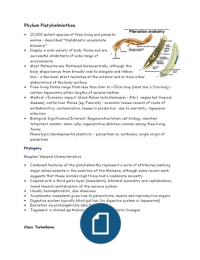
Phylum Platyhelminthes
20,000 extant species of free-living and parasitic
worms – described “triploblastic acoelomate
bilateria”
Display a wide variety of body forms and are
successful inhabitants of wide range of
environments
Most flatworms are flattened dorsoventrally, although the
body shape baries from broadly oval to elongate and ribbon-
like – a few bear short tentacles at the anterior end or have other
elaborations of the body surface
Free-living forms range from less than 1mm to ~30cm long (most are 1-3cm long) –
certain tapeworms attain lengths of several metres
Medical + Economic impact: blood flukes (schistomiasis) – (No.1 neglected tropical
disease), cattle liver flukes (eg. Fasciola) – economic losses consist of costs of
anthelminitics, contamination, losses in production due to mortality, tapeworm
infection
Biological Significance/Interest: Regeneration/stem cell biology, maintain
totipotent somatic stem cells, regenerative abilities common among free-living
forms
Phenotypic/developmental plasticity – parasitism vs. symbiosis, single origin of
parasitism
Phylogeny
Bauplan/ General Characteristics
Combined features of the platyhelminths represent a suite of attributes marking
major advancements in the evolution of the Metazoa, although some recent work
suggests that these animals might have had a coelomate ancestry
Coupled with a third germ layer (mesoderm), bilateral symmetry and cephalisation,
trend toward centralisation of the nervous system
Usually hermaphroditic, also dioecious
Acoelomate: mesoderm gives rise to parenchyma, muscle and reproductive organs
Digestive system typically blind gut/sac (no digestive system in tapeworms)
Excretion via protonephridia (aka flame cells)
Tegument: a ciliated epithelium, except in the parasitic lineages
Class Turbellaria
, Planarian worms – model organism of regeneration research
Morphogenic signalling
- Wnt signalling, APC, β-catenin
- β-catenin cell-signalling pathway very common in the animal kingdom: knowck
down β-catenin, loss of anterior-posterior identification
- Normal worm become hypercephalised – grows new heads
Flatworm “neoblast” – (ie. somatic stem cell)
- Unusual in maintaining somatic stem cells scattered
throughout the parenchyma throughout their lives
- Each cell division results in one new stem cell and one
differentiated cell
- The ability and degree of regeneration differs among
groups (parasitic groups have no regenerative abilities)
- Macrostomum lignano – new model flatworm for research
The Parasitic Worms (Neodermata = Trematoda + Monogenea + Cestoda)
Evolutionary Adaptations
Evading the host immune system (parasites tend to be host specific)
Massively increased reproductive output – extreme R-strategists: most effort in
producing large numbers of offspring, little in rearing them and 95% body mass
devoted to reproductive organs
First vertebrate hosts most likely to be fish
Formation of the neodermis
Digenea (flukes)
~18 000 species
Most diverse group of flatworms
Primarily enteric (intestinal) parasites of all vertebrate groups
Have major medical and economic importance
Highly complex life cycles involving 3-5 hosts
First host almost always a snail, less frequently bivalves, scaphopods and annelids
Both active and passive transmission strategies
Human bloodflukes – Schistosoma masoni
Causes Schistosomiasis/Biharziasis
, Dioecious –separate sexes
Blood dwelling
Life cycle
- Begins with miracidia (free-swimming/active penetration)
– Sporocyst (intra-mulloscan)
– Cercaria (free swimming/active penetration)
– Schistosomula (juvenile worm/active penetration)
Cestoda (tapeworms)
~9000 species
Have no gut/mouth- obtain
nutrients via absorption across the
tegument
Majority are segmented or
strobilated
Increase reproductive output via
repetition of reproductive organs
Enteric parasites of all major vertebrate groups
Have complex life cycles usually involving arthropod – 1st intermediate host
First host almost always snail, less frequently bivalves, scaphopods, annelids
Tapeworm infections most serious when humans play role of the intermediate host
(Taenia sollium causing neurocysticerocosis. Echinococcus multilocularis causing
hyatid disease)
Broad-fish tapeworm (Diphyllobothrium latum)
Monogenea
20,000 extant species of free-living and parasitic
worms – described “triploblastic acoelomate
bilateria”
Display a wide variety of body forms and are
successful inhabitants of wide range of
environments
Most flatworms are flattened dorsoventrally, although the
body shape baries from broadly oval to elongate and ribbon-
like – a few bear short tentacles at the anterior end or have other
elaborations of the body surface
Free-living forms range from less than 1mm to ~30cm long (most are 1-3cm long) –
certain tapeworms attain lengths of several metres
Medical + Economic impact: blood flukes (schistomiasis) – (No.1 neglected tropical
disease), cattle liver flukes (eg. Fasciola) – economic losses consist of costs of
anthelminitics, contamination, losses in production due to mortality, tapeworm
infection
Biological Significance/Interest: Regeneration/stem cell biology, maintain
totipotent somatic stem cells, regenerative abilities common among free-living
forms
Phenotypic/developmental plasticity – parasitism vs. symbiosis, single origin of
parasitism
Phylogeny
Bauplan/ General Characteristics
Combined features of the platyhelminths represent a suite of attributes marking
major advancements in the evolution of the Metazoa, although some recent work
suggests that these animals might have had a coelomate ancestry
Coupled with a third germ layer (mesoderm), bilateral symmetry and cephalisation,
trend toward centralisation of the nervous system
Usually hermaphroditic, also dioecious
Acoelomate: mesoderm gives rise to parenchyma, muscle and reproductive organs
Digestive system typically blind gut/sac (no digestive system in tapeworms)
Excretion via protonephridia (aka flame cells)
Tegument: a ciliated epithelium, except in the parasitic lineages
Class Turbellaria
, Planarian worms – model organism of regeneration research
Morphogenic signalling
- Wnt signalling, APC, β-catenin
- β-catenin cell-signalling pathway very common in the animal kingdom: knowck
down β-catenin, loss of anterior-posterior identification
- Normal worm become hypercephalised – grows new heads
Flatworm “neoblast” – (ie. somatic stem cell)
- Unusual in maintaining somatic stem cells scattered
throughout the parenchyma throughout their lives
- Each cell division results in one new stem cell and one
differentiated cell
- The ability and degree of regeneration differs among
groups (parasitic groups have no regenerative abilities)
- Macrostomum lignano – new model flatworm for research
The Parasitic Worms (Neodermata = Trematoda + Monogenea + Cestoda)
Evolutionary Adaptations
Evading the host immune system (parasites tend to be host specific)
Massively increased reproductive output – extreme R-strategists: most effort in
producing large numbers of offspring, little in rearing them and 95% body mass
devoted to reproductive organs
First vertebrate hosts most likely to be fish
Formation of the neodermis
Digenea (flukes)
~18 000 species
Most diverse group of flatworms
Primarily enteric (intestinal) parasites of all vertebrate groups
Have major medical and economic importance
Highly complex life cycles involving 3-5 hosts
First host almost always a snail, less frequently bivalves, scaphopods and annelids
Both active and passive transmission strategies
Human bloodflukes – Schistosoma masoni
Causes Schistosomiasis/Biharziasis
, Dioecious –separate sexes
Blood dwelling
Life cycle
- Begins with miracidia (free-swimming/active penetration)
– Sporocyst (intra-mulloscan)
– Cercaria (free swimming/active penetration)
– Schistosomula (juvenile worm/active penetration)
Cestoda (tapeworms)
~9000 species
Have no gut/mouth- obtain
nutrients via absorption across the
tegument
Majority are segmented or
strobilated
Increase reproductive output via
repetition of reproductive organs
Enteric parasites of all major vertebrate groups
Have complex life cycles usually involving arthropod – 1st intermediate host
First host almost always snail, less frequently bivalves, scaphopods, annelids
Tapeworm infections most serious when humans play role of the intermediate host
(Taenia sollium causing neurocysticerocosis. Echinococcus multilocularis causing
hyatid disease)
Broad-fish tapeworm (Diphyllobothrium latum)
Monogenea