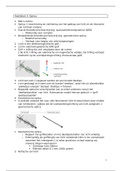
Evolution of C4 Photosynthesis
C3 photosynthesis is inefficient Rubisco evolved
when CO2 was very high and oxygen levels are very
low, not very adapted to modern day conditions
- Rubisco can catalyse an oxygenase reaction as
well as an carboxylase reaction (oxygenase
reaction can dominate carboxylase reaction, so
carbon is not fixed)
- Photorespiration (counters photosynthesis and produces carbon dioxide)
- This happens as CO2 concentration is low = 400ppm
- Considerable loss – under normal conditions: ~20=25% fixed in photosynthesis is
lost in photorespiration
Photorespiration is increased when leaf CO2 concentration is low (drought stress,
stomatal closure – oxygen and carbon dioxide are competitive susbstrates),
temperature is high (promiscuous enzyme –
specificity of Rubisco of carbon dioxide decreases,
also relative solubility of gases oxygen is more
soluble than CO2)
Photorespiration is suppressed in C4 plants
C4 plants: maize (Poaceae), sorghum (poaceae),
Amaranth (Amaranthaceae) – narrow, long leaves,
parallel veins in monocots and dicots (though
majority are C3 plants)
While C3 plants (during the light independent
stage of photosynthesis) – CO2 and RuBP combine
to form a 3 carbon compound, which splits to form 2 x 3C
C4 plants – the first compound produced in light independent stage is a 4 carbon
compounds
1. Bundle sheath cells contain Rubisco and RuBP and have no direct contact with air
inside the leaf – rubisco localised to a distinct cell layer between mesophyll and
vascular bundles (C4 photosynthesis metabolically concentrates CO2 from the
intercellular air spaces of a leaf into an internal compartment where primary
CO2-fixing enzyme RuBisCo is localised)
- BS proper is one of a number of cell layers modified to hold rubisco and
decarboxylating enzymes, reactons of C3 metabolic cycle
- Mestome sheath cells for example are non-BS cells that serve as the site of
CO2 concentration in certain C4 lineages
2. CO2 is first fixed by PEP carboxylase (= phosphoenolpyruvate carboxylase,
PEPC)
, 3. C4 photosynthesis acts as a CO2 pump
Bundle sheath cells often airtight – carbon dioxide high conc in bundle sheath
cells
C4 plants can be highly productive but is really only productive under specific
conditions
- Favours low CO2 concentrations (Buchanan, Gruissem and Jones, 2000) – at
concs above ~400ppm, C3 plants become more productive – CO2 fixation is much
higher)
- C4 favours high light intensity, higher than C3 (eg. Atriplex rosea C4, Atriplex
triangularis C3) (Krebs, 2001)
- C4 favours high temperatures
Crassulacean Acid Metablism (CAM)
variant of C4
Same biochemical reactions as C4
occurs in Crassula (fleshy, succulent
leaves), Agave, Pineapple, Tillandsia
CAM plants often adapted to
drought or epiphytic (grow on top of
other plants, no contact with soil or
water)
CAM relies on temporal separation, C4 is spatial separation
CO2 fixation occurs at night – PEP carboxylase (PEP
oxaloacetate malate, deprotonated to form acid)
activity , CO2 is stored as malic acid and in the day it
is released, then fixed by Rubisco
Stomata are only open during the night – to prevent
water loss from evapotranspiration, take up CO2,
malate stored in vacuoles
Some can survive for years without water (though at
some point, photosynthesis will stop)
Which environmental conditions are adapted to
C4 plants are mainly located in sub-tropical regions
Many C4 plants are grasses (Edwards et al., 2010)
C4 crops agricultural land is in Africa, South American countries (Leakey, 2009),
US (mostly maize)
, The principle role of the chloroplast is to trap light energy and convert it to chemical
energy in the form of carbohydrates, such as glucose. Multiple photosynthetic
pathways exist, the most common being the C3 pathway, which was the first to
originate 2.5 billion years ago (Bowsher et al., 2008). The first light dependent
reactions involve photosystems absorbing light and synthesising ATP by
photophosphorylation, Reduced NADPH is also produced in this process, which is
brought to the next stage of light independent reactions. The enzyme Rubisco then
converts CO2 via a series of intermediates, the first being glycerate-2-phosphate (C3
pathway). Plants in arid conditions have different metabolic pathways that avoid
photorespiration, a process in which Rubisco catalyses an unfavourable reaction with
O2 or excessive water loss by evapotranspiration. C4 plants contain their chloroplasts
in bundle sheath cells, away from O2, whereas other plants that exercise Crassulacean
acid metabolism convert trapped CO2 as malate at night, then use it for photosynthesis
during the day. Both of these pathways have a shorter history compared to that in C3
plants.
Evolution of this process
C4 photosynthesis occurs in 19 families, at least 4 distinct evolutionary origins in
Poaceae, 6 in the Cyperaceae, 10 lineages in Chenopodiaceae
- 2 origins operates within single cells (62 lineages estimated by Sage)
First evolved in grasses (24-30 million years ago) – molecular clock studies – grass
subfamily Chloridoideae duing mid-Oligocene epoch, later in dicots
- Numerous fossil and isotopic studies demonstrate widespread expansion of C4-
dominated ecosystems began approximately 10 Mya
- Oldest identifiable macrofossils of C4 plant parts date back to 12-15 Mya
Common in Poaceae (grasses), Cyperaceae (sedges), Chenopodiaceae and
Environmental Correlates of C4 Evolution
Carbon starvation hypothesis: proposed that low CO2 was a trigger for C4 evolution
by causing high rates of photorespiration in warm climates, thereby reducing
photosynthetic efficiency of the C3 flora
- 30 million year spread in timing of many C4 origins following the Oligocene CO2
decline now indicates that rather than serving as a trigger, low CO2 was a
precondition for C4 evolution, enabling other factors to play a pivotal role
Factors proposed to operate in concert with low CO2 in promoting C4 evolution
include heat, aridity, high light, salinity, ecological disturbance (fire and grazing by
large mammals) – C4 plants not seen in rainforests
Another approach to addressing environmental conditions that promoted this is to
examine field habitats and microclimates of extant species that branch at the
phylogenetic nodes across which the transition from C3 to C4 photosynthesis occurs
C3 photosynthesis is inefficient Rubisco evolved
when CO2 was very high and oxygen levels are very
low, not very adapted to modern day conditions
- Rubisco can catalyse an oxygenase reaction as
well as an carboxylase reaction (oxygenase
reaction can dominate carboxylase reaction, so
carbon is not fixed)
- Photorespiration (counters photosynthesis and produces carbon dioxide)
- This happens as CO2 concentration is low = 400ppm
- Considerable loss – under normal conditions: ~20=25% fixed in photosynthesis is
lost in photorespiration
Photorespiration is increased when leaf CO2 concentration is low (drought stress,
stomatal closure – oxygen and carbon dioxide are competitive susbstrates),
temperature is high (promiscuous enzyme –
specificity of Rubisco of carbon dioxide decreases,
also relative solubility of gases oxygen is more
soluble than CO2)
Photorespiration is suppressed in C4 plants
C4 plants: maize (Poaceae), sorghum (poaceae),
Amaranth (Amaranthaceae) – narrow, long leaves,
parallel veins in monocots and dicots (though
majority are C3 plants)
While C3 plants (during the light independent
stage of photosynthesis) – CO2 and RuBP combine
to form a 3 carbon compound, which splits to form 2 x 3C
C4 plants – the first compound produced in light independent stage is a 4 carbon
compounds
1. Bundle sheath cells contain Rubisco and RuBP and have no direct contact with air
inside the leaf – rubisco localised to a distinct cell layer between mesophyll and
vascular bundles (C4 photosynthesis metabolically concentrates CO2 from the
intercellular air spaces of a leaf into an internal compartment where primary
CO2-fixing enzyme RuBisCo is localised)
- BS proper is one of a number of cell layers modified to hold rubisco and
decarboxylating enzymes, reactons of C3 metabolic cycle
- Mestome sheath cells for example are non-BS cells that serve as the site of
CO2 concentration in certain C4 lineages
2. CO2 is first fixed by PEP carboxylase (= phosphoenolpyruvate carboxylase,
PEPC)
, 3. C4 photosynthesis acts as a CO2 pump
Bundle sheath cells often airtight – carbon dioxide high conc in bundle sheath
cells
C4 plants can be highly productive but is really only productive under specific
conditions
- Favours low CO2 concentrations (Buchanan, Gruissem and Jones, 2000) – at
concs above ~400ppm, C3 plants become more productive – CO2 fixation is much
higher)
- C4 favours high light intensity, higher than C3 (eg. Atriplex rosea C4, Atriplex
triangularis C3) (Krebs, 2001)
- C4 favours high temperatures
Crassulacean Acid Metablism (CAM)
variant of C4
Same biochemical reactions as C4
occurs in Crassula (fleshy, succulent
leaves), Agave, Pineapple, Tillandsia
CAM plants often adapted to
drought or epiphytic (grow on top of
other plants, no contact with soil or
water)
CAM relies on temporal separation, C4 is spatial separation
CO2 fixation occurs at night – PEP carboxylase (PEP
oxaloacetate malate, deprotonated to form acid)
activity , CO2 is stored as malic acid and in the day it
is released, then fixed by Rubisco
Stomata are only open during the night – to prevent
water loss from evapotranspiration, take up CO2,
malate stored in vacuoles
Some can survive for years without water (though at
some point, photosynthesis will stop)
Which environmental conditions are adapted to
C4 plants are mainly located in sub-tropical regions
Many C4 plants are grasses (Edwards et al., 2010)
C4 crops agricultural land is in Africa, South American countries (Leakey, 2009),
US (mostly maize)
, The principle role of the chloroplast is to trap light energy and convert it to chemical
energy in the form of carbohydrates, such as glucose. Multiple photosynthetic
pathways exist, the most common being the C3 pathway, which was the first to
originate 2.5 billion years ago (Bowsher et al., 2008). The first light dependent
reactions involve photosystems absorbing light and synthesising ATP by
photophosphorylation, Reduced NADPH is also produced in this process, which is
brought to the next stage of light independent reactions. The enzyme Rubisco then
converts CO2 via a series of intermediates, the first being glycerate-2-phosphate (C3
pathway). Plants in arid conditions have different metabolic pathways that avoid
photorespiration, a process in which Rubisco catalyses an unfavourable reaction with
O2 or excessive water loss by evapotranspiration. C4 plants contain their chloroplasts
in bundle sheath cells, away from O2, whereas other plants that exercise Crassulacean
acid metabolism convert trapped CO2 as malate at night, then use it for photosynthesis
during the day. Both of these pathways have a shorter history compared to that in C3
plants.
Evolution of this process
C4 photosynthesis occurs in 19 families, at least 4 distinct evolutionary origins in
Poaceae, 6 in the Cyperaceae, 10 lineages in Chenopodiaceae
- 2 origins operates within single cells (62 lineages estimated by Sage)
First evolved in grasses (24-30 million years ago) – molecular clock studies – grass
subfamily Chloridoideae duing mid-Oligocene epoch, later in dicots
- Numerous fossil and isotopic studies demonstrate widespread expansion of C4-
dominated ecosystems began approximately 10 Mya
- Oldest identifiable macrofossils of C4 plant parts date back to 12-15 Mya
Common in Poaceae (grasses), Cyperaceae (sedges), Chenopodiaceae and
Environmental Correlates of C4 Evolution
Carbon starvation hypothesis: proposed that low CO2 was a trigger for C4 evolution
by causing high rates of photorespiration in warm climates, thereby reducing
photosynthetic efficiency of the C3 flora
- 30 million year spread in timing of many C4 origins following the Oligocene CO2
decline now indicates that rather than serving as a trigger, low CO2 was a
precondition for C4 evolution, enabling other factors to play a pivotal role
Factors proposed to operate in concert with low CO2 in promoting C4 evolution
include heat, aridity, high light, salinity, ecological disturbance (fire and grazing by
large mammals) – C4 plants not seen in rainforests
Another approach to addressing environmental conditions that promoted this is to
examine field habitats and microclimates of extant species that branch at the
phylogenetic nodes across which the transition from C3 to C4 photosynthesis occurs