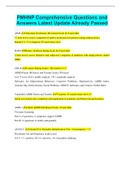
PMHNP Comprehensive Questions and Answers Latest Update Already Passed
AIMS Abnormal Involuntary Movement Scale for 8 and older 12 item tool to assess symptoms of tardive dyskinesia for patients taking antipsychotics Rating 0-4, >2 to diagnose TD and reduce dose BARS Barnes Akathisia Rating Scale for 8 and older 4 item tool to assess objective and subjective symptoms of akathisia with antipsychotics and/or SSRIs CRS-R Connors Rating Scales - Revised for 3-17 ADHD Parent (80 items) and Teacher Scales (59 items) Low T-score of 61= mildly atypical; >70 = markedly atypical Subscales for Oppositional Behaviors, Cognitive Problems, Hyperactivity, ADHD Index, Anxious-Shy, Perfectionism, Social Problems, DSM-IV Subscales and Connors' Global Index Vanderbilt ADHD Parent and Teacher 55 parent, 43 teacher items for 6-12 Initial assessment rates symptoms and impairment in academic and behavioral performance ASRS-1 Adult ADHD Self-Report Scale, 16 and older Two-part Screening Part A: 6 questions, 4 symptoms suggest ADHD Part B: 12 questions to clarify and quantify AUDIT-C Alcohol Use Disorders Identification Test - Consumption, > 13 Documents use and frequency in prior year 0-4, F >3 = positive, M >4 = positive, >8 = hazardous drinking CAGE-AID IDs problem drinking or druging, 13 and older (C=cut down, A=annoy, G=guilty, E=Eye-opener, AID=altered to include drugs CRAFFT 6-item screen for alcohol or drugs in adolescents, 14-18 (C=car, R=relax, A=alone, F=forget, F= family or friends, T= trouble) BAI Beck Anxiety Inventory, 17 and older Assesses 21 symptoms of anxiety, 0-36 scores HAM-A Hamilton Anxiety Scale, most commonly used 14 domains, 14=mild, 18-24= moderate, 25-30=severe LSAS-CA Liebowitz Social Anxiety Scale-Child/Adolescent Version, 7 and older 24 items, social and performance 55-65=moderate social phobia, 65-80=marked, 80-95=severe, >95=very severe MMSE Mini Mental Status Exam 30 items, 24-30= no cognitive impairment; 18-23=mild cognitive impairment; 0-17= severe cognitive impairment MOCA Montreal Cognitive Assessment >26=normal, add point for <12th grade education SPMSQ Short Portable Mental Status Questionnaire 10 items, more than 3 incorrect indicates dementia BDI-2 Beck Depression inventory, 13 and older presence and impact of depressive symptoms 21 items, <10=normal; 11-17=mild depression; 18-23=moderate; 24+=severe CCSD Cornell Scale for Depression in Dementia 19 items, <6=no significant depression; 8-17=probable major depression; >18=definite depression MDQ Mood Disorder Questionnaire Screen for mania or hypomania positive if 7 or more of 13 items in question #1 present and #2 is yes and #3 gets moderate or serious problem response YMRS Young Mania Rating Scale, 11 items (adult) Range 0-60; adults with 12 or more=mania CY-BOCS ... YBOCS Yale-Brown Obsessive Compulsive Scale 10 items; age 14 and older gold standard for OC symptoms score indicates level of severity BPRS Brief Psychiatric Rating Scale, 18 and older Assesses psychopathology (+, - and affective) with schizophrenia, not for screening or DX PANSS Positive and Negative Syndrome Scale, 18 and older measures changes in symptom intensity in psychosis and schizophrenia Gold standard in studies of treatment efficacy SPS Suicide Probability Scale, 13 and older Rapid measure of suicide risk higher score indicates greater risk CIWA-Ar Clinical Institute Withdrawal Assessment of Alcohol Scale, Revised 9 item symptom rating scale, max score 67; <10 does not warrant intervention COWS Clinical Opiate Withdrawal Scale Quantifies severity of withdrawal syndrome, guides dosing, monitors over time Used for induction of Suboxone 5-12=mild; 13-24= moderate; 25-36=mod to severe; >36=severe T4, FREE THYROXINE 0.8-2.8 Increased In Graves Decreased In Hypothyroidism TSH 2- 10 mu/l Normal values can range from 0.4 - 4.0 mIU/L (milli-international units per liter), Calcium, Ca++ 8.8-10.5 <7.0, tetany >11.0, hyperparathyroidism >13.5, hypercalcemic coma, metastatic cancer Sodium, Na+ 135-148 mEq/L hypernatremia dehydration hypovolemia diabetes insipidus eating too much salt gastroenteritis drugs such as adrenocorticosteroids, methyldopa, hydrazine, cough meds hyponatremia drugs such as lithium, vasopressin, diuretics addisons renal disorder gi fluid loss Magnesium, Mg 1.3 - 2.1 mEq/L lithium can increase hypomagnesemia depression, confusion, irritability,nystagmus, tetany, convulsions, ataxia, increased reflexes, muscle weakness hypermagnesemia N/V, respiratory depression, hypotension, depressed skeletal muscle contraction and nerve function, bradycardia Potassium, K+ 3.5-5.1 mEq/L hyperkalemia chronic marijuana use can elevate potassium Chloride, Cl 98 - 106 passive transport through sodium major anion in the extracellular fluid Liver - ALT 5 - 35 U/L - depakote can increase, safe to use up to 2 times normal limit Liver - AST 5 - 40 U/L slight elevation can occur in DT's depakote can increase, safe to use up to 2 times normal limit Liver - GGT 10 - 38 IU/L Thrombocytopenia Platelet count normal = 150,000-450,000 if below - bone marrow doesn't make enough platelets. or bone marrow makes enough platelets, but the body destroys them or uses them up. or - The spleen holds on to too many platelets. The spleen is an organ that normally stores about one-third of the body's platelets. It also helps your body fight infection and remove unwanted cell material. can be caused by Valproate Neutropenia A normal ANC is above 1,500 cells per microliter. An ANC less than 500 cells/µL is defined as neutropenia and significantly increases the risk of infection. Neutropenia is the condition of a low ANC, Clozapine - WBC => 3500 to initiate therapy, ANC MUST BE =>2000/mm, ck wbc/anc weekly x 6 months, then Q other week for 6 months; if stable then Q 4 weeks. after therapy test for at least 4 weeks, LIVER PANEL ALP, AST, ASP, BILIRUBIN, ALBUMIN, TTL PROTEIN, CBC with WBC DIFFERENTIAL, PLATELET COUNT. FOR VALPROATE THERAPY - CK BASELINE AND MONTHLY FOR SEVERAL MONTHS CREATININE 0.5-1.2 normal, kidney damage if elevated , athletes may be higher BUN 10-20 mg/dL LITHIUM THERAPY CREATININE/BUN, SERUM ELECTROLYTES, CBC W/WBC & DIFF, URINALYSIS, EKG, ck levels (post dose 12 hrs trough), after 4 days on med, then q 4-5 days during initial therapy lithium levels during acute tx 0.8 -1.2, during maintenance 0.6 - 1.0 ALP 44-147 CK, creatine kinase <240, indicates muscle injury of heart, brain, skeletal muscle, elevated in MI, myositis, rhabdomysitis BUN 10-20, increased in impaired kidney function, significant dehydration, measure with lithium Creatinine 0.4-0.8, may vary with age gender, ethnicity, more sensitive then bun, GFR >90, best measurement of kidney function, no need to adjust dose depakote if GFR > 60 SIGNS OF LITHIUM TOXICITY nystagmus, ataxia, increased deep tendon reflexes, altered mental status, cardiac arrhythmias what meds do to lithium ACE inhibitors, ARB's, nsaid, tetracyclines, metronidazole can INCREASE LITHIUM DECREASES LITHIUM LEVELS potassium-sparing diuretics, thiazide diuretics, theophyline decreases lithium Examples of ARB's ALL INCREASE LITHIUM Valsartan Telmisartan Losartan Irbesartan Irbesartan Azilsartan Olmesartan Olmesartan Examples of Ace Inhibitors ALL INCREASE LITHIUM Enalapril (Vasotec/Renitec) Ramipril (Altace/Prilace/Ramace/Ramiwin/Triatec/Tritace) Quinapril (Accupril) Perindopril (Coversyl/Aceon/Perindo) Lisinopril (Listril/Lopril/Novatec/Prinivil/Zestril) Benazepril (Lotensin) Imidapril (Tanatril) Trandolapril examples of potassium-sparing diuretics Epithelial sodium channel blockers Amiloride Triamterene Aldosterone antagonists: Spironolactone Eplerenone Core Competencies Management of Health Status Maintenance of Nurse-Patient Relationship Teaching/Coaching Professional Role Managing and Negotiating Healthcare Delivery Systems Monitoring Quality of Care Providing Culturally Sensitive Care When was NP role introduced and by whom 1965 Loretta Ford University of Colorado State Legislative Statutes Grant legal authority for NP practice Are the Nurse Practice Act of every state Provide title protection Define advanced practice Are prevailing state laws that define scope of practice Place restrictions on practice Sets NP credentialing requirements State grounds for disciplinary actions May decide about collaborative agreements Collaborative agreement Protocol that describes what types of drugs might be prescribed and defines some form of oversight board for NP practice Statutory Law Rules and regulations differ for each state May further define scope of practice and practice requirements May provide restrictions in practice unique to specific state Licensure A process by which an agency of state government grants permission to individuals accountable for the practice of a profession to engage in the practice of that profession Credentialing Process used to protect the public by ensuring a minimum level of professional competence Certification Credential that provides title protection Determines scope of practice Is the process by which a professional organization/association certifies that an individual licensed to practice as a professional has met certain predetermined standards Assures the public that an individual has mastery of a body of knowledge Assures that the individual has acquired the skills necessary to function in a particular specialty ANCC only one for psych Scope of practice Defines NP roles and actions Identifies competencies assumed to be held by all NPs who function in a particular role Has broad variations from state to state Standards of Practice Gives authoritative statements regarding the quality and type of practice that should be provided Provides a way to judge the nature of care provided Reflects the expectation for the care that should be provided to patients with various illnesses Reflects professional agreement focused on the minimum levels of acceptable performance Can be used to legally describe the standard of care that must be met by a provider May be precise protocols that must be followed or more general guidelines that recommend actions Four Rights of HIPAA 1. To be educated about HIPAA privacy protection 2. To have access to their own medical records 3. To request amendment of their health information to which they object 4. To require their permission for disclosure of their personal information HITECH Incentive payments for sharing specific EHR data Meaningful use incentives Improves outcomes Exceptions to confidentiality Intent to harm self or others Attorneys involved in litigation When records are released to insurance companies Answering court orders, subpoenas, summons Mandatory reporting of disease and conditions Tarasoff principle: Duty to warn potential victims of imminent danger of homicidal patients Child/elder abuse Justice Doing what is fair, fairness in all aspects of care Beneficience Promoting well being and doing good Nonmalfeasance Doing no harm Fidelity Being true and loyal Autonomy Doing for self Veracity Telling the truth Respect Treating everyone with equal respect Deontological Theory An action is judged as good or bad based on the act itself regardless of the consequences Teleological Theory An action is judged as good or bad based on the consequence or outcome Virtue Ethics Actions are chosen based on the moral virtues (honesty, courage, compassion, wisdom, gratitude, self respect) or the character of the person making the decision Four elements of negligence to prove malpractice Duty: NP had a duty to exercise reasonable care when undertaking and providing treatment to the patient Breach of duty: NP violated the applicable standard of care in treating the patient's condition Proximate cause: causal relationship between the breach in the standard of care and the patient's injuries Damages:there are permanent and substantial damages to the patient as a result of the breach in the standard of care Commitment Criteria Person has a diagnosed psychiatric disorder Person is harmful to self or others as a consequence of the disorder Person is unaware or unwilling to accept the nature and severity of the disorder Treatment is likely to improve functioning Primary Prevention Aimed at decreasing the incidence (number of new cases) of mental disorders (prevention) Secondary Prevention Aimed at decreasing prevalence (number of existing cases) of mental disorders (screening) Tertiary Prevention Aimed at decreasing the disability and severity of a mental disorder (rehab) Ethnicity Self identified race, tribe, or nation with which a person or group identifies and which greatly influences beliefs and behaviors Schizophrenia accounts for ____% of US homelessness 15-45% Sexual Identity How people identify psychologically on a continuum between female and male and to whom they are sexually or affectionately attracted Gender Identity A person's identity along a continuum between normative constructs of masculinity and femininity PICO P-patient, population, problem I-intervention C-comparison O-outcome Internal validity When the independent variable (treatment) caused a change in the dependent variable (outcome) External validity When the sample is representative of the population and the results can be generalized Mean Average of scores Standard deviation Indication of the possible deviations from the mean Variance How the values are dispersed around the mean; the larger the variance, the larger the dispersion of scores Inferential statistics Numerical values that enable one to reach conclusions that extend beyond the immediate data alone; generated by quantitative research designs t test Assesses whether the means of 2 groups are statistically different from each other Analysis of Variance (ANOVA) Tests the difference among 3 or more groups Pearson's r correlation Tests the relationship between 2 variables Probability Likelihood of an event occurring; lies
Escuela, estudio y materia
- Institución
- PMHNP Comprehensive
- Grado
- PMHNP Comprehensive
Información del documento
- Subido en
- 31 de diciembre de 2022
- Número de páginas
- 139
- Escrito en
- 2022/2023
- Tipo
- Examen
- Contiene
- Preguntas y respuestas
Temas
-
pmhnp comprehensive questions and answers latest update already passed

Documento también disponible en un lote