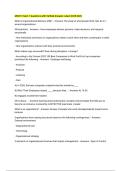
JMU BIO 140 Exam 3 Verified 2022 | questions and answers
cellular metabolism - Answer the name given to describe the many cellular chemical reactions homeostasis - Answer the cellular metabolism, cells maintain a fairly stable equilibrium of chemicals catabolic - Answer chemical reactions that tear less stable bonded molecules down to form stable bonded molecules (produce energy) anabolic - Answer chemical reactions that build less stable molecules from more stable molecules (use energy) thermodynamics - Answer the branch of physics which deals with the relationships between different forms of energy: potential and kinetic 1st law of thermodynamics - Answer energy can neither be created or destroyed, it can only change forms 2nd law of thermodynamics - Answer during every energy transfer/ transformation, so energy is unusable and is often given off as heat; energy transformations increase the entropy applying thermodynamics in a reaction: ΔG (must be negative) - Answer ΔG= G(products) - G(reactants) cellular respiration - Answer a set of catabolic reactions used by (organo)chemotrophs to make ATP; glucose is oxidized to form carbon dioxide autotrophs - Answer carbon from inorganic sources; vascular plants, hydrogen bacteria heterotrophs - Answer carbon from organic compounds; non-sulfur bacteria, animals phototrophs - Answer energy from sunlight chemotrophs - Answer energy from chemical compounds exergonic - Answer Chemical process accompanied by the release of energy endergonic - Answer A chemical reaction that requires the input of energy in order to proceed. energetic coupling - Answer transfer of energy from catabolism to anabolism, or transfer of energy from exergonic process to endergonic process. substrate (reactant) - Answer when a reactant binds an enzyme, through non-covalent interactions Trypsonase - Answer an enzyme that speeds up the process of breaking AA chains following basic amino acids cofactors - Answer inorganic components, usually metals (Zn, Mg) Coenzymes - Answer organic components (retinal, heme, biotin, chlorophyll) CML - Answer an overproduction of a particular white blood cell called granulocyte kinase (allosteric) - Answer an enzyme that catalyzes phosphorylation reactions; transfers a phosphate group from ATP to the substrate. Must be able to bind to both ATP and its substrate allosteric - Answer can exist in more than one folded form Gleevec - Answer competitive enzyme inhibitor; competes with ATP for binding site competitive enzyme inhibitors - Answer mimic the substrate and bind to the active site non-competitive enzyme inhibitors - Answer bind to some other part of the enzyme and change active site structure
Escuela, estudio y materia
- Institución
- James Madison University
- Grado
- JMU BIO 140
Información del documento
- Subido en
- 29 de diciembre de 2022
- Número de páginas
- 5
- Escrito en
- 2022/2023
- Tipo
- Examen
- Contiene
- Preguntas y respuestas
Temas
-
jmu bio 140 exam 3 verified 2022 | questions and answers

Documento también disponible en un lote