100% de satisfacción garantizada Inmediatamente disponible después del pago Tanto en línea como en PDF No estas atado a nada 4.2 TrustPilot
logo-home
Examen

Health Assessment ATI EXAM 1 correctly answered latest 2023

Puntuación
3.0
(1)
Vendido
17
Páginas
19
Grado
A+
Subido en
28-12-2022
Escrito en
2022/2023

Health Assessment ATI EXAM 1 correctly answered latest 2023A nurse is introducing herself to a client as the first step of a comprehensive physical examination. Which of the following strategies should the nurse use with this client? (select all that apply) A. Address the client with the appropriate title and her last name. B. Use a mix of open- and close-ended questions. C. Reduce environmental noise. D. Have the client complete a health history form. E. Perform the general survey before the examination. B, C, E Rationale: B. Open‑ended questions help the client tell her story in her own way. Closed‑ended questions are useful for clarifying and verifying information the nurse gathers from the client's story C. quiet, comfortable environment eliminates distractions and helps the client focus on the important aspects of the interview. E. The general survey is noninvasive and, along with the health history and vital sign measurement, can help put the client at ease before the more sensitive parts of the process, such as the examination A nurse in a provider's office is documenting his findings following an examination he performed for a client new to the practice. Which of the following parameters should he include as part of the general survey? (Select all that apply.) A. Posture B. Skin lesions C. Speech D. Allergies. E. immunization status A, B, C Rationale: A. Posture is part of the body structure or general appearance portion of the general survey. B. Skin lesions are part of the body structure or general appearance portion of the general survey. C. Speech is part of the behavior portion of the general survey A nurse is collecting data for a client's comprehensive physical examination. after the nurse inspects the client's abdomen, which of the following skills of the physical examination process should she perform next? A.olfaction B.auscultation C.Palpation D.Percussion B Rationale: B. Because palpation and percussion can alter the frequency and intensity of bowel sounds, the nurse should auscultate the abdomen next and before using those two techniques A nurse is performing a comprehensive physical examination of an older adult client. Which of the following interventions should the nurse use in consideration of the client's age? (Select all that apply.) a.Collect the data in one continuous session. B.Plan to allow plenty of time for position changes. C.Make sure the client has any essential sensory aids in place. D. tell the client to take her time answering questions. E. invite the client to use the bathroom before beginning the examination B, C, D, E Rationale: B. Because many older adults have mobility challenges, the nurse should plan to allow extra time for position changes. C. the nurse should make sure clients who use sensory aids have them available for use. the client has to be able to hear the nurse and see well enough to avoid injury. D. Some older clients need more time to collect their thoughts and answer questions, but most are reliable historians. Feeling rushed can hinder communication. E. This is a courtesy for all clients, to avoid discomfort during palpation of the lower abdomen for example, but this is especially important for older clients who have a smaller bladder capacity. A nurse in a family practice clinic is performing a physical examination of an adult client. Which part of her hands should she use during palpation for optimal assessment of skin temperature? A.Palmar surface B.Fingertips C.Dorsal surface D.Base of the fingers C Rationale: C. The dorsal surface of the hand is the most sensitive to temperature. A nurse is caring for an 82‑year‑old client in the emergency department who has an oral body temperature of 38.3° C (101° F), pulse rate 114/min, and respiratory rate 22/min. He is restless and his skin is warm. Which of the following interventions should the nurse take? (Select all that apply.) A.Obtain culture specimens before initiating antimicrobials. B.Restrict the client's oral fluid intake. C.Encourage the client to rest and limit activity. D. allow the client to shiver to dispel excess heat. E. assist the client with oral hygiene frequently A, C, E Rationale: A. he provider can prescribe cultures to identify any infectious organisms causing the fever. the nurse should obtain culture specimens before antimicrobial therapy to prevent interference with the detection of the infection. C.Rest helps conserve energy and decreases metabolic rate. activity can increase heat production E. Oral hygiene helps prevent cracking of dry mucous membranes of the mouth and lips A nurse is instructing an assistive personnel (aP) about caring for a client who has a low platelet count as a result of chemotherapy. Which of the following instructions is the priority for measuring vital signs for this client? A."Do not measure the client's temperature rectally." B."Count the client's radial pulse for 30 seconds and multiply it by 2." C."Do not let the client know you are counting her respirations." D."let the client rest for 5 minutes before you measure her blood pressure." A Rationale: A. The greatest risk to a client who has a low platelet count is an injury that results in bleeding. Using a thermometer rectally poses a risk of injury to the rectal mucosa. the low platelet count contraindicates the use of the rectal route for this client. A nurse is instructing a group of nursing students in measuring a client's respiratory rate. Which of the following guidelines should the nurse include? (Select all that apply.) A.Place the client in semi‑Fowler's position. B.Have the client rest an arm across the abdomen. C.Observe one full respiratory cycle before counting the rate. D.Count the rate for 30 sec if it is irregular. E.Count and report any sighs the client demonstrates. A, B, C Rationale: A. Having the client sit upright facilitates full ventilation and gives the students a clear view of chest and abdominal movements. B. With the client's arm across the abdomen or lower chest, it is easier for the students to see respiratory movements. C. Observing for one full respiratory cycle before starting to count assists the students in obtaining an accurate count. D. the students should count the rate for 1 min if it is irregular A nurse who is admitting a client who has a fractured femur obtains a blood pressure reading of 140/94 mm Hg. the client denies any history of hypertension. Which of the following actions should the nurse take first? A.Request a prescription for an antihypertensive medication. B. ask the client if she is having pain. C.Request a prescription for an anti-anxiety medication. D.Return in 30 min to recheck the client's blood pressure B Rationale: B. The first action the nurse should take using the nursing process is to assess the client for pain which can cause multiple complications, including elevated blood pressure. therefore, the nurse's priority is to perform a pain assessment. if the client's blood pressure is still elevated after pain interventions, the nurse should report this finding to the provider. A nurse is performing an admission assessment on a client. the nurse determines the client's radial pulse rate is 68/min and the simultaneous apical pulse rate is 84/min. What is the client's pulse deficit? 16/min the pulse deficit is the difference between the apical and radial pulse rates. it reflects the number of ineffective or non perfusing heartbeats that do not transmit pulsations to peripheral pulse points. 84‑68 = 16 A nurse at a clinic is collecting data about pain from of a client who reports severe abdominal pain. the nurse asks the client whether he has nausea and has been vomiting. Which of the following pain characteristics is the nurse attempting to determine? A.Presence of associated manifestations B.Location of the pain C.Pain quality D. aggravating and relieving factors A Rationale: A. The nurse should attempt to identify manifestations that occur along with the clients pain, such as nausea, fatigue or anxiety. A nurse is collecting data from a client who is reporting pain despite taking analgesia. Which of the following actions should the nurse take to determine the intensity of the client's pain? A. ask the client what precipitates the pain. B.Question the client about the location of the pain. C.Offer the client a pain scale to measure his pain. D.Use open‑ended questions to identify the client's pain sensations. C Rationale: C. The nurse should use a pain rating scale to help the client report the intensity of his pain. the nurse should use a numeric, verbal, or visual analog scale appropriate to the client's individual needs. A nurse is discussing the care of a group of clients with a newly licensed nurse. Which of the following clients should the newly licensed nurse identify as experiencing chronic pain? A. a client who has a broken femur and reports hip pain. B. a client who has incisional pain 72 hr following pacemaker insertion. C. a client who has food poisoning and reports abdominal cramping. D. a client who has episodic back pain following a fall 2 years ago D Rationale: D. A client who reports pain that lasts more than 6 months and continues beyond the time of tissue healing is experiencing chronic pain. the nurse should identify this client's pain as chronic, and assist with planning interventions to relieve manifestations associated with the pain A nurse is monitoring a client who is receiving opioid analgesia for adverse effects of the medication. Which of the following effects should the nurse anticipate? (Select all that apply.) a.Urinary incontinence B.Diarrhea C.Bradypnea D.Orthostatic hypotension e. nausea C, D, E Rationale: C.Opioid analgesia can cause respiratory depression, which causes respiratory rates to drop to dangerously low levels. the nurse should monitor the client's respiratory rate, and administer naloxone if indicated. D. Opioid analgesia can cause orthostatic hypotension. the nurse should monitor the client for dizziness or lightheadedness when changing positions. E. Opioid analgesia can cause nausea and vomiting. the nurse should monitor for and treat these complications as needed. A nurse is caring for a client who is receiving morphine via a patient‑controlled analgesia (PCA) infusion device after abdominal surgery. Which of the following statements indicates that the client knows how to use the device? A."i'll wait to use the device until it's absolutely necessary." B."i'll be careful about pushing the button too much so idon't get an overdose." C."i should tell the nurse if the pain doesn't stop while i am using this device." D."i will ask my adult child to push the dose button when i am sleeping." C Rationale: C. PCA allows the client to self‑administer pain medication on an as‑needed basis. if the client is not achieving adequate pain control, he should let the nurse know so that she can initiate a reevaluation of the client's pain management plan and possible dosage change. A nurse is using an interpreter to communicate with a client. Which of the following actions should the nurse use when communicating with a client and his family? (Select all that apply.) A. talk to the interpreter about the family while the family is in the room. B. ask the family one question at a time. C. look at the interpreter when asking the family questions. D. use lay terms if possible. E. do not interrupt the interpreter and the family as they talk B, D, E Rationale: B. Asking the family one question at a time will promote effective communication between the family and the nurse/interpreter. D.using lay terms will promote effective communication between the family and the nurse/interpreter. E.not interrupting will promote effective communication between the family and the nurse/interpreter. A nurse is caring for a client who shares the nurse's religious background. Which of the following information should the nurse anticipate A.Members of the same religion share similar feelings about their religion. B. a shared religious background generates mutual regard for one another. C. the same religious beliefs can influence individuals differently. D. the nurse and client should discuss the differences and commonalities in their beliefs C Rationale: C.Members of any particular religion should be assessed for individual feelings and ideas

Mostrar más Leer menos
Institución
Health Assessment ATI
Grado
Health Assessment ATI


Ups! No podemos cargar tu documento ahora. Inténtalo de nuevo o contacta con soporte.

Libro relacionado

Escuela, estudio y materia

Institución
Health Assessment ATI
Grado
Health Assessment ATI

Información del documento

Subido en
28 de diciembre de 2022
Archivo actualizado en
26 de mayo de 2025
Número de páginas
19
Escrito en
2022/2023
Tipo
Examen
Contiene
Preguntas y respuestas

Temas

Vista previa del contenido

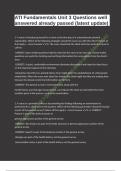
ATI Fundamentals Unit 3 Questions well
answered already passed (latest update)

1. A nurse is introducing herself to a client as the first step of a comprehensive physical
examination. Which of the following strategies should the nurse use with this client? (Select all
that apply.) - correct answer ✔✔A. The nurse should ask the client what she wants the nurse to
call her.

CORRECT: Open-ended questions help the client tell her story in her own way. Closed-ended
questions are useful for clarifying and verifying information the nurse gathers from the client's
story.

CORRECT: A quiet, comfortable environment eliminates distractions and helps the client focus
on the important aspects of the interview.

Having the client fill out a printed history form might deter the establishment of a therapeutic
relationship. When the nurse asks about her history, the client might feel they are wasting time
because she already wrote that information on the form.

CORRECT: The general survey is noninvasive and, along with the

health history and vital sign measurement, can help put the client at ease before the more
sensitive parts of the process, such as the examination.


2. A nurse in a provider's office is documenting his findings following an examination he
performed for a client new to the practice. Which of the following parameters should he include
as part of the general survey? (Select all that apply.) - correct answer ✔✔2. A. CORRECT:
Posture is part of the body structure or

general appearance portion of the general survey.

CORRECT: Skin lesions are part of the body structure or general appearance portion of the
general survey.

CORRECT: Speech is part of the behavior portion of the general survey.

Allergies are part of the health history, not the general survey.

Immunization status is part of the health history, not the general survey.

, A nurse is collecting data for a client's comprehensive physical examination. After the nurse
inspects the client's abdomen, which of the following skills of the physical examination process
should she perform next? - correct answer ✔✔3. A. Olfaction is the use of the sense of smell to
detect any unexpected findings that the nurse cannot detect via other means, such as a fruity
breath odor. Unless there is an open lesion on the client's abdomen, this is not the next step in
an abdominal examination.

CORRECT: Because palpation and percussion can alter the frequency and intensity of bowel
sounds, the nurse should auscultate the abdomen next and before using those two techniques.

Palpation is the next step in examining other areas of the body, but not the abdomen.

Percussion is important for detecting gas, fluid, and solid masses in the abdomen, but it is not
the next step in an abdominal assessment.


4. A nurse is performing acomprehensive physical examination of an older adult client. Which of
the following interventions should the nurse use in consideration of the client's age? (Select all
that apply.) - correct answer ✔✔4. A. The nurse should perform the various parts of the
assessment in several shorter segments to avoid overtiring the client.

CORRECT: Because many older adults have mobility challenges, the nurse should plan to allow
extra time for position changes.

CORRECT: The nurse should make sure clients who use sensory aids have them available for
use. The client has to be able to hear the nurse and see well enough to avoid injury.

CORRECT: Some older clients need more time to collect their thoughts and answer questions,
but most are reliable historians. Feeling rushed can hinder communication.

CORRECT: This is a courtesy for all clients, to avoid discomfort during palpation of the lower
abdomen for example, but this is especially important for older clients who have a smaller
bladder capacity.


5. A nurse in a family practice clinic is performing a physical examination of an adult client.
Which part of her hands should she use during palpation for optimal assessment of skin
temperature? - correct answer ✔✔5. A. The palmar surface of the hands is especially sensitive
to vibration, not temperature.
$51.99
Accede al documento completo:

100% de satisfacción garantizada
Inmediatamente disponible después del pago
Tanto en línea como en PDF
No estas atado a nada


Documento también disponible en un lote

Reseñas de compradores verificados

Se muestran los comentarios
2 año hace

3.0

1 reseñas

5
0
4
0
3
1
2
0
1
0
Reseñas confiables sobre Stuvia

Todas las reseñas las realizan usuarios reales de Stuvia después de compras verificadas.

Conoce al vendedor

Seller avatar
Los indicadores de reputación están sujetos a la cantidad de artículos vendidos por una tarifa y las reseñas que ha recibido por esos documentos. Hay tres niveles: Bronce, Plata y Oro. Cuanto mayor reputación, más podrás confiar en la calidad del trabajo del vendedor.
StuviaExamHub Havard School
Seguir Necesitas iniciar sesión para seguir a otros usuarios o asignaturas
Vendido
456
Miembro desde
3 año
Número de seguidores
355
Documentos
16965
Última venta
6 días hace
EXAM HUB (LATEST UPDATE)

QUALITY WORK OF ALL KIND OF QUIZ or EXAM WITH GUARANTEE OF AN A+ latest updates Im an expert on major courses especially; psychology,Nursing, Human resource Management & Project writing. Assisting students with quality work is my first priority. I ensure scholarly standards in my documents . I assure a GOOD GRADE if you will use my work. Feel free to purchase n recommend others for 100% pass EXAMS!

3.6

84 reseñas

5
38
4
10
3
17
2
6
1
13

Recientemente visto por ti

Por qué los estudiantes eligen Stuvia

Creado por compañeros estudiantes, verificado por reseñas

Calidad en la que puedes confiar: escrito por estudiantes que aprobaron y evaluado por otros que han usado estos resúmenes.

¿No estás satisfecho? Elige otro documento

¡No te preocupes! Puedes elegir directamente otro documento que se ajuste mejor a lo que buscas.

Paga como quieras, empieza a estudiar al instante

Sin suscripción, sin compromisos. Paga como estés acostumbrado con tarjeta de crédito y descarga tu documento PDF inmediatamente.

Student with book image

“Comprado, descargado y aprobado. Así de fácil puede ser.”

Alisha Student

Preguntas frecuentes