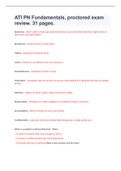
ATI PN Fundamentals, proctored exam review. 31 pages.
Autonomy - client's right to make own personal decisions, even when those decisions might not be in the client's own best interest Beneficence - positive actions to help others Fidelity - agreement to keep promises Justice - fairness in care delivery and use of resources Nonmaleficence - avoidance of harm or injury Paternalism - assumption that one person can assume responsibility for making the decisions of another person Advocacy - support of clients' health, safety, and personal rights Responsibility - willingness to respect obligations and follow through on promises Accountability - ability to answer for one's own actions Confidentiality - protection of privacy without diminishing access to high-quality care When is a problem an ethical dilemma? - When: - A review of scientific data is not enough to solve it. - It involves a conflict between two moral imperatives. - The answer will have a profound effect on the situation and the client. Ethical decision making - Process that requires striking a balance between science and morality A nurse is caring for a client who decides not to have surgery despite significant blockages in his coronary arteries. The nurse understands that this client's choice is an example of which of the following ethical principles? A. Fidelity B. Autonomy C. Justice D. Nonmaleficence - B. Autonomy In this situation, the client is exercising his right to make his own personal decision about surgery, regardless of others' opinions of what is "best" for him. This is an example of autonomy. A nurse offers pain medication to a client who is postoperative prior to ambulation. The nurse understands that this aspect of care delivery is an example of which of the following ethical principles? A. Fidelity B. Autonomy C. Justice D. Beneficence - D. Beneficence Beneficence is taking positive actions to help others. By administering pain medication before the client attempts a potentially painful exercise like ambulation, the nurse is taking a specific and positive action to help the client. A nurse is instructing a group of nursing students about the responsibilities involved with organ donation and procurement. When the nurse explains that all clients waiting for a kidney transplant have to meet the same qualifications, the students should understand that this aspect of care delivery is an example of which of the following ethical principles? A. Fidelity B. Autonomy C. Justice D. Nonmaleficence - C. Justice Justice is fairness in care delivery and in the use of resources. By applying the same qualifications to all potential kidney transplant recipients, organ procurement organizations demonstrate this ethical principle in determining the allocation of these scarce resources. A nurse questions a medication prescription as too extreme in light of the client's advanced age and unstable status. The nurse understands that this action is an example of which of the following ethical principles? A. Fidelity B. Autonomy C. Justice D. Nonmaleficence - D. Nonmaleficenc
Escuela, estudio y materia
- Institución
- ATI PN Fundamentals
- Grado
- ATI PN Fundamentals
Información del documento
- Subido en
- 27 de diciembre de 2022
- Número de páginas
- 31
- Escrito en
- 2022/2023
- Tipo
- Examen
- Contiene
- Preguntas y respuestas
Temas
-
ati pn fundamentals
-
proctored exam review 31 pages

Documento también disponible en un lote