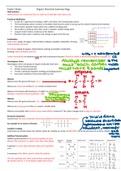
Course 3 Chemistry
DYNAMIC EQUILIBRIUM 2
ACIDS & BASES 4
ORBITALS 6
ISOELECTRIC POINT 7
SALTS & SEPARATION 8
BUFFERS 8
LEWIS STRUCTURES 9
ELECTROCHEMISTRY 10
HAN University of Applied Sciences, Nijmegen, The Netherlands
Bachelor of Life Sciences
Propaedeutic Year
Course 3: Molecular Biological research on DNA and Proteins
Notes by Melchior Philips (http://melch.io/r)
,Dynamic Equilibrium
Dynamic equilibrium is the condition of a chemical reaction where the rate of the forward
reaction equals the rate of the reverse reaction.
o This means that the formation of products from reagents is happening at the same
speed as the degradation of products back into reagents. When this happens, there
is no net change in products or reagents.
o If the conditions of the chemical reaction changes, the equilibrium shifts.
An example of a reversible reaction in equilibrium: H2 (g) + I2 (g) ⇌ 2 HI (g)
The Equilibrium Constant (Kc) of a reversible reaction allows us to calculate at which
concentrations of products and reagents the dynamic equilibrium occurs.
o The Kc for any general reaction aA + bB ⇌ cC + dD can be calculated as:
[𝐶]𝑐 [𝐷]𝑑
𝐾𝑐 =
[𝐴]𝑎 [𝐵]𝑏
o The concentrations of the products raised to the power of their stoichiometric
coefficients, divided by the concentrations of the reagents raised to the power of
their stoichiometric coefficients.
o Solids do not affect the equilibrium and are omitted.
o Pure liquids (H2O) are also omitted because they do not affect the equilibrium.
The water equilibrium constant (Kw) is equal to 10-14.
[𝑂𝐻 − ][𝐻3 𝑂+ ]
𝐾𝑤 = = 10−14
1
o Note that H2O is omitted because it is a pure liquid.
o Also note that–log (10-14) = 14, forming the basis of the pH scale. (More about that
when we talk about Acids and Bases)
The equilibrium constant states the ratio of products to reactants at equilibrium.
o A large equilibrium constant (Kc > 1) indicates that there are more products than
reactants.
o A small equilibrium constant (Kc < 1) indicates that there are more reactants than
products.
o If the equilibrium constant is 1, the amount of products and reactants is the same.
Examples:
2 SO2 + O2 ⇌ 2 SO3 Kc = 8(1025)
[𝑆𝑂3 ]2
8 × 1025 =
[𝑆𝑂3 ]2 [𝑂2 ]
There’s a lot more products (SO3) than reagents, because Kc >> 1.
N2 + 2 O2 ⇌ 2 NO2 Kc = 3(10-17)
[𝑁𝑂2 ]2
3 × 10−17 =
[𝑁2 ][𝑂2 ]2
There’s a lot more reagents than products, because Kc << 1.
The Reaction Quotient (Q) uses the same formula as the equilibrium constant, but it is not
known whether the reaction is at equilibrium.
Course 3 Chemistry page 2 http://melch.io/r
, o By comparing the reaction quotient to the equilibrium constant, you can predict
whether the reaction will move towards the products or the reagents.
o If Q > K, the reaction will move towards the reagent’s side.
o If Q < K, the reaction will move towards the product’s side.
o If Q = K, the reaction is at equilibrium.
Example:
N2O4 ⇌ 2 NO2 Kc = 8.85(10-3)
[NO2] = 0.0255 M [N2O4] = 0.0331 M
[𝑁𝑂2 ]2 0.02552
𝑄= = = 1.96 × 10⁻²
[𝑁2 𝑂4 ] 0.0331
Q > K, so the reaction will move towards the reagent’s side. Some
NO2 will decompose into N2O4.
Recommended materials:
o Nivaldo J. Tro – Principles of Chemistry: A Molecular Approach, Chapter 14.
o Khan Academy – Reactions in Equilibrium
https://www.khanacademy.org/science/chemistry/chemical-
equilibrium/equilibrium-constant/v/reactions-in-equilibrium
Course 3 Chemistry page 3 http://melch.io/r
, Acids & Bases
Acids and bases were defined by Swedish chemist Svante Arrhenius in the 1880s.
o An Acid is a substance that produces H+ ions in aqueous solution.
o A Base is a substance that produces OH- ions in aqueous solution.
Some common acids and bases:
Formula Name of Acid Formula Name of Base
HCl Hydrochloric Acid NaOH Sodium Hydroxide
H2SO4 Sulphuric Acid KOH Potassium Hydroxide
HNO3 Nitric Acid NaHCO3 Sodium Bicarbonate
HC2H3O2 Acetic Acid NaCO2 Sodium Carbonate
H3C6H5O7 Citric Acid NH3 Ammonia
H2CO2 Carbonic Acid
HF Hydrofluoric Acid
H3PO4 Phosphoric Acid
Table 1: Common Acids and Bases
Acid Strength is determined by an acid’s Acid Ionization Constant (Ka).
[𝐻3 𝑂][𝐴− ]
𝐾𝑎 =
[𝐻𝐴]
o Strong acids completely ionize into their products.
Completely ionizing acids are indicated with a single arrow.
E.g.: 𝐻𝐶𝑙 (𝑎𝑞) + 𝐻2 𝑂 (𝑙) → 𝐻3 𝑂+ (𝑎𝑞) + 𝐶𝑙 − (𝑎𝑞)
A 1.0 M HCl solution will have an H3O+ concentration of 1.0 M.
The most important strong acids are:
Hydrochloric acid (HCl)
Hydrobromic acid (HBr)
Hydriodic acid (HI)
Nitric acid (HNO3)
Perchloric acid (HClO4)
Sulphuric Acid (H2SO4)
o Weak acids are acids that do not completely ionize in solution.
incompletely ionizing acids are indicated with a double arrow.
E.g.: 𝐻𝐹 (𝑎𝑞) + 𝐻2 𝑂 (𝑙) → 𝐻3 𝑂+ (𝑎𝑞) + 𝐹 − (𝑎𝑞)
←
A 1.0 M HF solution will have an H3O+ concentration that is much less than
1.0 M.
The most important weak acids are:
Hydrofluoric acid (HF)
Acetic acid (HC2H3O2)
Formic acid (HCHO2)
Sulphurous acid (H2SO3)
Carbonic acid (H2CO3)
Phosphoric acid (H3PO4)
Course 3 Chemistry page 4 http://melch.io/r
DYNAMIC EQUILIBRIUM 2
ACIDS & BASES 4
ORBITALS 6
ISOELECTRIC POINT 7
SALTS & SEPARATION 8
BUFFERS 8
LEWIS STRUCTURES 9
ELECTROCHEMISTRY 10
HAN University of Applied Sciences, Nijmegen, The Netherlands
Bachelor of Life Sciences
Propaedeutic Year
Course 3: Molecular Biological research on DNA and Proteins
Notes by Melchior Philips (http://melch.io/r)
,Dynamic Equilibrium
Dynamic equilibrium is the condition of a chemical reaction where the rate of the forward
reaction equals the rate of the reverse reaction.
o This means that the formation of products from reagents is happening at the same
speed as the degradation of products back into reagents. When this happens, there
is no net change in products or reagents.
o If the conditions of the chemical reaction changes, the equilibrium shifts.
An example of a reversible reaction in equilibrium: H2 (g) + I2 (g) ⇌ 2 HI (g)
The Equilibrium Constant (Kc) of a reversible reaction allows us to calculate at which
concentrations of products and reagents the dynamic equilibrium occurs.
o The Kc for any general reaction aA + bB ⇌ cC + dD can be calculated as:
[𝐶]𝑐 [𝐷]𝑑
𝐾𝑐 =
[𝐴]𝑎 [𝐵]𝑏
o The concentrations of the products raised to the power of their stoichiometric
coefficients, divided by the concentrations of the reagents raised to the power of
their stoichiometric coefficients.
o Solids do not affect the equilibrium and are omitted.
o Pure liquids (H2O) are also omitted because they do not affect the equilibrium.
The water equilibrium constant (Kw) is equal to 10-14.
[𝑂𝐻 − ][𝐻3 𝑂+ ]
𝐾𝑤 = = 10−14
1
o Note that H2O is omitted because it is a pure liquid.
o Also note that–log (10-14) = 14, forming the basis of the pH scale. (More about that
when we talk about Acids and Bases)
The equilibrium constant states the ratio of products to reactants at equilibrium.
o A large equilibrium constant (Kc > 1) indicates that there are more products than
reactants.
o A small equilibrium constant (Kc < 1) indicates that there are more reactants than
products.
o If the equilibrium constant is 1, the amount of products and reactants is the same.
Examples:
2 SO2 + O2 ⇌ 2 SO3 Kc = 8(1025)
[𝑆𝑂3 ]2
8 × 1025 =
[𝑆𝑂3 ]2 [𝑂2 ]
There’s a lot more products (SO3) than reagents, because Kc >> 1.
N2 + 2 O2 ⇌ 2 NO2 Kc = 3(10-17)
[𝑁𝑂2 ]2
3 × 10−17 =
[𝑁2 ][𝑂2 ]2
There’s a lot more reagents than products, because Kc << 1.
The Reaction Quotient (Q) uses the same formula as the equilibrium constant, but it is not
known whether the reaction is at equilibrium.
Course 3 Chemistry page 2 http://melch.io/r
, o By comparing the reaction quotient to the equilibrium constant, you can predict
whether the reaction will move towards the products or the reagents.
o If Q > K, the reaction will move towards the reagent’s side.
o If Q < K, the reaction will move towards the product’s side.
o If Q = K, the reaction is at equilibrium.
Example:
N2O4 ⇌ 2 NO2 Kc = 8.85(10-3)
[NO2] = 0.0255 M [N2O4] = 0.0331 M
[𝑁𝑂2 ]2 0.02552
𝑄= = = 1.96 × 10⁻²
[𝑁2 𝑂4 ] 0.0331
Q > K, so the reaction will move towards the reagent’s side. Some
NO2 will decompose into N2O4.
Recommended materials:
o Nivaldo J. Tro – Principles of Chemistry: A Molecular Approach, Chapter 14.
o Khan Academy – Reactions in Equilibrium
https://www.khanacademy.org/science/chemistry/chemical-
equilibrium/equilibrium-constant/v/reactions-in-equilibrium
Course 3 Chemistry page 3 http://melch.io/r
, Acids & Bases
Acids and bases were defined by Swedish chemist Svante Arrhenius in the 1880s.
o An Acid is a substance that produces H+ ions in aqueous solution.
o A Base is a substance that produces OH- ions in aqueous solution.
Some common acids and bases:
Formula Name of Acid Formula Name of Base
HCl Hydrochloric Acid NaOH Sodium Hydroxide
H2SO4 Sulphuric Acid KOH Potassium Hydroxide
HNO3 Nitric Acid NaHCO3 Sodium Bicarbonate
HC2H3O2 Acetic Acid NaCO2 Sodium Carbonate
H3C6H5O7 Citric Acid NH3 Ammonia
H2CO2 Carbonic Acid
HF Hydrofluoric Acid
H3PO4 Phosphoric Acid
Table 1: Common Acids and Bases
Acid Strength is determined by an acid’s Acid Ionization Constant (Ka).
[𝐻3 𝑂][𝐴− ]
𝐾𝑎 =
[𝐻𝐴]
o Strong acids completely ionize into their products.
Completely ionizing acids are indicated with a single arrow.
E.g.: 𝐻𝐶𝑙 (𝑎𝑞) + 𝐻2 𝑂 (𝑙) → 𝐻3 𝑂+ (𝑎𝑞) + 𝐶𝑙 − (𝑎𝑞)
A 1.0 M HCl solution will have an H3O+ concentration of 1.0 M.
The most important strong acids are:
Hydrochloric acid (HCl)
Hydrobromic acid (HBr)
Hydriodic acid (HI)
Nitric acid (HNO3)
Perchloric acid (HClO4)
Sulphuric Acid (H2SO4)
o Weak acids are acids that do not completely ionize in solution.
incompletely ionizing acids are indicated with a double arrow.
E.g.: 𝐻𝐹 (𝑎𝑞) + 𝐻2 𝑂 (𝑙) → 𝐻3 𝑂+ (𝑎𝑞) + 𝐹 − (𝑎𝑞)
←
A 1.0 M HF solution will have an H3O+ concentration that is much less than
1.0 M.
The most important weak acids are:
Hydrofluoric acid (HF)
Acetic acid (HC2H3O2)
Formic acid (HCHO2)
Sulphurous acid (H2SO3)
Carbonic acid (H2CO3)
Phosphoric acid (H3PO4)
Course 3 Chemistry page 4 http://melch.io/r