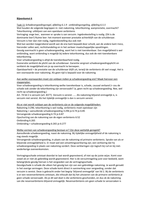
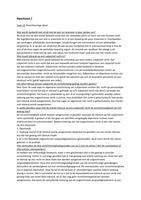
22.09.2022: First Impressions
Situation A:
Problem Statement: How does physical appearance affect our first impressions
of others?
Learning Goal:
How are first impressions made?
Situation B:
Learning Goals:
What are the mechanisms that attach causes to behaviour? (prejudices,
principles, etc.)
How do we attribute causes to our own and other people’s behaviour?
Notes on Literature
1. “The Power of Situations: Jonestown and the Fundamental Attribution
Error”
a. Abstract
i. The Fundamental Attribution Error (FAE): the tendency to overestimate
dispositional and underestimate situational causes for other’s behavior.
ii. 155 undergraduate students explained the causes of a person’s “bad
day”.
b. The Study
i. Used the real-life example of Jonestown to examine students’ use of
FAE.
ii. Presented college students with a videotaped documentary about the
Peoples Temple and respectively to each group:
1. A classroom discussion about the commonalities of groups.
22.09.2022: First Impressions 1
, 2. A classroom lecture on the FAE
3. A lecture on research methods (control group)
iii. All participants later completed measures of attributions for a target
person’s behavior (pen and pencil)
c. Results
i. Suggest that using cult groups as real-life examples and emphasizing
powerful situational/social influence forces within them can reduce
students’ tendencies to make the FAE
ii. Students exposed to the powerful situational forces surrounding
Jonestown residents made less dispositional and more situational
attributions for behaviors in an “unrelated task”.
iii. Although FAE lectures increased students’ dispositional attributions,
exposure to the vivid case of Jonestown more effectively increased their
situational attributions (maybe because it more compellingly illustrated
powerful situational influences on behavior)
2. “The Belief in a Favourable Future”
a. Introduction
i. Belied in a favourable future (BFF): a belief that future others’
preferences and beliefs will change to align with their own.
ii. The conceptualization and hypotheses draw on 2 bodies of research:
1. Forecasting: people tend to be worse at forecasting events than they
believe themselves to be (also, people lean toward optimism about
their distant futures)
2. Naive realism (three tenets):
a. I perceive the world objectively
b. Rational others must see the world as I do
c. Those who disagree with me are uninformed, irrational and
biased
i. CONSEQUENCE: people tend to project their beliefs,
attributes and preferences onto other people (also called the
false-consensus effect (FCE))
22.09.2022: First Impressions 2
Situation A:
Problem Statement: How does physical appearance affect our first impressions
of others?
Learning Goal:
How are first impressions made?
Situation B:
Learning Goals:
What are the mechanisms that attach causes to behaviour? (prejudices,
principles, etc.)
How do we attribute causes to our own and other people’s behaviour?
Notes on Literature
1. “The Power of Situations: Jonestown and the Fundamental Attribution
Error”
a. Abstract
i. The Fundamental Attribution Error (FAE): the tendency to overestimate
dispositional and underestimate situational causes for other’s behavior.
ii. 155 undergraduate students explained the causes of a person’s “bad
day”.
b. The Study
i. Used the real-life example of Jonestown to examine students’ use of
FAE.
ii. Presented college students with a videotaped documentary about the
Peoples Temple and respectively to each group:
1. A classroom discussion about the commonalities of groups.
22.09.2022: First Impressions 1
, 2. A classroom lecture on the FAE
3. A lecture on research methods (control group)
iii. All participants later completed measures of attributions for a target
person’s behavior (pen and pencil)
c. Results
i. Suggest that using cult groups as real-life examples and emphasizing
powerful situational/social influence forces within them can reduce
students’ tendencies to make the FAE
ii. Students exposed to the powerful situational forces surrounding
Jonestown residents made less dispositional and more situational
attributions for behaviors in an “unrelated task”.
iii. Although FAE lectures increased students’ dispositional attributions,
exposure to the vivid case of Jonestown more effectively increased their
situational attributions (maybe because it more compellingly illustrated
powerful situational influences on behavior)
2. “The Belief in a Favourable Future”
a. Introduction
i. Belied in a favourable future (BFF): a belief that future others’
preferences and beliefs will change to align with their own.
ii. The conceptualization and hypotheses draw on 2 bodies of research:
1. Forecasting: people tend to be worse at forecasting events than they
believe themselves to be (also, people lean toward optimism about
their distant futures)
2. Naive realism (three tenets):
a. I perceive the world objectively
b. Rational others must see the world as I do
c. Those who disagree with me are uninformed, irrational and
biased
i. CONSEQUENCE: people tend to project their beliefs,
attributes and preferences onto other people (also called the
false-consensus effect (FCE))
22.09.2022: First Impressions 2