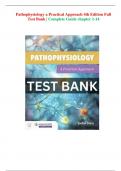
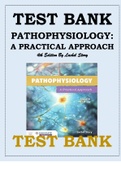
FULL TEST BANK
Test Bank For Pathophysiology: A
Practical Approach 4th Edition By Lachel
Story 9781284205435 Chapter 1- 14 Complete
Guide .
PRINTED PDF | ORIGINAL DIRECTLY FROM THE PUBLISHER | 100%
VERIFIED ANSWERS | DOWNLOAD IMMEDIATELY AFTER THE ORDER
Complete Test bank, All Chapters are included.
For more Test banks, ATI, HESI exams, and more contact us here:
stuviacontact+thenursingnotes@gmail.
com
,Pathophysiology: A Practical Approach: A Practical Approach 4th
Edition Story Test Bank
Chapter 1 Cellular Function
___ 1. An increase in cardiac size and function due to increased workload is termed
A) Atrophy.
B) Functional.
C) Hypertrophy.
D) Inflammation.
___ 2. While assessing a patient diagnosed with Marfan's Syndrome, the nurse should
include which of the following that is consistent with the syndrome?
A) Cardiac assessment for coarctation of the aorta.
B) Genital assessment for small testicles.
C) Mental assessment for impairment.
D) Oral assessment for cleft palate.
___ 3. Children with PKU must avoid phenylalanine in the diet. Phenylalanine is most
likely to be a component of
A) Fat.
B) Sugar.
C) Protein.
D) Carbohydrate.
___ 4. A 17-year-old college-bound student receives a vaccine against an organism that
causes meningitis. This is an example of
A) primary prevention.
B) secondary prevention.
C) tertiary prevention.
D) disease treatment.
___ 5. Metaplasia is
A) The disorganization of cells into various sizes, shapes, and arrangements.
B) The replacement of one differentiated cell type with another.
C) The transformation of a cell type to malignancy.
D) An irreversible cellular adaptation.
WWW.NURSYLAB.COM
, ___ 6. During a routine ultrasound of a 38 year old women 26 weeks gestation reveals a
fetus with a small square head, upward slant of the eyes, and low set ears. The
nurse recognizes that these findings are consistent with which of the following?
A) Fragile X Syndrome.
B) Monosomy X (Turner's Syndrome).
C) Trisomy 21 (Down's Syndrome).
D) Trisomy X (Klinefelter's Syndrome).
___ 7. While discussing treatment options with a parent of a newly diagnosed Monosomy
X (Turner's Syndrome) child, the nurse should include which of the following?
A) There is no treatment or cure.
B) Symptoms of the condition are treated with estrogen.
C) Symptoms of the condition are treated with testosterone.
D) Institutionalization is the preferred method of managing care.
___ 8. Which of the following assessment findings indicates an alteration in homeostatic
control mechanisms?
A) Fever
B) Throat pain
C) Joint stiffness
D) Positive throat culture
___ 9. What information should parents be given about the consequences of
phenylketonuria (PKU)?
A) Mental retardation is inevitable.
B) PKU is commonly associated with other congenital anomalies.
C) High dietary tyramine may help induce enzyme production.
D) Failure to treat properly results in progressive mental retardation.
___ 10. Injury that occurs when blood flow is diminished to tissue is called _____ injury.
A) hypoxic
B) ischemic
C) hyperemic
D) neoplastic
___ 11. Tay sachs is caused by which of the following?
A) A deficiency or absence of hexosaminidase A
B) A defect on chromosome 17 or 22
C) A mutation on chromosome 15
D) An error in converting phenylalanine to tyrosine
WWW.NURSYLAB.COM
, C) A mutation on chromosome 15
D) An error in converting phenylalanine to tyrosine
___ 12. An obese but otherwise healthy teen goes to a health fair and has her blood
pressure checked. This is an example of
A) primary prevention.
B) secondary prevention.
C) tertiary prevention.
D) disease treatment.
___ 13. Characteristics of X-linked recessive disorders include which of the following?
A) The son of a carrier mother has a 25% chance of being affected.
B) Affected fathers transmit the gene to all of their sons.
C) All daughters of affected fathers are carriers.
D) Boys and girls are equally affected.
___ 14. A factor associated with risk of Down syndrome is
A) Maternal age.
B) Maternal alcohol intake.
C) Family history of heritable diseases.
D) Exposure to TORCH syndrome organisms.
___ 15. Which type of gangrene is usually a result of arterial occlusion?
A) Necrosis.
B) Dry.
C) Wet.
D) Gas.
___ 16. The cancer growth continuum is divided into the following stages.
A) Stage 1, Stage 2, Stage 3
B) Initiation, Progression, Promotion
C) Preliminary, Evolutionary, Metastasis
D) Initiation, Promotion, Progression
___ 17. A disease in which the principal manifestation is an abnormal growth of cells
leading to formation of tumors is called a __________ disease.
A) congenital
B) degenerative
C) metabolic
D) neoplastic
WWW.NURSYLAB.COM
Test Bank For Pathophysiology: A
Practical Approach 4th Edition By Lachel
Story 9781284205435 Chapter 1- 14 Complete
Guide .
PRINTED PDF | ORIGINAL DIRECTLY FROM THE PUBLISHER | 100%
VERIFIED ANSWERS | DOWNLOAD IMMEDIATELY AFTER THE ORDER
Complete Test bank, All Chapters are included.
For more Test banks, ATI, HESI exams, and more contact us here:
stuviacontact+thenursingnotes@gmail.
com
,Pathophysiology: A Practical Approach: A Practical Approach 4th
Edition Story Test Bank
Chapter 1 Cellular Function
___ 1. An increase in cardiac size and function due to increased workload is termed
A) Atrophy.
B) Functional.
C) Hypertrophy.
D) Inflammation.
___ 2. While assessing a patient diagnosed with Marfan's Syndrome, the nurse should
include which of the following that is consistent with the syndrome?
A) Cardiac assessment for coarctation of the aorta.
B) Genital assessment for small testicles.
C) Mental assessment for impairment.
D) Oral assessment for cleft palate.
___ 3. Children with PKU must avoid phenylalanine in the diet. Phenylalanine is most
likely to be a component of
A) Fat.
B) Sugar.
C) Protein.
D) Carbohydrate.
___ 4. A 17-year-old college-bound student receives a vaccine against an organism that
causes meningitis. This is an example of
A) primary prevention.
B) secondary prevention.
C) tertiary prevention.
D) disease treatment.
___ 5. Metaplasia is
A) The disorganization of cells into various sizes, shapes, and arrangements.
B) The replacement of one differentiated cell type with another.
C) The transformation of a cell type to malignancy.
D) An irreversible cellular adaptation.
WWW.NURSYLAB.COM
, ___ 6. During a routine ultrasound of a 38 year old women 26 weeks gestation reveals a
fetus with a small square head, upward slant of the eyes, and low set ears. The
nurse recognizes that these findings are consistent with which of the following?
A) Fragile X Syndrome.
B) Monosomy X (Turner's Syndrome).
C) Trisomy 21 (Down's Syndrome).
D) Trisomy X (Klinefelter's Syndrome).
___ 7. While discussing treatment options with a parent of a newly diagnosed Monosomy
X (Turner's Syndrome) child, the nurse should include which of the following?
A) There is no treatment or cure.
B) Symptoms of the condition are treated with estrogen.
C) Symptoms of the condition are treated with testosterone.
D) Institutionalization is the preferred method of managing care.
___ 8. Which of the following assessment findings indicates an alteration in homeostatic
control mechanisms?
A) Fever
B) Throat pain
C) Joint stiffness
D) Positive throat culture
___ 9. What information should parents be given about the consequences of
phenylketonuria (PKU)?
A) Mental retardation is inevitable.
B) PKU is commonly associated with other congenital anomalies.
C) High dietary tyramine may help induce enzyme production.
D) Failure to treat properly results in progressive mental retardation.
___ 10. Injury that occurs when blood flow is diminished to tissue is called _____ injury.
A) hypoxic
B) ischemic
C) hyperemic
D) neoplastic
___ 11. Tay sachs is caused by which of the following?
A) A deficiency or absence of hexosaminidase A
B) A defect on chromosome 17 or 22
C) A mutation on chromosome 15
D) An error in converting phenylalanine to tyrosine
WWW.NURSYLAB.COM
, C) A mutation on chromosome 15
D) An error in converting phenylalanine to tyrosine
___ 12. An obese but otherwise healthy teen goes to a health fair and has her blood
pressure checked. This is an example of
A) primary prevention.
B) secondary prevention.
C) tertiary prevention.
D) disease treatment.
___ 13. Characteristics of X-linked recessive disorders include which of the following?
A) The son of a carrier mother has a 25% chance of being affected.
B) Affected fathers transmit the gene to all of their sons.
C) All daughters of affected fathers are carriers.
D) Boys and girls are equally affected.
___ 14. A factor associated with risk of Down syndrome is
A) Maternal age.
B) Maternal alcohol intake.
C) Family history of heritable diseases.
D) Exposure to TORCH syndrome organisms.
___ 15. Which type of gangrene is usually a result of arterial occlusion?
A) Necrosis.
B) Dry.
C) Wet.
D) Gas.
___ 16. The cancer growth continuum is divided into the following stages.
A) Stage 1, Stage 2, Stage 3
B) Initiation, Progression, Promotion
C) Preliminary, Evolutionary, Metastasis
D) Initiation, Promotion, Progression
___ 17. A disease in which the principal manifestation is an abnormal growth of cells
leading to formation of tumors is called a __________ disease.
A) congenital
B) degenerative
C) metabolic
D) neoplastic
WWW.NURSYLAB.COM