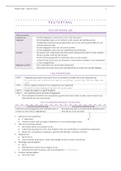
Health Promotion and Disease Prevention (HPDP)
Lecture 1: Introduction
Elementary HPDP aspects:
Able to distinguish lifestyle and risk factors, and HPDP terminology
Able to name and apply different types of prevention and intervention levels
Able to name and determine different tools and instruments for HPDP intervention
Many chronic diseases are influenced by lifestyle factors:
Lifestyle factors: BRAVVO-acronyme
Bewegen, Roken, Alcohol, Voeding, Veilige seks, Ontspannen/stress, or;
PA, Smoking, Alcohol, Nutrition, Safe sex, Stress
Risk factor: when unhealthy behavioural choices are made
PA → low levels of PA
Smoking → >10 cigarettes a day
Alcohol → > 7 units a day
Socio-ecological model: levels of influence over human behaviour:
Health promotion
= maintaining peoples’ current health status...and ideally shifting towards better health
E.g. smoking reduction with the aim of maintaining an optimal respiratory and CV-
system
Disease Prevention
= preventing people getting a disease... and prevent a shift towards the seriousness of a
disease
E.g. smoking reduction with the aim to reduce the chance of getting lung cancer
, Many lifestyle factors focus initially on Health Promotion (increase PA, reduce
smoking) → and then have an effect on Disease Prevention (preventing obesity,
preventing cancer)
Types of prevention:
1) Primary prevention
To prevent (development) of disease
2) Secondary prevention
Screening of disease/early detection
3) Tertiary prevention
Prevent/reduce the seriousness or complications of disease
Prevention targets different population levels:
Universal
Designed to reach entire population, without regard to individual risk factors and
intends to reach a very large audience
Selective
Targets subgroups of general population that are determined to be at risk. Subgroups
may be distinguished by traits such as age, gender, family history, economic status
etc.
Indicated
Involves a screening process and aims to identify individuals who exhibit early signs
of a disease and other problem behaviours
,Intervention levels, and tools or
instruments
Eliminate, restrict,
disincentive e.g.,
legislature/law, sanctions
Incentive, shift, enable e.g.,
pricing, nudging, facilities
Enable, educate e.g.,
education, training
HPDP in real-life setting:
HPDP requires multi factorial interventions in the complexity of real-life settings
Individuals more from setting to setting, and constantly making lifestyle choices,
influences on different levels (intra and interpersonal, institutional, community, policy).
Consequently, interventions are often aimed at a specific setting
Definition of a setting: physical and recognizable structure with predefined
geographical boundaries
Lecture 2: Upstream determinants of lifestyle behaviours and chronic disease
risk
Upstream determinants
= upstream determinants of public health are one of the most useful determinants, because
they try to resolve problems by setting interventions/searching for the cause of the health
problem. These factors lie outside of the control of the individual.
Upstream determinants involve:
Adjust pricing
Adjust environment
Adjustments in law: e.g. fat- and sugar tax
Exposure
= can be defined as environmental and lifestyle behaviours and how these exposures relate
to health, all non-hereditary influences → so everything that is not related to your genome
Genome and exposome upstream determinants interact
, Cortisol (stress hormone) makes you want to flight or fight and for that you need fast energy
> so triggered by all the fast food places
Structering environmental determinants: ANGELO
Micro: individual level
Meso: group level
Macro: community/governmental level
Micro Meso Macro
Socio-cultural
Physical
Economic
Political
The evidence in a nutshell:
Socio-cultural
SEP: huge determinant in lifestyle related chronic diseases/obesity
Social capital
Social network
Economic environment
Evidence mostly from economic field
Healthier diets are more costly
Pricing strategies are effective: taxing/discounts; especially if they are salient (you
also put a sign about the price change; higher or lower)
Effects on NCDs yet to be determined
Political environment
Taxation of SSB
Mandatory food labelling
Car-free streets/Sundays
Advertisement ban
Schools: healthier canteens
Physical education policy
Physical environments
The risk of obesity is higher in urban areas
More green space contributes to less risk of diabetes
Walk ability the higher the better cause less diabetes
Evidence base is relatively thin:
Lecture 1: Introduction
Elementary HPDP aspects:
Able to distinguish lifestyle and risk factors, and HPDP terminology
Able to name and apply different types of prevention and intervention levels
Able to name and determine different tools and instruments for HPDP intervention
Many chronic diseases are influenced by lifestyle factors:
Lifestyle factors: BRAVVO-acronyme
Bewegen, Roken, Alcohol, Voeding, Veilige seks, Ontspannen/stress, or;
PA, Smoking, Alcohol, Nutrition, Safe sex, Stress
Risk factor: when unhealthy behavioural choices are made
PA → low levels of PA
Smoking → >10 cigarettes a day
Alcohol → > 7 units a day
Socio-ecological model: levels of influence over human behaviour:
Health promotion
= maintaining peoples’ current health status...and ideally shifting towards better health
E.g. smoking reduction with the aim of maintaining an optimal respiratory and CV-
system
Disease Prevention
= preventing people getting a disease... and prevent a shift towards the seriousness of a
disease
E.g. smoking reduction with the aim to reduce the chance of getting lung cancer
, Many lifestyle factors focus initially on Health Promotion (increase PA, reduce
smoking) → and then have an effect on Disease Prevention (preventing obesity,
preventing cancer)
Types of prevention:
1) Primary prevention
To prevent (development) of disease
2) Secondary prevention
Screening of disease/early detection
3) Tertiary prevention
Prevent/reduce the seriousness or complications of disease
Prevention targets different population levels:
Universal
Designed to reach entire population, without regard to individual risk factors and
intends to reach a very large audience
Selective
Targets subgroups of general population that are determined to be at risk. Subgroups
may be distinguished by traits such as age, gender, family history, economic status
etc.
Indicated
Involves a screening process and aims to identify individuals who exhibit early signs
of a disease and other problem behaviours
,Intervention levels, and tools or
instruments
Eliminate, restrict,
disincentive e.g.,
legislature/law, sanctions
Incentive, shift, enable e.g.,
pricing, nudging, facilities
Enable, educate e.g.,
education, training
HPDP in real-life setting:
HPDP requires multi factorial interventions in the complexity of real-life settings
Individuals more from setting to setting, and constantly making lifestyle choices,
influences on different levels (intra and interpersonal, institutional, community, policy).
Consequently, interventions are often aimed at a specific setting
Definition of a setting: physical and recognizable structure with predefined
geographical boundaries
Lecture 2: Upstream determinants of lifestyle behaviours and chronic disease
risk
Upstream determinants
= upstream determinants of public health are one of the most useful determinants, because
they try to resolve problems by setting interventions/searching for the cause of the health
problem. These factors lie outside of the control of the individual.
Upstream determinants involve:
Adjust pricing
Adjust environment
Adjustments in law: e.g. fat- and sugar tax
Exposure
= can be defined as environmental and lifestyle behaviours and how these exposures relate
to health, all non-hereditary influences → so everything that is not related to your genome
Genome and exposome upstream determinants interact
, Cortisol (stress hormone) makes you want to flight or fight and for that you need fast energy
> so triggered by all the fast food places
Structering environmental determinants: ANGELO
Micro: individual level
Meso: group level
Macro: community/governmental level
Micro Meso Macro
Socio-cultural
Physical
Economic
Political
The evidence in a nutshell:
Socio-cultural
SEP: huge determinant in lifestyle related chronic diseases/obesity
Social capital
Social network
Economic environment
Evidence mostly from economic field
Healthier diets are more costly
Pricing strategies are effective: taxing/discounts; especially if they are salient (you
also put a sign about the price change; higher or lower)
Effects on NCDs yet to be determined
Political environment
Taxation of SSB
Mandatory food labelling
Car-free streets/Sundays
Advertisement ban
Schools: healthier canteens
Physical education policy
Physical environments
The risk of obesity is higher in urban areas
More green space contributes to less risk of diabetes
Walk ability the higher the better cause less diabetes
Evidence base is relatively thin: