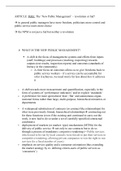
ARTICLE: Pollit: The ‘New Public Management’ – revolution or fad?
in general public managers have more freedom, politicians more control and
public service users more choice
the NPM is not just a fad but neither a revolution
WHAT IS THE NEW PUBLIC MANAGEMENT?
A shift in the focus of management systems and efforts from inputs
(staff, buildings) and processes (teaching, inspecting) towards
outputs (test results, inspection reports) and outcomes (standards of
literacy in the community)
o A clear focus on outcomes allows us to give freedoms back to
public service workers – if a service can be accountable for
what it achieves, we need worry far less about how it achieves
it
A shift towards more measurement and quantification, especially in the
form of systems of ‘performance indicators’ and/or explicit ‘standards’
A preference for more specialized,‘lean’,‘flat’ and autonomous organ-
izational forms rather than large, multi-purpose, hierarchical ministries or
departments
A widespread substitution of contracts (or contract-like relationships) for
what were previously formal, hierarchical relationships contracting out
for these functions (even if the existing unit continued to carry out the
work, it now had to do so under a set of carefully-specified contractual
conditions)
deployment of markets (or market- type) mechanisms (MTMs) for the
delivery of public service not only to use contracts but to do so
through a process of mandatory competitive tendering (= Public services
which used to be run by local councils were forced to put their services to
competitive tendering, allowing private companies to win the right to run
services for a fixed number of years)
emphasis on service quality and a consumer orientation (thus extending
the market analogy by re- defining citizen-users of public services as
‘consumers’)
in general public managers have more freedom, politicians more control and
public service users more choice
the NPM is not just a fad but neither a revolution
WHAT IS THE NEW PUBLIC MANAGEMENT?
A shift in the focus of management systems and efforts from inputs
(staff, buildings) and processes (teaching, inspecting) towards
outputs (test results, inspection reports) and outcomes (standards of
literacy in the community)
o A clear focus on outcomes allows us to give freedoms back to
public service workers – if a service can be accountable for
what it achieves, we need worry far less about how it achieves
it
A shift towards more measurement and quantification, especially in the
form of systems of ‘performance indicators’ and/or explicit ‘standards’
A preference for more specialized,‘lean’,‘flat’ and autonomous organ-
izational forms rather than large, multi-purpose, hierarchical ministries or
departments
A widespread substitution of contracts (or contract-like relationships) for
what were previously formal, hierarchical relationships contracting out
for these functions (even if the existing unit continued to carry out the
work, it now had to do so under a set of carefully-specified contractual
conditions)
deployment of markets (or market- type) mechanisms (MTMs) for the
delivery of public service not only to use contracts but to do so
through a process of mandatory competitive tendering (= Public services
which used to be run by local councils were forced to put their services to
competitive tendering, allowing private companies to win the right to run
services for a fixed number of years)
emphasis on service quality and a consumer orientation (thus extending
the market analogy by re- defining citizen-users of public services as
‘consumers’)