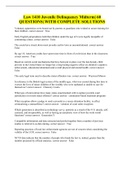
Juvenile Delinquency| 78 QUESTIONS| WITH COMPLETE SOLUTIONS
Discuss the social construction of teenagers and how they are defined. correct answer: Focus on teenagers + conceptualizing them as their own group came when the baby boomer generation hit that age range--more concentration on them as their own group of people Defined as a separate group from both children and adults-> teenagers tend to be impulsive, rebellious, confused/identity-seeking, etc Why is understanding the social construction of teenagers relevant to the study of delinquency? correct answer: We understand teenagers as its own unique category and treat them accordingly. Understanding the definition and public perception of them gives researchers a starting basis for how to study them and how to treat/punish them. What are status offenses? Provide examples correct answer: Status offenses are offenses that are only illegal due to the age of the person committing them. Chronic status offenses indicate problems in the home rather than innate criminality. There are are four most common types: truancy, running away, possession/consumption of alcohol/tobacco, and ungovernability How do status offenses compare with delinquent acts? Provide examples correct answer: Status offenses are only illegal because of the age of the perpetrator. Delinquent acts are inherently against the law for all ages (a status offense would be underage drinking, where a delinquent act would be possession of cocaine) What is the age crime curve and what theories best explain it? correct answer: The idea that most crime is committed by a certain age range (16-24, usually). Theories: youth trying to impress peers, teenagers lack supervision and are more susceptible to crime, as youth mature the costs of crime outweigh the benefits, Why is the age-crime curve relevant to the study of delinquency? correct answer: it focuses primarily on the juvenile population Describe the two methods that FBI uses to collect official data that can be used to study juveniles. correct answer: The UCR (uniform crime report): the number of total arrests/arrests for specific crimes and can be separated by age NIBRS (national incident based reporting system): includes not just arrests but all incidents reported to local agencies-> compiled by the FBI What are the strengths and weaknesses of using official data to study juvenile delinquency? correct answer: Strengths: easy/accessible, separate by ages, routinely conducted, uses same standards
Escuela, estudio y materia
- Institución
- Liberty University
- Grado
- Juvenile Delinquency
Información del documento
- Subido en
- 12 de diciembre de 2022
- Número de páginas
- 9
- Escrito en
- 2022/2023
- Tipo
- Examen
- Contiene
- Preguntas y respuestas
Temas
-
juvenile delinquency| 78 questions| with complete solutions

Documento también disponible en un lote