July 17, 2020 APM346 – Week 10 Justin Ko
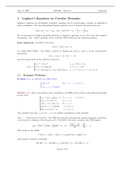
1 Laplace’s Equation on Circular Domains
Laplace’s equation on rotationally symmetric domains can be solved using a change of variables to
polar coordinates. The two dimensional Laplace operator in its Cartesian and polar forms are
1 1
∆u(x, y) = uxx + uyy and ∆u(r, θ) = urr + ur + 2 uθθ .
r r
We are interested in finding bounded solutions to Laplace’s equation, so we often have that implicit
assumption. The “radial” problem will be an Euler ODE which has the following solution.
Euler Equations: An ODE of the form
ax2 y 00 + bxy 0 + cy = 0
are called Euler ODEs. The ODE is solved by finding the roots r1 and r2 of the characteristic
polynomial
C(x) = ax(x − 1) + bx + c = 0
and the general form of the solution is given by
r1 r2
C1 x + C2 x
r1 , r2 ∈ R, r1 6= r2
y(x) = C1 xr + C2 log(x)xr r1 = r2 = r ∈ R
α α
C1 x cos(β log x) + C2 x sin(β log x) r1 = α + iβ, r2 = α − iβ, β 6= 0
1.1 Example Problems
Problem 1.1. (?) (Interior of a Disk) Solve
(
∆u = 0 for r < a, − π ≤ θ ≤ π,
u|r=a = 1 + 2 sin(θ),
Solution 1.1. After converting to polar coordinates, our PDE can be written as the following problem
on the circle
1 1
urr + r ur + r2 uθθ = 0 0 < r < a, −π ≤ θ ≤ π
u(r, −π) = u(r, π) 0<r<a
uθ (r, −π) = uθ (r, π) 0<r<a
u(a, θ) = 1 + 2 sin(θ) −π ≤ θ ≤ π
r→0 u(r, θ) < ∞ −π ≤ θ ≤ π
lim
The condition that limr→0 u(r, θ) < ∞ is an implicit assumption of this problem.
Step 1 — Separation of Variables: The PDE has periodic homogeneous angular boundary conditions,
so we look for a solution of the form u(r, θ) = R(r)Θ(θ). For such a solution, the PDE implies
1 1 r2 R00 + rR0 Θ00
∆u = R00 Θ + R0 Θ + 2 RΘ00 = 0 =⇒ − = = −λ.
r r R Θ
This results in the ODEs
r2 R00 (r) + rR(r) − λR0 (r) = 0 and Θ00 (θ) + λΘ(θ) = 0
with angular boundary conditions
R(r)Θ(−π) = R(r)Θ(π) = 0, R(r)Θ0 (−π) = R(r)Θ0 (π) = 0
Page 1 of 7
, July 17, 2020 APM346 – Week 10 Justin Ko
and radial boundary conditions
R(a)Θ(θ) = 1 + 2 sin(θ) lim R(r)Θ(θ) < ∞.
r→0
For non-trivial solutions to the angle problem, we require R(r) 6≡ 0, Θ(−π) = Θ(π), Θ0 (−π) = Θ0 (π).
Step 2 — Eigenvalue Problem: We now solve the periodic angular eigenvalue problem
(
Θ00 + λΘ = 0
Θ(π) − Θ(−π) = Θ0 (π) − Θ0 (−π) = 0.
The eigenvalues and corresponding eigenfunctions are given by the full Fourier series
λ0 = 0, Θ0 (x) = 1, λn = n2 , Θn (x) = cos(nx), Φn (x) = sin(nx), n = 1, 2, . . . .
Step 3 — Radial Problem: We now solve the radial problem for each eigenvalue. The ODE
r2 R00 + rR0 − λR = 0
is an Euler ODE with solutions
R0 (r) = C0 log r + D0 , Rn (r) = Cn r−n + Dn rn , n = 1, 2, . . .
Since the solution should be regular at 0 (limr→0 R(r) < ∞), we need Cn = 0 for all n ≥ 0, so our
solution is of the form
R0 (r) = D0 , Rn (r) = Dn rn , n = 1, 2, . . .
for some arbitrary coefficients D0 and Dn .
Step 4 — General Solution: Using the principle of superposition, and summing all the eigenfunc-
tions gives us the general solution
∞
X
u(r, θ) = A0 + rn (An cos(nθ) + Bn sin(nθ))
n=1
where A0 , An and Bn are yet to be determined coefficients.
Step 5 — Particular Solution: To find constants A0 , An and Bn we need to use the boundary condition.
Using the boundary condition we get
∞
X
1 + 2 sin(θ) = u(a, θ) = A0 + an (An cos(nθ) + Bn sin(nθ)) .
n=1
Instead of solving for the Fourier series like usual, we can just equate coefficients to see that
2
A0 = 1, a1 A1 = 2 =⇒ A1 = ,
a
and the rest of the coefficients are 0.
Step 6 — Final Answer: To summarize, the solution to the PDE is given by
2
u(r, θ) = 1 + r sin(θ).
a
Page 2 of 7
1 Laplace’s Equation on Circular Domains
Laplace’s equation on rotationally symmetric domains can be solved using a change of variables to
polar coordinates. The two dimensional Laplace operator in its Cartesian and polar forms are
1 1
∆u(x, y) = uxx + uyy and ∆u(r, θ) = urr + ur + 2 uθθ .
r r
We are interested in finding bounded solutions to Laplace’s equation, so we often have that implicit
assumption. The “radial” problem will be an Euler ODE which has the following solution.
Euler Equations: An ODE of the form
ax2 y 00 + bxy 0 + cy = 0
are called Euler ODEs. The ODE is solved by finding the roots r1 and r2 of the characteristic
polynomial
C(x) = ax(x − 1) + bx + c = 0
and the general form of the solution is given by
r1 r2
C1 x + C2 x
r1 , r2 ∈ R, r1 6= r2
y(x) = C1 xr + C2 log(x)xr r1 = r2 = r ∈ R
α α
C1 x cos(β log x) + C2 x sin(β log x) r1 = α + iβ, r2 = α − iβ, β 6= 0
1.1 Example Problems
Problem 1.1. (?) (Interior of a Disk) Solve
(
∆u = 0 for r < a, − π ≤ θ ≤ π,
u|r=a = 1 + 2 sin(θ),
Solution 1.1. After converting to polar coordinates, our PDE can be written as the following problem
on the circle
1 1
urr + r ur + r2 uθθ = 0 0 < r < a, −π ≤ θ ≤ π
u(r, −π) = u(r, π) 0<r<a
uθ (r, −π) = uθ (r, π) 0<r<a
u(a, θ) = 1 + 2 sin(θ) −π ≤ θ ≤ π
r→0 u(r, θ) < ∞ −π ≤ θ ≤ π
lim
The condition that limr→0 u(r, θ) < ∞ is an implicit assumption of this problem.
Step 1 — Separation of Variables: The PDE has periodic homogeneous angular boundary conditions,
so we look for a solution of the form u(r, θ) = R(r)Θ(θ). For such a solution, the PDE implies
1 1 r2 R00 + rR0 Θ00
∆u = R00 Θ + R0 Θ + 2 RΘ00 = 0 =⇒ − = = −λ.
r r R Θ
This results in the ODEs
r2 R00 (r) + rR(r) − λR0 (r) = 0 and Θ00 (θ) + λΘ(θ) = 0
with angular boundary conditions
R(r)Θ(−π) = R(r)Θ(π) = 0, R(r)Θ0 (−π) = R(r)Θ0 (π) = 0
Page 1 of 7
, July 17, 2020 APM346 – Week 10 Justin Ko
and radial boundary conditions
R(a)Θ(θ) = 1 + 2 sin(θ) lim R(r)Θ(θ) < ∞.
r→0
For non-trivial solutions to the angle problem, we require R(r) 6≡ 0, Θ(−π) = Θ(π), Θ0 (−π) = Θ0 (π).
Step 2 — Eigenvalue Problem: We now solve the periodic angular eigenvalue problem
(
Θ00 + λΘ = 0
Θ(π) − Θ(−π) = Θ0 (π) − Θ0 (−π) = 0.
The eigenvalues and corresponding eigenfunctions are given by the full Fourier series
λ0 = 0, Θ0 (x) = 1, λn = n2 , Θn (x) = cos(nx), Φn (x) = sin(nx), n = 1, 2, . . . .
Step 3 — Radial Problem: We now solve the radial problem for each eigenvalue. The ODE
r2 R00 + rR0 − λR = 0
is an Euler ODE with solutions
R0 (r) = C0 log r + D0 , Rn (r) = Cn r−n + Dn rn , n = 1, 2, . . .
Since the solution should be regular at 0 (limr→0 R(r) < ∞), we need Cn = 0 for all n ≥ 0, so our
solution is of the form
R0 (r) = D0 , Rn (r) = Dn rn , n = 1, 2, . . .
for some arbitrary coefficients D0 and Dn .
Step 4 — General Solution: Using the principle of superposition, and summing all the eigenfunc-
tions gives us the general solution
∞
X
u(r, θ) = A0 + rn (An cos(nθ) + Bn sin(nθ))
n=1
where A0 , An and Bn are yet to be determined coefficients.
Step 5 — Particular Solution: To find constants A0 , An and Bn we need to use the boundary condition.
Using the boundary condition we get
∞
X
1 + 2 sin(θ) = u(a, θ) = A0 + an (An cos(nθ) + Bn sin(nθ)) .
n=1
Instead of solving for the Fourier series like usual, we can just equate coefficients to see that
2
A0 = 1, a1 A1 = 2 =⇒ A1 = ,
a
and the rest of the coefficients are 0.
Step 6 — Final Answer: To summarize, the solution to the PDE is given by
2
u(r, θ) = 1 + r sin(θ).
a
Page 2 of 7