Standard First Aid, CPR, and AED Pre-Test Examination verified answers
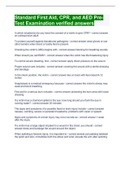
Standard First Aid, CPR, and AED Pre-Test Examination verified answers In which situation(s) do you have the consent of a victim to give CPR? an unresponsive adult To protect yourself against bloodborne pathogens wear gloves or use other barriers when blood or bodily fluid is present Checking the victim's ABCs begins with listening for breathing sounds When should you call EMS? when the victim has life threatening injury To control severe bleeding, first apply direct pressure on the wound Proper wound care includes covering the wound with a sterile dressing and bandage In the shock position, the victim lies on back with feet raised 8-12 inches Anaphylaxis is a medical emergency because the victim's airway may swell and block breathing First aid for a serious burn includes protecting the burn area with loose dressing If a victim has a chemical spilled in the eye, how long should you flush the eye in running water? 20 minutes The signs and symptoms of a possible head or brain injury include nausea, vomiting, severe or persistent headache; problems with vision or speech Signs and symptoms of a brain injury may occur as late as 1 week after the injury If a victim has a large object impaled in a wound in the chest, you should dress and bandage the wound around the object When splinting a forearm injury, it is important to put padding between the splint and skin; immobilize both the elbow and wrist; elevate the arm after splinting When putting ice on a a sprained ankle, keep the ice on the ankle 30 minutes then off for at least 30 minutes When a victim has persistent chest pressure or pain call 911 immediately Help protect a victim having a seizure from being injured by putting a pillow or folded coat under the victim's head If you know the victim is diabetic and is having a diabetic emergency, but you do not show whether it is a problem of high or low blood sugar, you should give the victim sugar The first thing to do for a responsive victim who has swallowed a poisonous substance is to call the poison control center If someone is bitten by a dog, the first thing you should do is clean the wound with soap and water The signs and symptoms of an allergic reaction to a bee sting may include difficulty breathing An effective way to warm a victim of hypothermia is to cover the victim with blankets The signs and symptoms of heatstroke include hot flushed skin If you are the first on the scene of a vehicle crash, you should try to help an unresponsive driver by supporting the victim's head and neck if you can safely reach into the vehicle It may be acceptable to move a seriously injured victim if fire or an explosion is likely; poisonous fumes are present; the victim is in the way of another seriously injured victim The first step in the cardiac chain of survival is early access Basic life support is often needed for victims of choking, drowning, or heat attack For purposes of performing basic life support techniques, a child is defined as someone between the ages of 1 and 8 The recovery position is used for a victim who is unresponsive and breathing Rescue breathing is performed on a victim after the chest compressions of CPR have begun To open an unresponsive victim's airway when a spinal injury is not suspected tilt the head back and liftt he chin To make sure your air is going into the victim's lungs during rescue breathing watch the victim's chest rise and fall; listen for the rushing sound of air filling the lungs; blow hard to the point of feeling resistance The purpose of using a barrier device during rescue breathing is to prevent transmission of infections Rescue breathing is given to adults at a rate of 1 breath every 1 second Rescue breathing is given to infants and children at a rate of 1 breath every 3 seconds If a victim who is choking is coughing, you should encourage continued coughing to expel the object The hand position to give abdominal thrusts to a responsive choking child or adult is in the middle of the abdomen just above the navel Choking care for a responsive infant includes alternating back blows and chest thrusts If the responsive choking adult to whom you are giving abdominal thrusts suddenly becomes unresponsive, what should you do? start CPR The correct hand position for chest compressions in CPR for an adult or child is on the lower half of the breastbone midway between nipples The correct hand position for chest compression in CPR for an infant is one finger-width below an imaginary line between the nipples Give chest compressions in CPR to an adult at a rate of 100 compressions per minute The depth of chest compressions in CPR for an adult is 2 to 2 1/2 minutes In CPR for an adult, what is the correct ratio of compressions to breaths? 30 to 2 In CPR for an infant or child, what is the correct ratio of compressions to breaths? 15 to 1 Once you have begun CPR you should continue until the victim shows signs of circulation or breathing; an AED is brought to the scene and is ready to use; EMS personnel arrive and take over An AED works by shocking the heart to restore a normal rhythm when the heart is filibrating An AED should be used on a victim without signs of circulation as soon as possible To use the AED appropriately position the victim on their back; keep victim away from water; dry the victim's chest if necessary before applying pads When connected properly to the victim, the AED unit will advise you when to give a shock; check the victim's circulation and give CPR; wait for the unit to analyze the victim's heart rhythm Following universal precautions mean always assuming blood and other bodily fluids may be infected Checking for signs of circulation involves looking for tingling sensations in the hands and feet You should gently press on wound edges to promote some bleeding with: a puncture wound that is not bleeding Which of the following is a sign that you may have wrapped a circular bandage to tightly around a victim's arm? victim's fingers are tingling An important first aid step for a victim with a large third- degree burn is to prevent shock The signs and symptoms of a possible spinal injury may include breathing problems and inability to move body parts The first aid for a fracture includes immobilizing the fracture area Someone who has asthma may have which medication to use if an asthma attack occurs? an inhaler The sign and symptoms of carbon monoxide poisoning may include headache, dizziness, nausea The first aid for frostbitten fingers include putting dry gauze or fluffy cloth between the fingers "Early access" in the cardiac chain of survival refers to starting CPR right away for a victim without signs of circulation Basic life support is care given to a victim who is not breathing or whose heart has stopped The recovery position is used for an unresponsive victim to help keep the airway open; allow fluids to drain from the mouth; prevent inhaling stomach contents if the victim vomits Rescue breathing is given to all victims who are not breathing
Escuela, estudio y materia
- Institución
- POST First Responder First Aid
- Grado
- POST First Responder First Aid
Información del documento
- Subido en
- 10 de diciembre de 2022
- Número de páginas
- 5
- Escrito en
- 2022/2023
- Tipo
- Examen
- Contiene
- Preguntas y respuestas
Temas
-
standard first aid
-
cpr
-
and aed pre test examination verified answers
-
in which situations do you have the consent of a victim to give cpr an unresponsive adult
-
to protect yourself against bloodbor

Documento también disponible en un lote