MC
ATC
Cost
Increasing returns - fixed Diminishing returns
factors used more reflected in rising unit
efficiently costs
C1
Optimum output
(MC = ATC)
0
O1
Output
Costs in the long run
A A - B = Increasing returns
to scale or economies of
Costs scale
MC
SATC
Diseconomie
B s of scale
LRAC Minimum
efficient scale
Output
, Economies of scale: The benefits gained from falling long-run average costs as the
scale of output increases.
Diseconomies of scale: Where long-run average costs increase as the scale of
output increases.
Economies of scale
Internal economies of scale: The benefits that accrue to a firm as a result of its
decision to produce on a larger scale.
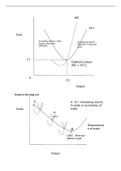
Economies of scale can only accrue to a firm in the long run. Internal economies of
scale occur because the firm’s output is rising proportionately faster than the inputs,
hence the firm is increasing returns to scale. If the increase in output is proportional
to the increase in inputs, the firm will get constant returns to scale and the LRAC will
be horizontal. If the increase in output is less than proportional, the firm will see
diminishing returns to scale or diseconomies of scale.
The principal advantage for a firm benefiting from economies of scale is a decrease
in the cost per unit produced. The possible benefits or economies depend on the
nature of the economic activity:
● Technical economies: These are the advantages made directly in the
production process. Some production techniques only become viable once a
certain level of output is reached. For example, the growth in size of container
vessels allowed more products to be carried.
● Purchasing economies: As firms increase their purchasing power with
suppliers. Through bulk buying, they are able to purchase units more cheaply,
thus decreasing their average costs.
● Marketing economies: Large-scale firms are able to promote their products
on TV and in newspapers at lower rates because they are able to purchase
large quantities of air time and space. They are also likely to be able to make
savings in their costs of distribution because of the large volumes of products
being shipped.
● Managerial economies: In large-scale firms these come about as a result of
specialisation. Experts can be hired to manage operations, finance, human
resources, sales, logistics… In smaller firms these tasks are often performed
by a single manager multi-tasking.
● Technological economies: Many firms can save money through the
application of online ordering and booking systems. They do not need to
employ as many people, therefore reducing their average cost.
ATC
Cost
Increasing returns - fixed Diminishing returns
factors used more reflected in rising unit
efficiently costs
C1
Optimum output
(MC = ATC)
0
O1
Output
Costs in the long run
A A - B = Increasing returns
to scale or economies of
Costs scale
MC
SATC
Diseconomie
B s of scale
LRAC Minimum
efficient scale
Output
, Economies of scale: The benefits gained from falling long-run average costs as the
scale of output increases.
Diseconomies of scale: Where long-run average costs increase as the scale of
output increases.
Economies of scale
Internal economies of scale: The benefits that accrue to a firm as a result of its
decision to produce on a larger scale.
Economies of scale can only accrue to a firm in the long run. Internal economies of
scale occur because the firm’s output is rising proportionately faster than the inputs,
hence the firm is increasing returns to scale. If the increase in output is proportional
to the increase in inputs, the firm will get constant returns to scale and the LRAC will
be horizontal. If the increase in output is less than proportional, the firm will see
diminishing returns to scale or diseconomies of scale.
The principal advantage for a firm benefiting from economies of scale is a decrease
in the cost per unit produced. The possible benefits or economies depend on the
nature of the economic activity:
● Technical economies: These are the advantages made directly in the
production process. Some production techniques only become viable once a
certain level of output is reached. For example, the growth in size of container
vessels allowed more products to be carried.
● Purchasing economies: As firms increase their purchasing power with
suppliers. Through bulk buying, they are able to purchase units more cheaply,
thus decreasing their average costs.
● Marketing economies: Large-scale firms are able to promote their products
on TV and in newspapers at lower rates because they are able to purchase
large quantities of air time and space. They are also likely to be able to make
savings in their costs of distribution because of the large volumes of products
being shipped.
● Managerial economies: In large-scale firms these come about as a result of
specialisation. Experts can be hired to manage operations, finance, human
resources, sales, logistics… In smaller firms these tasks are often performed
by a single manager multi-tasking.
● Technological economies: Many firms can save money through the
application of online ordering and booking systems. They do not need to
employ as many people, therefore reducing their average cost.