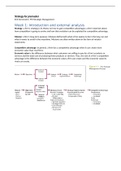
Strategy for premaster
Erik Sonneveld | PM Strategic Management
Week 1: Introduction and external analysis
Strategy: a firm’s strategy is its theory on how to gain competitive advantages; a firm’s best bet about
how competition is going to evolve and how that evolution can be exploited for competitive advantage.
Mission: a firm’s long-term purpose. Missions define both what a firm aspires to be in the long run and
what it wants to avoid in the meantime. Missions are often written down in the form of mission
statements.
Competitive advantage: In general, a firm has a competitive advantage when it can create more
economic value than rival firms.
Economic value is the difference between what customers are willing to pay for a firm’s products or
services and the total cost of producing these products or services. Thus, the size of a firm’s competitive
advantage is the difference between the economic value a firm can create and the economic value its
rivals can create.
,Economic value created: the difference between perceived benefits gained by a customer and the full
economic costs. Triangle + square
Triangle: consumer surplus
Square: producer surplus
Consumer surplus: value (willingness to pay) – price
Producer surplus: price – cost
Economic value created: value – cost OR cs + ps
A firm’s competitive advantage can be measured in 2 ways:
1. Accounting performance = looking at the published profit and loss and balance sheet statement
(blz36 ratio’s), be careful with different standards or countries
2. Economic measures = compare the level of return to its costs of capital
Accounting measures:
Profit ratio is revenue divided by assets for example employees
Liquidity ratio is how easy a company can pay back short term debt, flexibility in short term
money
Leverage ratio is how easy you can get more money to finance for new debt / investments
Activity ratio is how quickly your inventory is used or processes happen
Economic measures:
The costs of debt
The costs of equity
Weighted average costs of capital (WACC)
o When the WACC is lower than the ROA, the company is performing above expectations
o When your ROA is lower than the industry’s average ROA it is not a good thing
Competitive advantage is when your ratio is higher than the industry’s
,Levels of analysis in external environment
Part of task environment
General Environment
Industry
Strategic Group
Individual Firm
Internal/competitor
Strategic groups: Set of companies with similar strategies (strategy dimensions)
For ex. Aldi and Lidl > Lidl and AH are NOT in the same strategic group
More competition within strategic groups than between strategic groups
Not all groups have the same profitability
Possible mobility barriers between groups
General external environment
The general environment is outside of the industry and is about trends, things that are changing
• Demographics trends (only numbers): age, sex, marital status income, ethnicity and other
personal attributes that might affect buying patterns (only numbers, based on other categories)
• Culture trends: values, beliefs and norms that guide behaviour in society
• Economic climate: the overall health of the economic systems within which a firm operates
• Legal and political conditions: the law and legal system's impact on business, together with the
general nature of the relationship between government and business
• Specific international events (Ecological in European models): events like (civil) wars, political
coup, terrorism, famines which have an effect on the firm’s ability to generate a competitive
advantage
• Technological change: A shift in the frontier of technological possibilities and the underlying
infrastructure (infrastructure 5G, internet)
Industry: Set of companies that fulfil a similar need with a similar production process
Too narrow: actual competitors are labelled substitutes or new entrants
Too broad: actual substitutes are labelled direct competitors
Market: Collection of customers
The Structure–Conduct–Performance Model
, • Originally developed to spot anti-competitive conditions for anti-trust purposes
• Came to be used to assess the possibilities for above normal profits for firms within an industry
Porters 5 forces:
Threat from existing competitors
• Large numbers of competitors
• Slow or declining industry growth
• Low product differentiation (leading to low customer loyalty and switching costs)
• Industry capacity added in large increments
Threat from new competitors (not yet active in the industry)
• High industry growth rate
• Low barriers of entry
• Economies of scale
• Product differentiation
• Government regulation of entry
• Retaliation of incumbent
• Proprietary technology
• Managerial know-how
• Favourable access to raw materials
• Learning-curve cost advantages
Threat of substitute products
Substitutes are from a different industry but fulfil similar need
Coke and Pepsi are rivals, milk is a substitute for both.
• High potential of fulfilling the same need (high quality)
• Low switching costs for customers
Also think about the person spending money, what can they also do with this money
Threat of supplier leverage
• Small number of firms in supplier’s industry
• Highly differentiated product
• Lack of close substitutes for suppliers’ products
• Focal firm is an insignificant customer of supplier
• High switching costs for focal firm
Threat from buyer’s influence
• Small number of buyers
• Low level differentiation
• Low switching costs
End-consumers such as customers from Domino’s Pizza usually have a low buyer influence
if a company for example accounts for 20% of your profit, then it has high buyer influence
Complementors as a sixth force
• Customers value the focal firm’s products more when the customers also own the product of
the other firm. Complementors increase the size of the market.
Example: game consoles. Complementor: the games you can play. Or airline industry – hotel industry.
Drawbacks 5 forces
Erik Sonneveld | PM Strategic Management
Week 1: Introduction and external analysis
Strategy: a firm’s strategy is its theory on how to gain competitive advantages; a firm’s best bet about
how competition is going to evolve and how that evolution can be exploited for competitive advantage.
Mission: a firm’s long-term purpose. Missions define both what a firm aspires to be in the long run and
what it wants to avoid in the meantime. Missions are often written down in the form of mission
statements.
Competitive advantage: In general, a firm has a competitive advantage when it can create more
economic value than rival firms.
Economic value is the difference between what customers are willing to pay for a firm’s products or
services and the total cost of producing these products or services. Thus, the size of a firm’s competitive
advantage is the difference between the economic value a firm can create and the economic value its
rivals can create.
,Economic value created: the difference between perceived benefits gained by a customer and the full
economic costs. Triangle + square
Triangle: consumer surplus
Square: producer surplus
Consumer surplus: value (willingness to pay) – price
Producer surplus: price – cost
Economic value created: value – cost OR cs + ps
A firm’s competitive advantage can be measured in 2 ways:
1. Accounting performance = looking at the published profit and loss and balance sheet statement
(blz36 ratio’s), be careful with different standards or countries
2. Economic measures = compare the level of return to its costs of capital
Accounting measures:
Profit ratio is revenue divided by assets for example employees
Liquidity ratio is how easy a company can pay back short term debt, flexibility in short term
money
Leverage ratio is how easy you can get more money to finance for new debt / investments
Activity ratio is how quickly your inventory is used or processes happen
Economic measures:
The costs of debt
The costs of equity
Weighted average costs of capital (WACC)
o When the WACC is lower than the ROA, the company is performing above expectations
o When your ROA is lower than the industry’s average ROA it is not a good thing
Competitive advantage is when your ratio is higher than the industry’s
,Levels of analysis in external environment
Part of task environment
General Environment
Industry
Strategic Group
Individual Firm
Internal/competitor
Strategic groups: Set of companies with similar strategies (strategy dimensions)
For ex. Aldi and Lidl > Lidl and AH are NOT in the same strategic group
More competition within strategic groups than between strategic groups
Not all groups have the same profitability
Possible mobility barriers between groups
General external environment
The general environment is outside of the industry and is about trends, things that are changing
• Demographics trends (only numbers): age, sex, marital status income, ethnicity and other
personal attributes that might affect buying patterns (only numbers, based on other categories)
• Culture trends: values, beliefs and norms that guide behaviour in society
• Economic climate: the overall health of the economic systems within which a firm operates
• Legal and political conditions: the law and legal system's impact on business, together with the
general nature of the relationship between government and business
• Specific international events (Ecological in European models): events like (civil) wars, political
coup, terrorism, famines which have an effect on the firm’s ability to generate a competitive
advantage
• Technological change: A shift in the frontier of technological possibilities and the underlying
infrastructure (infrastructure 5G, internet)
Industry: Set of companies that fulfil a similar need with a similar production process
Too narrow: actual competitors are labelled substitutes or new entrants
Too broad: actual substitutes are labelled direct competitors
Market: Collection of customers
The Structure–Conduct–Performance Model
, • Originally developed to spot anti-competitive conditions for anti-trust purposes
• Came to be used to assess the possibilities for above normal profits for firms within an industry
Porters 5 forces:
Threat from existing competitors
• Large numbers of competitors
• Slow or declining industry growth
• Low product differentiation (leading to low customer loyalty and switching costs)
• Industry capacity added in large increments
Threat from new competitors (not yet active in the industry)
• High industry growth rate
• Low barriers of entry
• Economies of scale
• Product differentiation
• Government regulation of entry
• Retaliation of incumbent
• Proprietary technology
• Managerial know-how
• Favourable access to raw materials
• Learning-curve cost advantages
Threat of substitute products
Substitutes are from a different industry but fulfil similar need
Coke and Pepsi are rivals, milk is a substitute for both.
• High potential of fulfilling the same need (high quality)
• Low switching costs for customers
Also think about the person spending money, what can they also do with this money
Threat of supplier leverage
• Small number of firms in supplier’s industry
• Highly differentiated product
• Lack of close substitutes for suppliers’ products
• Focal firm is an insignificant customer of supplier
• High switching costs for focal firm
Threat from buyer’s influence
• Small number of buyers
• Low level differentiation
• Low switching costs
End-consumers such as customers from Domino’s Pizza usually have a low buyer influence
if a company for example accounts for 20% of your profit, then it has high buyer influence
Complementors as a sixth force
• Customers value the focal firm’s products more when the customers also own the product of
the other firm. Complementors increase the size of the market.
Example: game consoles. Complementor: the games you can play. Or airline industry – hotel industry.
Drawbacks 5 forces