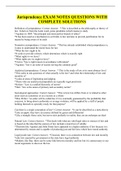
Jurisprudence EXAM NOTES QUESTIONS WITH COMPLETE SOLUTIONS
Definition of jurisprudence: Correct Answer: * This is described as the philosophy or theory of law. It derives from the Latin word, juries prudentia (which means to study *Aquinas in 1809: "the principal and most perfect branch of ethics" *It has been used as a mechanism to set limits to law and also to provide justification for its means by being aware of its ends Normative jurisprudence: Correct Answer: *This has already established what jurisprudence is, it aims to understand the moral basis for law *What the law ought to be *It seeks to provide a theory which determines which is morally right *What rights to we have? *What rights are we ought to have? *Cierco: "law is right reason in accordance with nature" *Aquinas: "law is an order of reason serving the common good" Analytical jurisprudence: Correct Answer: * This is the study of law at its most abstract level *This seeks to ask questions of what actually is the law? and what the relationship of law and morality is? *Looks at areas of legislating and judging *Those who are analytical jurisprudists are typically legal positivists *Kelsen: "Law is a unified hierarchy of norms" *Hart: "law is the union of primary and secondary norms" Sociological approaches: Correct Answer: *This is how law differs from or is related to other areas such as economics or as a society as a whole *Max Weber: "an order will be called law if it is externally guaranteed by the probability that coercion, to bring about conformity or avenge violation, will be applied by a staff of people holding themselves specially ready for that purpose" Can there is a single conception of law?: Correct Answer: *it can be described as a meta-theory *Like an apple: they have an essence defined by genus and differential *Like a triangle: these exist, but never exist perfectly in reality, they are an archetype an ideal Natural Law: Correct Answer: *This deals with what are valid legal rules or sources of law and is based on the idea that the sources of law include a moral test of validity *Theorists like Aquinas and John Finnis have appealed to a higher authority if law because it is determined by reason and is capable of producing just and fair laws which have moral authority Legal positivism: Correct Answer: *Classical, there is no connection between law and morality *only law enacted by government or the state have legal authority *Modern, like Raz, there can be some link between morality and law but it is unnecessary to use moral arguments to discover the law
Escuela, estudio y materia
- Institución
- Liberty University
- Grado
- Jurisprudence
Información del documento
- Subido en
- 4 de diciembre de 2022
- Número de páginas
- 21
- Escrito en
- 2022/2023
- Tipo
- Examen
- Contiene
- Preguntas y respuestas
Temas
-
jurisprudence exam notes questions with complete solutions

Documento también disponible en un lote