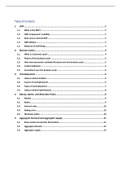
Table of Contents
1. GDP ........................................................................................................................... 2
1.1. What is the GDP?........................................................................................................... 2
1.2. GDP components’ volatility ........................................................................................... 2
1.3. Real versus nominal GDP ............................................................................................... 3
1.4. GDP deflator .................................................................................................................. 3
1.5. Measure of well-being ................................................................................................... 3
2. Business Cycles........................................................................................................... 4
2.1. What is a business cycle? ............................................................................................... 4
2.2. Phases of the business cycle .......................................................................................... 4
2.3. How macroeconomic variables fluctuate over the business cycle................................... 5
2.4. Cyclical indicators .......................................................................................................... 5
2.5. Investment over the business cycle ............................................................................... 6
3. Unemployment .......................................................................................................... 6
3.1. Labour market statistics ................................................................................................ 6
3.2. Causes of unemployment .............................................................................................. 6
3.3. Types of unemployment ................................................................................................ 7
3.4. Labour market imperfections......................................................................................... 8
4. Money, Banks, and Monetary Policy .......................................................................... 8
4.1. Money ........................................................................................................................... 8
4.2. Banks............................................................................................................................. 9
4.3. Interest rates ................................................................................................................10
4.4. Baking crisis ..................................................................................................................10
4.5. Monetary policy ...........................................................................................................10
5. Aggregate Demand and Aggregate Supply .............................................................. 11
5.1. Basic model of economic fluctuations ...........................................................................11
5.2. Aggregate demand .......................................................................................................12
5.3. Aggregate supply ..........................................................................................................13
, 1. GDP
1.1. What is the GDP?
• Gross Domestic Product (GDP) is the total market value of all final goods and services
produced within a country in a given period of time.
o Where output is valued at market prices and only the value of final goods is recorded
and therefore the value is counted only once.
o It includes both tangible and intangible (e.g. food, clothing, cars) and intangible
services (e.g. haircuts, house cleaning).
o Includes goods produced in the period being considered, not transactions including
goods produced in the past.
o It measures the value of production within the geographic confines of a country.
o It usually measures the value of production in a year or quarter (three months).
• There are two ways of measuring GDP – the income approach and the expenditure approach
– since both income and expenditure of an economy are equal, considering that every
transaction has a buyer and seller.
o Flow-of-cost or income approach: GDP (Y) = Wages + Rents + Interest + Profit
o Flow-of-product or expenditure approach: GDP = C + I + G + NX
§ Consumption (C): The spending on capital equipment, inventories, and
structures, including new housing
§ Government spending (G): The spending on goods and services by local and
central governments. Does not include transfer payments because they are
not made in exchange for currently produced goods or services
§ Net exports (NX) = Exports – Imports: Exports are included but imports are
excluded. Hence, GDP includes value added, income from domestic
production or consumption of it.
• GDP provides useful information to businesses. For instance, there is a close relationship
between GDP and aggregate demand. That is, if GDP is growing fast, demand is likely to have
to the same pattern, and if demand is expected to grow fast, most managers will be optimistic
about sales, which will increase investment. Moreover, expected changes in sales will affect
employment, inventory held, investment, and budgeting.
1.2. GDP components’ volatility
• Consumption:
o Consumption smoothing is a source of stabilisation in an economy.
o When there are limitations to consumption smoothing (e.g. credit constraints:
households cannot borrow as much as they wish) this stabilisation effect is limited (it
may even amplify the initial shock).
o To understand the business cycle and how to manage it we must keep this into
account
• Investment:
1. GDP ........................................................................................................................... 2
1.1. What is the GDP?........................................................................................................... 2
1.2. GDP components’ volatility ........................................................................................... 2
1.3. Real versus nominal GDP ............................................................................................... 3
1.4. GDP deflator .................................................................................................................. 3
1.5. Measure of well-being ................................................................................................... 3
2. Business Cycles........................................................................................................... 4
2.1. What is a business cycle? ............................................................................................... 4
2.2. Phases of the business cycle .......................................................................................... 4
2.3. How macroeconomic variables fluctuate over the business cycle................................... 5
2.4. Cyclical indicators .......................................................................................................... 5
2.5. Investment over the business cycle ............................................................................... 6
3. Unemployment .......................................................................................................... 6
3.1. Labour market statistics ................................................................................................ 6
3.2. Causes of unemployment .............................................................................................. 6
3.3. Types of unemployment ................................................................................................ 7
3.4. Labour market imperfections......................................................................................... 8
4. Money, Banks, and Monetary Policy .......................................................................... 8
4.1. Money ........................................................................................................................... 8
4.2. Banks............................................................................................................................. 9
4.3. Interest rates ................................................................................................................10
4.4. Baking crisis ..................................................................................................................10
4.5. Monetary policy ...........................................................................................................10
5. Aggregate Demand and Aggregate Supply .............................................................. 11
5.1. Basic model of economic fluctuations ...........................................................................11
5.2. Aggregate demand .......................................................................................................12
5.3. Aggregate supply ..........................................................................................................13
, 1. GDP
1.1. What is the GDP?
• Gross Domestic Product (GDP) is the total market value of all final goods and services
produced within a country in a given period of time.
o Where output is valued at market prices and only the value of final goods is recorded
and therefore the value is counted only once.
o It includes both tangible and intangible (e.g. food, clothing, cars) and intangible
services (e.g. haircuts, house cleaning).
o Includes goods produced in the period being considered, not transactions including
goods produced in the past.
o It measures the value of production within the geographic confines of a country.
o It usually measures the value of production in a year or quarter (three months).
• There are two ways of measuring GDP – the income approach and the expenditure approach
– since both income and expenditure of an economy are equal, considering that every
transaction has a buyer and seller.
o Flow-of-cost or income approach: GDP (Y) = Wages + Rents + Interest + Profit
o Flow-of-product or expenditure approach: GDP = C + I + G + NX
§ Consumption (C): The spending on capital equipment, inventories, and
structures, including new housing
§ Government spending (G): The spending on goods and services by local and
central governments. Does not include transfer payments because they are
not made in exchange for currently produced goods or services
§ Net exports (NX) = Exports – Imports: Exports are included but imports are
excluded. Hence, GDP includes value added, income from domestic
production or consumption of it.
• GDP provides useful information to businesses. For instance, there is a close relationship
between GDP and aggregate demand. That is, if GDP is growing fast, demand is likely to have
to the same pattern, and if demand is expected to grow fast, most managers will be optimistic
about sales, which will increase investment. Moreover, expected changes in sales will affect
employment, inventory held, investment, and budgeting.
1.2. GDP components’ volatility
• Consumption:
o Consumption smoothing is a source of stabilisation in an economy.
o When there are limitations to consumption smoothing (e.g. credit constraints:
households cannot borrow as much as they wish) this stabilisation effect is limited (it
may even amplify the initial shock).
o To understand the business cycle and how to manage it we must keep this into
account
• Investment: