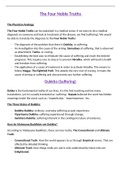
The Four Noble Truths
The Physician Analogy:
The Four Noble Truths can be explained in a medical sense. If we were to do a medical
diagnosis on someone and look at treatment of the disease, we find (suffering). We would
be able to translate the diagnosis to the Four Noble Truths:
- The diagnosis of the problem that there is Dukkha, or suffering.
- An investigation into the cause of the arising, Samudaya of suffering, that is observed
as attachment, Tanha, or craving.
- Establishing the best way to eliminate the cause of suffering and reach the desired
prognosis. This requires one to stop or to prevent Nirodha, which will lead to health
and freedom from suffering.
- The application of a cause of treatment in order to activate Nirodha. This means to
follow Magga, The Eightfold Path. This attacks the very root of craving. It treats the
cause of arising or suffering and also prevents any further suffering.
Dukkha (Suffering)
Dukka is the fundamental reality of our lives, it is the first teaching and has many
translations, yet it is usually translated as ‘suffering.’ Rapula believed the word has hidden
meanings inside the word, such as; ‘imperfection,’ ‘impermanence,’ etc.
The Three States of Dukkha:
- Dukkha Dukkha: ordinary, everyday suffering as pain experience.
- Viparinama Dukkha: suffering experienced through change.
- Sankhara Dukkha: suffering inherent in the contingent nature of existence.
How do Mahayana Buddhists see Dukkha?
According to Mahayana Buddhists, there are two truths; The Conventional and Ultimate
Truth:
- Conventional Truth: How the world appears to us through Empirical senses. That are
affected by deluded thinking.
- Ultimate Truth: How things really are and is only understood by those who are
Enlightened.
, Therefore, the Dukkha is only visible to deluded beings who see the Conventional Truth. It
is not an Ultimate Truth as it can be destroyed and only truths that are eternal are held
there. Once we reach Nirvana, we see that the idea of Dukkha is not truly real.
According to the Heart Sutra “There is no … suffering, no origin of suffering, no cessation of
suffering and no path.” This is because of The Buddhist idea of Sunyata – that if everything
is interdependent, then is has no true being and so is ultimately empty. Only an
Enlightened being will truly understand that suffering and the causes of suffering, Nirvana
and all Buddhist teachings have no real reality when they understand them when we see it
from an Enlightened point of view.
Is Dukkha pessimistic?
In my view, Dukkha attempts to explain the root cause of suffering which brings happiness
in knowing it and helps us to keep on moving on the path to Enlightenment.
It is pessimistic
- Our whole life is suffering.
- Everyone must suffer.
- Happiness is now suffering as you try to recreate memories or a ‘Nostos.’
It isn’t pessimistic
- Makes life more optimistic.
- Helps you understand suffering by allowing you to see the importance of suffering
(Four Noble Truths).
- True happiness is achieved through suffering.
Tanha (Craving that causes Samudaya)
Tanha can be defined as ‘craving’ or thirst but can also be translated as attachment. It is
described by Narada Thera as “a powerful mental force latent in all.” And, by Walpola
Rahula as “Not the first or the only cause of the arising of Dukkha, but it is the most
individual case.”
Tanha is driven by the three poisons or fires of Lobha (Greed), Dosa (Hatred) and Moha
(Delusion). These fires burn away and fuel the idea of, and desire for, a self.
The Three Types of Tanha:
- Craving for sensual pleasures (pleasures that are initiated by interaction with the
sense of sight, sound, smell, taste, touch, and mental perceptions).
The Physician Analogy:
The Four Noble Truths can be explained in a medical sense. If we were to do a medical
diagnosis on someone and look at treatment of the disease, we find (suffering). We would
be able to translate the diagnosis to the Four Noble Truths:
- The diagnosis of the problem that there is Dukkha, or suffering.
- An investigation into the cause of the arising, Samudaya of suffering, that is observed
as attachment, Tanha, or craving.
- Establishing the best way to eliminate the cause of suffering and reach the desired
prognosis. This requires one to stop or to prevent Nirodha, which will lead to health
and freedom from suffering.
- The application of a cause of treatment in order to activate Nirodha. This means to
follow Magga, The Eightfold Path. This attacks the very root of craving. It treats the
cause of arising or suffering and also prevents any further suffering.
Dukkha (Suffering)
Dukka is the fundamental reality of our lives, it is the first teaching and has many
translations, yet it is usually translated as ‘suffering.’ Rapula believed the word has hidden
meanings inside the word, such as; ‘imperfection,’ ‘impermanence,’ etc.
The Three States of Dukkha:
- Dukkha Dukkha: ordinary, everyday suffering as pain experience.
- Viparinama Dukkha: suffering experienced through change.
- Sankhara Dukkha: suffering inherent in the contingent nature of existence.
How do Mahayana Buddhists see Dukkha?
According to Mahayana Buddhists, there are two truths; The Conventional and Ultimate
Truth:
- Conventional Truth: How the world appears to us through Empirical senses. That are
affected by deluded thinking.
- Ultimate Truth: How things really are and is only understood by those who are
Enlightened.
, Therefore, the Dukkha is only visible to deluded beings who see the Conventional Truth. It
is not an Ultimate Truth as it can be destroyed and only truths that are eternal are held
there. Once we reach Nirvana, we see that the idea of Dukkha is not truly real.
According to the Heart Sutra “There is no … suffering, no origin of suffering, no cessation of
suffering and no path.” This is because of The Buddhist idea of Sunyata – that if everything
is interdependent, then is has no true being and so is ultimately empty. Only an
Enlightened being will truly understand that suffering and the causes of suffering, Nirvana
and all Buddhist teachings have no real reality when they understand them when we see it
from an Enlightened point of view.
Is Dukkha pessimistic?
In my view, Dukkha attempts to explain the root cause of suffering which brings happiness
in knowing it and helps us to keep on moving on the path to Enlightenment.
It is pessimistic
- Our whole life is suffering.
- Everyone must suffer.
- Happiness is now suffering as you try to recreate memories or a ‘Nostos.’
It isn’t pessimistic
- Makes life more optimistic.
- Helps you understand suffering by allowing you to see the importance of suffering
(Four Noble Truths).
- True happiness is achieved through suffering.
Tanha (Craving that causes Samudaya)
Tanha can be defined as ‘craving’ or thirst but can also be translated as attachment. It is
described by Narada Thera as “a powerful mental force latent in all.” And, by Walpola
Rahula as “Not the first or the only cause of the arising of Dukkha, but it is the most
individual case.”
Tanha is driven by the three poisons or fires of Lobha (Greed), Dosa (Hatred) and Moha
(Delusion). These fires burn away and fuel the idea of, and desire for, a self.
The Three Types of Tanha:
- Craving for sensual pleasures (pleasures that are initiated by interaction with the
sense of sight, sound, smell, taste, touch, and mental perceptions).