The Changing Nature of the Welfare Mix
The Components of the Welfare Mix
What are the advantages and disadvantages of welfare being provided by each of the different providers in
the ‘welfare mix’? // Discuss the reasons for provision by the state rather than by alternative providers in a
developed welfare state such as the UK.
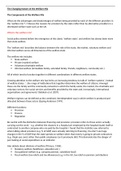
What is the welfare mix?
Social policy existed before the emergence of the classic ‘welfare state’; and welfare has always been more
than state welfare.
The ‘welfare mix’ describes the balance between the role of the state, the market, voluntary welfare and
informal welfare across all dimensions of the welfare state.
The welfare mix includes:
State welfare
Private (market) welfare
Voluntary/charitable welfare
Informal welfare (immediate family, extended family, friends, neighbours, community etc.)
All of which tend to function together in different combinations in different welfare states.
Growing attention to the welfare mix has led to an increasing tendency to talk of ‘welfare systems’, instead
of welfare states: ‘…the range of institutions that together determine the welfare of citizens. Amongst
these are the family and the community networks in which the family exists, the market, the charitable and
voluntary sectors, the social services and benefits provided by the state and, increasingly, international
organisations and agreements’ (Baldock et al. 2007).
Welfare regimes can be defined as the combined, interdependent way in which welfare is produced and
allocated between these actors (Esping-Andersen 1999).
Different functions:
Provision
Finance
Regulation
Be careful with the distinction between financing and provision: provision refers to those actors actually
carrying out the work – e.g. whether the cleaners in a hospital are employed by the hospital (state) itself or
contracted to another company who are paid by the hospital. I found that the statistics you referred to
when talking about provision (e.g. % of GDP) were actually referring to financing. You don’t see huge
changes in the % of GDP that the state spends on welfare when that money is going to private contractors
(e.g. Virgin eye care) rather than public employees (as it previously did). This demonstrates the danger of
just looking at social expenditure as an indicator.
Also debate about divisions of welfare (Titmuss, 1958):
Statutory welfare (healthcare, education etc.)
Occupational welfare (e.g. company pension, subsidised food)
Fiscal welfare (tax reliefs and tax allowances) e.g. in the UK, tax relief on pension contributions
, NOTE the distributional effects of different divisions of welfare are different e.g. the employed middle class
may be disproportionately benefitted by occupational welfare in comparison to statutory welfare.
NOTE the divisions of welfare are a separate concept to the welfare mix. Analysis in the UK tends to focus
on the welfare mix, but worth recognising the importance of divisions of welfare as well.
Advantages/disadvantages of different providers in the welfare mix
STATE vs. PRIVATE
State welfare in relation to private (market) welfare:
State welfare is able to respond to need - rather than the ability to pay (as with private welfare)
But market welfare - including services and financial products - can be seen as being more efficient
(in terms of productivity, and allocation)
Are there assumptions here about how markets work?
o i.e. do assumptions based on private goods translate to the provision of services
traditionally provided by the state e.g. healthcare and education? A lot of issues here
Choice (as an advantage of private welfare)
Logic: by giving citizens a ‘choice’ over who they turn to for their welfare needs, they would
improve service quality and create more equity as it would give people from lower socioeconomic
backgrounds the same ability to choose as others already had
According to Hirschman’s (1970) model, individuals who wish to improve the service they receive
need to be able to either exit (choice) their current provider or have a voice (be able to complain)
Reforms, especially since 2005, have been aimed at increasing choice mechanisms
An increase in choice theoretically could improve equity of outcomes, yet in reality, it may actually
have the opposite effect. Having the opportunity to make different choices is not the same as
having the ability to make different choices. Buchardt et al. (2015) distinguish between ‘choice as
choosing’ and ‘choice as autonomy’ (i.e. the narrow motivation of choice policies leads to a focus
on services rather than outcomes for individuals and fails to address deep ‐seated inequalities in the
opportunities people have for real autonomy. Policies aimed at improving choice may only improve
the former and not the latter)
Disadvantages in autonomy map onto existing socioeconomic inequalities such as disability and
social class
As Greve (2009) argues, choice in the welfare state can lead to more equitable outcomes, but only
if a number of conditions are fulfilled in order to ensure free choice, including sufficient and precise
information, trust in providers, low transaction costs and several others. If these conditions are not
met, increased choice will lead to less equitable outcomes
https://www.kingsfund.org.uk/sites/default/files/Patient-choice-final-report-Kings-Fund-
Anna_Dixon-Ruth-Robertson-John-Appleby-Peter-Purge-Nancy-Devlin-Helen-Magee-June-2010.pdf
^this seems like an interesting take on choice in healthcare: how do patients choose and how do
providers respond?
“Competition for patients was limited to the periphery of catchment areas. This is consistent with
spatial models of competition (where location of the firm is important to the customer), which
predict that competition arises at the margins of geographic boundaries where the cost of
switching is lowest.”
STATE vs. VOLUNTARY/CHARITABLE
State welfare in relation to voluntary/charitable welfare:
State welfare can offer more comprehensive coverage, and a more rights-based approach (rather
than discretion)
The Components of the Welfare Mix
What are the advantages and disadvantages of welfare being provided by each of the different providers in
the ‘welfare mix’? // Discuss the reasons for provision by the state rather than by alternative providers in a
developed welfare state such as the UK.
What is the welfare mix?
Social policy existed before the emergence of the classic ‘welfare state’; and welfare has always been more
than state welfare.
The ‘welfare mix’ describes the balance between the role of the state, the market, voluntary welfare and
informal welfare across all dimensions of the welfare state.
The welfare mix includes:
State welfare
Private (market) welfare
Voluntary/charitable welfare
Informal welfare (immediate family, extended family, friends, neighbours, community etc.)
All of which tend to function together in different combinations in different welfare states.
Growing attention to the welfare mix has led to an increasing tendency to talk of ‘welfare systems’, instead
of welfare states: ‘…the range of institutions that together determine the welfare of citizens. Amongst
these are the family and the community networks in which the family exists, the market, the charitable and
voluntary sectors, the social services and benefits provided by the state and, increasingly, international
organisations and agreements’ (Baldock et al. 2007).
Welfare regimes can be defined as the combined, interdependent way in which welfare is produced and
allocated between these actors (Esping-Andersen 1999).
Different functions:
Provision
Finance
Regulation
Be careful with the distinction between financing and provision: provision refers to those actors actually
carrying out the work – e.g. whether the cleaners in a hospital are employed by the hospital (state) itself or
contracted to another company who are paid by the hospital. I found that the statistics you referred to
when talking about provision (e.g. % of GDP) were actually referring to financing. You don’t see huge
changes in the % of GDP that the state spends on welfare when that money is going to private contractors
(e.g. Virgin eye care) rather than public employees (as it previously did). This demonstrates the danger of
just looking at social expenditure as an indicator.
Also debate about divisions of welfare (Titmuss, 1958):
Statutory welfare (healthcare, education etc.)
Occupational welfare (e.g. company pension, subsidised food)
Fiscal welfare (tax reliefs and tax allowances) e.g. in the UK, tax relief on pension contributions
, NOTE the distributional effects of different divisions of welfare are different e.g. the employed middle class
may be disproportionately benefitted by occupational welfare in comparison to statutory welfare.
NOTE the divisions of welfare are a separate concept to the welfare mix. Analysis in the UK tends to focus
on the welfare mix, but worth recognising the importance of divisions of welfare as well.
Advantages/disadvantages of different providers in the welfare mix
STATE vs. PRIVATE
State welfare in relation to private (market) welfare:
State welfare is able to respond to need - rather than the ability to pay (as with private welfare)
But market welfare - including services and financial products - can be seen as being more efficient
(in terms of productivity, and allocation)
Are there assumptions here about how markets work?
o i.e. do assumptions based on private goods translate to the provision of services
traditionally provided by the state e.g. healthcare and education? A lot of issues here
Choice (as an advantage of private welfare)
Logic: by giving citizens a ‘choice’ over who they turn to for their welfare needs, they would
improve service quality and create more equity as it would give people from lower socioeconomic
backgrounds the same ability to choose as others already had
According to Hirschman’s (1970) model, individuals who wish to improve the service they receive
need to be able to either exit (choice) their current provider or have a voice (be able to complain)
Reforms, especially since 2005, have been aimed at increasing choice mechanisms
An increase in choice theoretically could improve equity of outcomes, yet in reality, it may actually
have the opposite effect. Having the opportunity to make different choices is not the same as
having the ability to make different choices. Buchardt et al. (2015) distinguish between ‘choice as
choosing’ and ‘choice as autonomy’ (i.e. the narrow motivation of choice policies leads to a focus
on services rather than outcomes for individuals and fails to address deep ‐seated inequalities in the
opportunities people have for real autonomy. Policies aimed at improving choice may only improve
the former and not the latter)
Disadvantages in autonomy map onto existing socioeconomic inequalities such as disability and
social class
As Greve (2009) argues, choice in the welfare state can lead to more equitable outcomes, but only
if a number of conditions are fulfilled in order to ensure free choice, including sufficient and precise
information, trust in providers, low transaction costs and several others. If these conditions are not
met, increased choice will lead to less equitable outcomes
https://www.kingsfund.org.uk/sites/default/files/Patient-choice-final-report-Kings-Fund-
Anna_Dixon-Ruth-Robertson-John-Appleby-Peter-Purge-Nancy-Devlin-Helen-Magee-June-2010.pdf
^this seems like an interesting take on choice in healthcare: how do patients choose and how do
providers respond?
“Competition for patients was limited to the periphery of catchment areas. This is consistent with
spatial models of competition (where location of the firm is important to the customer), which
predict that competition arises at the margins of geographic boundaries where the cost of
switching is lowest.”
STATE vs. VOLUNTARY/CHARITABLE
State welfare in relation to voluntary/charitable welfare:
State welfare can offer more comprehensive coverage, and a more rights-based approach (rather
than discretion)