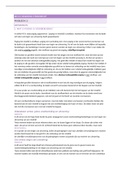
Organisation Document
1. OB & Diversity + articles
2. Attitudes & Personality + articles
3. Motivation + articles
4. Emotions & Moods + articles
5. Perception & Decision Making + articles
6. Groups & Teams + articles
Week 1: OB & Diversity
Chapter 1
Learning Content Key
goals takeaway
→ From quantitative → human behaviour studying “managers
importance → until 1980’s technical aspects were of priority, focusing on economics, finances/quantitative can’t succeed
of techniques on technical
interperson → this changed when businesses began to realise importance of understanding human behaviour in skills alone,
al skills in determining effectiveness they need
workplace → “developing interpersonal skills is essential for managerial effectiveness” good people
skills”
High performing employees are crucial
→ developing manager’s interpersonal skills
→ outstanding employees are in short supply
→ competition for talented employees exists
→ companies with reputations are good places to work (microsoft, EMC)
Creating a pleasant workplace
(1) Positive social relationships - associated with loser stress at work, lower dropouts
(2) Managers with good interpersonal skills - likely to make workplace more pleasant
(3) Being able to relate to manager as employee - allows for more supportive dialogue and
ideas will be endorsed more often
(4) Companies with better workplaces - generate superior financial performance
→ manager Managers (administrators) → work in organisation to: Managers
‘s functions, - get things done through other people need to
roles and - make decisions, develop
skills - allocate resources their
- Direct the activities of others to attain goals personal
Organization → a social unit composed of 2+ people, functions on a continuous basis to achieve skills to
common set of goals become
- Eg: schools, hospitals, churches, stores effective
and
4 management functions successful
- Planning → defining organisational goals and establishing means to achieve the goal
- Organising → determining which tasks are to be done and by who
- Leading → coordinate the people, motivate employees
, - Controlling → ensue things to as they should
Mintzberg’s managerial roles
Management skills
Effective vs. successful managerial activities
Successful managers → defined in terms of speed of promotion within organisation
Effective managers → defined in terms of quantity and quality of their performance
4 activities
(1) Traditional management → Decision making, planning and controlling
(2) Communication → Exchanging routine information and processing paperwork
(3) Human resource management → Motivating, disciplining, managing conflict, staffing and
training
(4) Networking → Socialising, and interacting with outsiders
, ∴Findings challenge assumption that promotions are based on performance, illustrated importance
of networking in getting ahead (managers who are most effective in jobs are not always promotes
the fastest, almost opposite)
→ define OB → field of study that investigated impact individuals, groups and structure have on behaviour Studies
OB within organisations, for the purpose of applying such knowledge towards improving an individuals,
organisation’s effectiveness groups,
→ an area of expertise (a field of study) structure to
advance
Studies: knowledge
(1) Individuals and improve
(2) Groups organisation
(3) structure al'
effectivenes
s
→ Show Improving predictive ability (supplement intuitive opinions → systematic approach) Field of OB
value of OB = built on
Common sense Systematic approach
aa systematic
systematic knowledge,
Watching others and interpreting their behaviour Looking at relationships, attempting
study decades
to attribute causes/effect, basing
worth of
conclusions on scientific evidence
research to
(data)
replace
May lead to erroneous predictions Allow for predictive ability preconceive
d notions
Evidence-based management We advise
→ approach that complements systematic study that you use
→ involves basing managerial decisions on available scientific evidence evidence as
→ you might think: don’t all managers use evidence? but in reality, many managerial decision are much as
made spontaneously with little systematic study of available evidence possible to
inform your
“People go into OB thinking they already know alot about human behaviour, which is not typically true” intuition,
that is the
Big data promise of
→ extensive use of statistical analysis OB”
→ holds convincing promise
→ in dealing with people, leaders often wrong you'll have biases, use data instead
→ identify Disciplines OB is built on OB = a
, major (1) Psychology (micro) → seeks to explain behaviour of humans/animals science
behavioural (2) Social psychology (macro) → focuses on people’s influence on one another that's built
science (3) Sociology (macro) → studies people in relation to their social environment/culture on
discipline (4) Anthropology (macro) → study of societies (in different cultures) contribution
contributin s from a
g to OB number of
behavioural
disciplines,
at
micro/macr
o levels of
analyses.
→ Correlations ≠ causation OB, unlike
demonstrat - Don’t expect to find cause-effect relationships, people are different physical
e why few - we can only say that x leads to y under conditions specified in Z (contingency variables that sciences,
absolutes moderate relationship between 2 or more variables) cannot be
apply to OB - People = complex and complicated generalised:
humans are
complex
→ identify Challenges and opportunities of managers Today’s
challenges (1) Economic pressures challenges
& (a) recession of 2008 US bring
opportuniti (b) when times are bad, managers need to decide who must be fired opportuniti
1. OB & Diversity + articles
2. Attitudes & Personality + articles
3. Motivation + articles
4. Emotions & Moods + articles
5. Perception & Decision Making + articles
6. Groups & Teams + articles
Week 1: OB & Diversity
Chapter 1
Learning Content Key
goals takeaway
→ From quantitative → human behaviour studying “managers
importance → until 1980’s technical aspects were of priority, focusing on economics, finances/quantitative can’t succeed
of techniques on technical
interperson → this changed when businesses began to realise importance of understanding human behaviour in skills alone,
al skills in determining effectiveness they need
workplace → “developing interpersonal skills is essential for managerial effectiveness” good people
skills”
High performing employees are crucial
→ developing manager’s interpersonal skills
→ outstanding employees are in short supply
→ competition for talented employees exists
→ companies with reputations are good places to work (microsoft, EMC)
Creating a pleasant workplace
(1) Positive social relationships - associated with loser stress at work, lower dropouts
(2) Managers with good interpersonal skills - likely to make workplace more pleasant
(3) Being able to relate to manager as employee - allows for more supportive dialogue and
ideas will be endorsed more often
(4) Companies with better workplaces - generate superior financial performance
→ manager Managers (administrators) → work in organisation to: Managers
‘s functions, - get things done through other people need to
roles and - make decisions, develop
skills - allocate resources their
- Direct the activities of others to attain goals personal
Organization → a social unit composed of 2+ people, functions on a continuous basis to achieve skills to
common set of goals become
- Eg: schools, hospitals, churches, stores effective
and
4 management functions successful
- Planning → defining organisational goals and establishing means to achieve the goal
- Organising → determining which tasks are to be done and by who
- Leading → coordinate the people, motivate employees
, - Controlling → ensue things to as they should
Mintzberg’s managerial roles
Management skills
Effective vs. successful managerial activities
Successful managers → defined in terms of speed of promotion within organisation
Effective managers → defined in terms of quantity and quality of their performance
4 activities
(1) Traditional management → Decision making, planning and controlling
(2) Communication → Exchanging routine information and processing paperwork
(3) Human resource management → Motivating, disciplining, managing conflict, staffing and
training
(4) Networking → Socialising, and interacting with outsiders
, ∴Findings challenge assumption that promotions are based on performance, illustrated importance
of networking in getting ahead (managers who are most effective in jobs are not always promotes
the fastest, almost opposite)
→ define OB → field of study that investigated impact individuals, groups and structure have on behaviour Studies
OB within organisations, for the purpose of applying such knowledge towards improving an individuals,
organisation’s effectiveness groups,
→ an area of expertise (a field of study) structure to
advance
Studies: knowledge
(1) Individuals and improve
(2) Groups organisation
(3) structure al'
effectivenes
s
→ Show Improving predictive ability (supplement intuitive opinions → systematic approach) Field of OB
value of OB = built on
Common sense Systematic approach
aa systematic
systematic knowledge,
Watching others and interpreting their behaviour Looking at relationships, attempting
study decades
to attribute causes/effect, basing
worth of
conclusions on scientific evidence
research to
(data)
replace
May lead to erroneous predictions Allow for predictive ability preconceive
d notions
Evidence-based management We advise
→ approach that complements systematic study that you use
→ involves basing managerial decisions on available scientific evidence evidence as
→ you might think: don’t all managers use evidence? but in reality, many managerial decision are much as
made spontaneously with little systematic study of available evidence possible to
inform your
“People go into OB thinking they already know alot about human behaviour, which is not typically true” intuition,
that is the
Big data promise of
→ extensive use of statistical analysis OB”
→ holds convincing promise
→ in dealing with people, leaders often wrong you'll have biases, use data instead
→ identify Disciplines OB is built on OB = a
, major (1) Psychology (micro) → seeks to explain behaviour of humans/animals science
behavioural (2) Social psychology (macro) → focuses on people’s influence on one another that's built
science (3) Sociology (macro) → studies people in relation to their social environment/culture on
discipline (4) Anthropology (macro) → study of societies (in different cultures) contribution
contributin s from a
g to OB number of
behavioural
disciplines,
at
micro/macr
o levels of
analyses.
→ Correlations ≠ causation OB, unlike
demonstrat - Don’t expect to find cause-effect relationships, people are different physical
e why few - we can only say that x leads to y under conditions specified in Z (contingency variables that sciences,
absolutes moderate relationship between 2 or more variables) cannot be
apply to OB - People = complex and complicated generalised:
humans are
complex
→ identify Challenges and opportunities of managers Today’s
challenges (1) Economic pressures challenges
& (a) recession of 2008 US bring
opportuniti (b) when times are bad, managers need to decide who must be fired opportuniti