

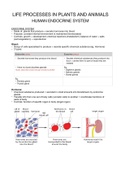
LIFE PROCESSES IN PLANTS AND ANIMALS
HUMAN ENDOCRINE SYSTEM
ENDOCRINE SYSTEM
- Made of: glands that produce + secrete hormones into blood
- Purpose: constant internal environment is maintained (homeostasis)
- Controls: growth + development; chemical reactions (metabolism); balance of water + salts
(osmoregulation); + reproduction
Gland:
- Group of cells specialised to produce + secrete specific chemical substance (eg. Hormone)
- 2 types:
Endocrine (within) Exocrine (without)
- Secrete hormones they produce into blood - Secrete chemical substances they produce into
duct = carries them to part of body they are
needed
- Have no ducts (ductless glands) Eg.
*ducts: tubes that connect one part of body to another • Digestive glands
• Salivary glands
• Sweat glands
Eg.
• Pituitary gland
• Thyroid gland
Hormone:
- Chemical substance produced + secreted in small amounts into bloodstream by endocrine
glands
- Transfer info from one set of body cells (somatic cells) to another = coordinates functions of
parts of body
- Controls: function of specific organ in body (target organ)
, Nervous vs endocrine system:
Nervous system Endocrine system
• Neurons • Glands
• Info transmitted in form of nerve impulses • Info transmitted in form of hormones
• Nerve impulses travel along nerve fibres • Hormones travel in blood
• Info travels quickly • Info travels slowly
• Affects the action of effectors (muscles/glands) • Affects the action of target organs
• Effect of nerve impulse does not last long • Effect of hormone can last for long time
HUMAN ENDOCRINE SYSTEM
ENDOCRINE SYSTEM
- Made of: glands that produce + secrete hormones into blood
- Purpose: constant internal environment is maintained (homeostasis)
- Controls: growth + development; chemical reactions (metabolism); balance of water + salts
(osmoregulation); + reproduction
Gland:
- Group of cells specialised to produce + secrete specific chemical substance (eg. Hormone)
- 2 types:
Endocrine (within) Exocrine (without)
- Secrete hormones they produce into blood - Secrete chemical substances they produce into
duct = carries them to part of body they are
needed
- Have no ducts (ductless glands) Eg.
*ducts: tubes that connect one part of body to another • Digestive glands
• Salivary glands
• Sweat glands
Eg.
• Pituitary gland
• Thyroid gland
Hormone:
- Chemical substance produced + secreted in small amounts into bloodstream by endocrine
glands
- Transfer info from one set of body cells (somatic cells) to another = coordinates functions of
parts of body
- Controls: function of specific organ in body (target organ)
, Nervous vs endocrine system:
Nervous system Endocrine system
• Neurons • Glands
• Info transmitted in form of nerve impulses • Info transmitted in form of hormones
• Nerve impulses travel along nerve fibres • Hormones travel in blood
• Info travels quickly • Info travels slowly
• Affects the action of effectors (muscles/glands) • Affects the action of target organs
• Effect of nerve impulse does not last long • Effect of hormone can last for long time


