Cardiac
Normal cardiac output - Normal cardiac output is 60-100 beats per minute. If below 60 is brady cardia and the patient is at risk for poor perfusion. Cardiac output is defined as the amount of blood pumped from the left ventricle each minute. Remember that arrhythmia is a deviation from a normal rhythm and a dysrhythmia is a disturbance in the normal rhythm. Medications for:
contractility, maintaining normal blood pressure, various tachycardias, bradycardias, different degrees of A V blocks, and arrhythmias PHARM
Class 1- Sodium channel blockers- electrical pulses will become slow. Used for TACHYARHYTHMIAS
Class II- Beta Blockers. Beta receptors are blocked. Used for tach arrhythmias
Class III- potassium channel blockers. Amiodarone. Used for V tach and V fib
Class for- calcium channel blockers- diltiazem, arabamil? Given to slow ventricular rate in a fib and supra ventricular tachycardia. Adenosine/ Digoxin- Adenosine has very short half life and is given IV push and primarily used to stop supra ventricular tach
Digoxin- will slow conduction through the AV node. A fib and A flutter
Heparin is given for A fib- will cause pooling that will lead to clotting and can cause PE or stroke. Cardiac rhythm interpretations
P wave: represents atrial contraction depolarization; small, rounded and upright (in Lead II). Are they present before every QRS and do they look the same?
PR Interval (PRI): time it takes the impulse to travel from the SA node to the bundle branches. It should measure 0.12-0.20 seconds. Starts at P wave and ends at the beginning of the ventricular contraction. QRS Interval: represents ventricular depolarization (contraction); it should measure 0.04-0.10 seconds.
T wave: represents ventricular repolarization (relax). Monitor for changes in amplitude or configuration. QT Interval: represents the amount of time it takes for ventricular depolarization and repolarization. Measurement will depend on heart rate but it is usually 0.40 to 0.44 seconds.
U wave: Rare/ uncommon. Resting of perkinje fibers. ST segment: Starting with the ventricular contraction to before the T wave. THIS IS WHERE MI CAN BE DETECTED. Depolarization is contraction. Results in action potential.
Repolarization is relaxation If AV conduction is not normal will see cardiac block. Steps for Dysrhythmia Interpretation:
Step 1: Determine rate
Step 2: Determine regularity
Step 3: Determine P waves
Step 4: Determine PR interval (measurement)
Step 5: Determine QRS interval (measurement)
Step 6: Determine QT interval (measurement)
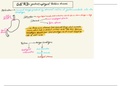
PLEASE SEE NOTES… TRIED TO EXPLAIN BUT IT WAS DIFFICULT. 6 Seconds = 30 small squares. Count for atrial or ventricular rate is to count 30 large squares (P Wave for Atrium contraction) (R wave for ventricular waves).
Example: If four squares are counted in P wave then take 4x10= 40 and will give atrial rate. External vs internal pacemaker- EXTERNAL is done in EMERGENT situations!! Is used until permanent pacemaker can be placed. Internal pacemaker is either synchronous (demand) or asynchronous (fixed rate) When a pacing stimulus is delivered to the heart, a spike (or pacemaker artifact) is seen on the monitor or ECG strip. The spike should be followed by evidence of depolarization (i.e., a P wave, indicating atrial depolarization, or a QRS complex, indicating ventricular depolarization). This pattern is referred
Normal cardiac output - Normal cardiac output is 60-100 beats per minute. If below 60 is brady cardia and the patient is at risk for poor perfusion. Cardiac output is defined as the amount of blood pumped from the left ventricle each minute. Remember that arrhythmia is a deviation from a normal rhythm and a dysrhythmia is a disturbance in the normal rhythm. Medications for:
contractility, maintaining normal blood pressure, various tachycardias, bradycardias, different degrees of A V blocks, and arrhythmias PHARM
Class 1- Sodium channel blockers- electrical pulses will become slow. Used for TACHYARHYTHMIAS
Class II- Beta Blockers. Beta receptors are blocked. Used for tach arrhythmias
Class III- potassium channel blockers. Amiodarone. Used for V tach and V fib
Class for- calcium channel blockers- diltiazem, arabamil? Given to slow ventricular rate in a fib and supra ventricular tachycardia. Adenosine/ Digoxin- Adenosine has very short half life and is given IV push and primarily used to stop supra ventricular tach
Digoxin- will slow conduction through the AV node. A fib and A flutter
Heparin is given for A fib- will cause pooling that will lead to clotting and can cause PE or stroke. Cardiac rhythm interpretations
P wave: represents atrial contraction depolarization; small, rounded and upright (in Lead II). Are they present before every QRS and do they look the same?
PR Interval (PRI): time it takes the impulse to travel from the SA node to the bundle branches. It should measure 0.12-0.20 seconds. Starts at P wave and ends at the beginning of the ventricular contraction. QRS Interval: represents ventricular depolarization (contraction); it should measure 0.04-0.10 seconds.
T wave: represents ventricular repolarization (relax). Monitor for changes in amplitude or configuration. QT Interval: represents the amount of time it takes for ventricular depolarization and repolarization. Measurement will depend on heart rate but it is usually 0.40 to 0.44 seconds.
U wave: Rare/ uncommon. Resting of perkinje fibers. ST segment: Starting with the ventricular contraction to before the T wave. THIS IS WHERE MI CAN BE DETECTED. Depolarization is contraction. Results in action potential.
Repolarization is relaxation If AV conduction is not normal will see cardiac block. Steps for Dysrhythmia Interpretation:
Step 1: Determine rate
Step 2: Determine regularity
Step 3: Determine P waves
Step 4: Determine PR interval (measurement)
Step 5: Determine QRS interval (measurement)
Step 6: Determine QT interval (measurement)
PLEASE SEE NOTES… TRIED TO EXPLAIN BUT IT WAS DIFFICULT. 6 Seconds = 30 small squares. Count for atrial or ventricular rate is to count 30 large squares (P Wave for Atrium contraction) (R wave for ventricular waves).
Example: If four squares are counted in P wave then take 4x10= 40 and will give atrial rate. External vs internal pacemaker- EXTERNAL is done in EMERGENT situations!! Is used until permanent pacemaker can be placed. Internal pacemaker is either synchronous (demand) or asynchronous (fixed rate) When a pacing stimulus is delivered to the heart, a spike (or pacemaker artifact) is seen on the monitor or ECG strip. The spike should be followed by evidence of depolarization (i.e., a P wave, indicating atrial depolarization, or a QRS complex, indicating ventricular depolarization). This pattern is referred